Residence Halls and Emergency Evacuation
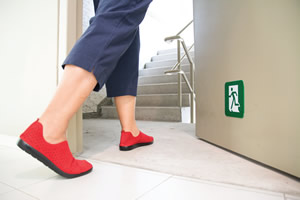
PHOTO © PRASAN MAKSAEN
One of the elements of safe residence hall design is proper building evacuation. When someone enters a building, eventually they need to exit, sometimes quickly in the case of an emergency. Building codes, products, and emergency evacuation plans all play important roles in protecting the health, welfare, and safety of residence hall occupants when an emergency evacuation is necessary.
Meeting Code in Building Design
The International Building Code (IBC) was first published in 1997 by International Code Council (ICC). According to ICC, which updates IBC every three years, “It is an essential tool to preserve public health and safety that provides safeguards from hazards associated with the built environment. It addresses design and installation of innovative materials that meet or exceed public health and safety goals (www.iccsafe.org).” ICC notes that the document is so important that it is common for jurisdictions to adopt and then “amend the code in the process to reflect local practices and laws.”
IBC is one tool in building design. The other is the community required to interpret and apply code in the design process. “The safe design of a building is an integrated process that involves many specialists, architects, and engineers from multiple disciplines, including fire protection, security design systems, evacuation alarm systems, and structural,” observes Javier Esteban, AIA, principal at KWK Architects, a St. Louis-based architectural firm focusing on higher education. “All work together toward a common goal of protecting life first and property second.”
As code changes, notes Esteban, “there’s always an examination of what was previously required and how, in the case of an emergency, the building responded to it.” This helps designers know more about what to expect in the case of an emergency. For example, residence halls didn’t use to require sprinklers; now they do. This means that fire is no longer an issue, but smoke is. So now, moving forward, code will change in order to address managing evacuation through smoke. This cyclical process serves to make buildings more safe.
Products That Can Help
Products and technologies also facilitate smooth evacuation in the case of residence hall emergencies. Fire and smoke alarms, fire suppression systems, proper illumination, special illuminated signals visible with smoke in the room/corridor that are connected to backup power or battery, audible alarms, and evacuation enunciation devices that guide students to specific areas are now common place in new residence halls.
Here are two additional newer products.
1. Elevator smoke curtains. Transparent smoke curtains in front of elevator doors trap smoke in one place, preventing it from spreading into elevator shafts and providing a way for firefighters accessing the floor from the elevator to visually inspect it before proceeding. “In the last few years,” says Esteban, “we have gained a better understanding of how smoke behaves with elevator doors and in elevator shafts. Smoke evacuation has affected how elevator lobbies are designed.” He notes that smoke curtains use a combination of magnets, reinforced plastic motorized curtains, and alarm/smoke detectors in the elevator lobby to give designers multiple options for providing safe residence halls while also promoting community, in this case eliminating additional elevator lobby enclosures.
2. Door closers. It used to be that residence hall room doors could be opened and would remain open on their own. Students could open their room doors to signal that they were available to talk, thus promoting a sense of community through the corridor. Now, however, codes require that the corridors also serve as emergency egress corridors; therefore, they must provide a minimum level of smoke and fire protection during a building evacuation, from a half hour up to two or more hours of fire protection. Designers are outfitting fire-rated room doors with door closers that provide a positive door latching, ensuring that room doors are always closed, which, unfortunately, limits community.
One device provides a door closer/holder with a multi-point hold-open function connected to an alarm system that activates the closer in case of an emergency, automatically closing the door. This device is different from the traditional magnetic door closer that only allows for a 90-degree angle.
“The multi-point hold-open function allows the students to create their own ‘door language,’” says Esteban. “When the door is fully open, the student is open to visits; when the door is set at 45 degrees, the student may be studying, but still open to interaction. Now the corridor is re-gaining its important community activity, but in a safer way.”
This section would not be complete without a discussion of signage. In some jurisdictions, exit signage is required high on the wall and low on the wall. Here’s why: Imagine being in an area with high ceilings and smoke obscures the exit signs that are above door frames. Now imagine being in an area with low ceilings and needing to crawl through smoke. It is for these reasons that Esteban notes that signage must be thoroughly thought out from day one, especially because “exiting in an emergency is a more visceral reaction than a logical one.” He favors combining signage with an addressable alarm system and a voice evacuation system that tells students where to go and how to act, which takes into consideration that they may not be searching for an exit in a logical manner.
The Emergency Evacuation Plan
Esteban indicates that studies show that, in an emergency, most people tend to try to exit a building in the same way that they entered, bypassing closer, safer, and more efficient routes to safety. Designers must put themselves in the shoes of a students who, perhaps panicked, are going to run to exit the building in an emergency, implementing design elements that help students find the closest route to safety and encourage organized exiting. Doing so reduces the potential of “confusion, injury, and property damage,” according to the Occupational Safety and Health Administration (OSHA, www.osha.gov). OSHA is an arm of the U.S. Department of Labor that assures “safe and healthful working conditions for working men and women by setting and enforcing standards and by providing training, outreach, education, and assistance.”
As a result, emergency evacuation plans are a must. OSHA’s website is an ideal starting point for developing your own, as is asking colleagues at other colleges and universities to share theirs. Two that you may want to review are University of Colorado Boulder (www.colorado.edu) and Pennsylvania State University (policy.psu.edu/policies/sy28).
Once in place, plans need to be followed through, because it serves no one to have a plan that isn’t used. They also must be reviewed and updated on a regular basis, especially as existing residence halls are renovated and new buildings come on line.
Taking into account building code, products, and emergency evacuation plans when designing residence halls helps to protect the health, welfare, and safety of residence hall occupants when an emergency evacuation is necessary.
This article originally appeared in the College Planning & Management June 2019 issue of Spaces4Learning.