New, Highly-Flexible Chair Supports Students’ Natural Movement

VS America, a school and office furniture company, launched a new suite of highly-flexible chairs designed by influential architect Jean Nouvel. The JUMPER chair family emphasizes ergonomic design for active sitting in educational and corporate spaces. The chairs’ shape helps support correct back posture while encouraging natural movement.
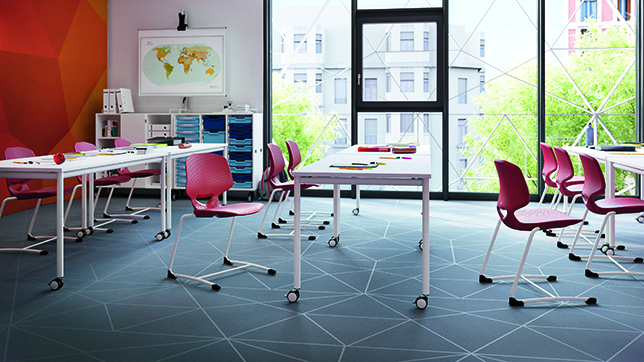
The JUMPER chair family emphasizes ergonomic design for active sitting in educational and corporate spaces. The chairs’ shape helps support correct back posture while encouraging natural movement.

Schools can choose from six sizes with five frame variants and a variety of colors. One of the choices, the JUMPER Air Active, is the first school and office chair to be awarded Cradle to Cradle certification in silver, meaning the product was manufactured using materials harmless to people and the environment.

The JUMPER Air Active is particularly aimed for students. While seated at a desk, the air-cushioned seat shell tilts forward and opens the angle of the students’ hips and helps position their spine into the proper posture. Then while they’re sitting back in the chair, the seat shell tilts to relieve built-up tension.
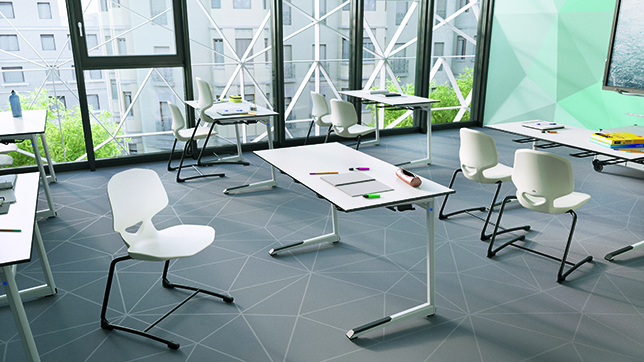
The JUMPER chair family emphasizes ergonomic design for active sitting in educational and corporate spaces. The chairs’ shape helps support correct back posture while encouraging natural movement.

“If you want to jump, you have to be flexible. Therefore, JUMPER may not be rigid,” explained designer Jean Nouvel in a press release. “The chair must support movement. We have accomplished this through the inner tension and stability of the structure of the seat shell as well as the structure of the frames. On JUMPER, one sits truly flexible, in the true sense of the word.”

The JUMPER suite of chairs recently won the Best of NeoCon Gold Award in Education Solutions and the Metropolis Likes Award.

Find more information about JUMPER chairs at VS America’s website.

About the Author

Yvonne Marquez is senior editor of Spaces4Learning. She can be reached at [email protected].

Featured

  • Rethinking K-12 Schools as a Continuous Learning Experience

    Most students move through three or more separate facilities during their K-12 journey, yet the built environments they encounter at each stage have traditionally been designed in isolation, with little continuity in spatial language, learning philosophy, or physical resources. Each new school is a reset with different layouts, learning models, expectations, and ways of moving through a building. The next generation of school design is making the case that the first day of kindergarten and the last day of high school can and should feel connected through common support systems and infrastructure in the physical environment.

  • Planning with Clarity: Using AI to Make Better Campus Decisions, Not Just Better Designs

    Higher education leaders are being asked to make increasingly high-stakes decisions about campus facilities amid greater uncertainty than ever before. Social and economic pressures, shifting enrollment, and evolving learning models compete with growing deferred maintenance needs to strain even the most robust infrastructure budgets.

  • Virginia Tech Tops Out New College of Engineering Building

    Virginia Tech in Blacksburg, Va., recently celebrated the topping out of Mitchell Hall, which will soon stand as the largest College of Engineering building on campus, according to a news release. The university partnered with Skanska on the 285,500-square-foot facility, which has an expected completion date of winter 2028.

  • Children walking along bright school corridor with motion blur

    How Next-Gen Design Is Reshaping the Student Experience

    The environments where students learn play a crucial role in shaping their growth in and out of the classroom. By centering design on well-being, flexibility, and purpose, districts can ensure their facilities remain vibrant community assets for many years to come.