Remote Wisconsin College Leading the Nation in Sustainability
ASHLAND, WI–One of the smallest and most remote colleges in Wisconsin has been named the top performer in sustainable curriculum.
Northland College, located at the tip of the state near Lake Superior and with a student body of 600, was named first in sustainable curriculum by the Association for the Advancement of Sustainability in Higher Education.
The AASHE Sustainable Campus Index recognizes top-performing colleges and universities in 17 sustainability impact areas.
“What we’re doing here is one of the best kept secrets in higher ed,” says Kate Ullman, director of sustainability. “Dedicated staff, faculty and students are tackling climate change, challenging social injustices, instituting sustainability initiatives and working with community partners to solve local and global issues.”
The Index evaluates using the Sustainability Tracking, Assessment and Rating System, a voluntary framework used by hundreds of colleges and universities to measure, report, and strengthen their contributions to global sustainability.
Northland ranked first in curriculum for its courses, programs, and learning outcomes in sustainability, as well as living laboratory initiatives, immersive experiences, sustainability literacy, and faculty development.
“Northland is a place where you come to realize that even though our world is replete with challenges, that it is our calling to be stewards of the land and our great joy to be given this opportunity,” says Alec Drachenberg, who graduated in May with a degree in sustainable community development. “This is our spirit and this is our path.”
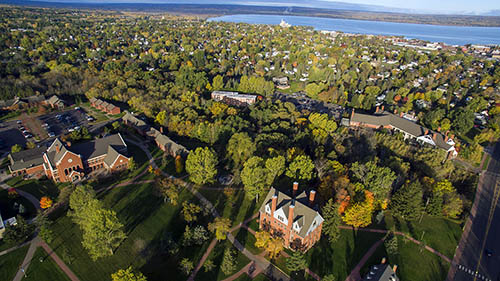
Northland College was the first in the nation in 1971 to add environmental studies to its coursework and to make it part of its mission. In 2003, Northland became a charter member of the EcoLeague, a consortium of six colleges and universities that share missions based on environmental responsibility and social change.
Every academic department at Northland College offers sustainability courses and there are seven majors and minors specific to sustainability—sustainable community development, one of the only of its kind in the country; humanity and nature studies; sustainable business; ecological restoration; environmental education; climate studies; and sustainable agriculture.
A significant number of students work and research with one of the four centers focused on areas of sustainability—Sigurd Olson Environmental Institute, Hulings Rice Food Center, Mary Griggs Burke Center for Freshwater Innovation, and Center for Rural Communities.
“Behind everything we do at the college—from the courses we teach to the research and internships we provide—there’s faculty, staff, and students evaluating, re-evaluating and pushing to do even more for the planet,” Ullman says.
About Northland College
Northland College is a private liberal arts college with a progressive focus on the environment and sustainability. The college prepares students from across the U.S. and around the world for meaningful lives and successful careers. Founded in 1892, Northland College is located at the top of Wisconsin, on the south shore of Lake Superior. Adjacent to the Apostle Islands and nearly a million acres of national forest, Northland has an unparalleled living laboratory and natural playground just beyond its doors. Learn more at www.northland.edu.