Flooring and the Impact It Has On K-12 Learning Environments
When it comes to high-traffic areas in schools, flooring plays a lead role in defining learning spaces.
Flooring is a critical part of the process when designing a K-12 school environment. Flooring plays a
lead role in defining high-traffic areas. When it comes to the selection
of hard or soft surfaces, PBK first considers the impact
the application will have on functionality and effectiveness of the
learning environment.
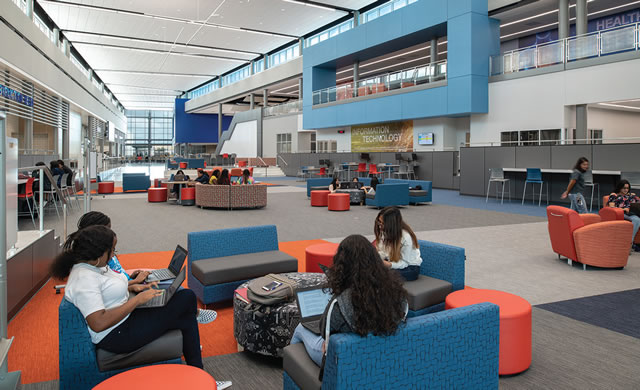
When entering the Center for Advanced Careers in Alief, Texas,
visitors encounter an open environment showcasing different career pathways, all flowing into the heart of the facility —
in what we call, an interactive observation lab. The flooring application
connecting each of the various areas is terrazzo; the nearly
216,000-square-foot facility was created with a central communal
plaza and learning on display. The smooth finish, with no grout lines,
offers a quieter handling of rolling carts and/or other mobile equipment.
Terrazzo is extremely durable, highly moisture resistant and
easy to clean. It is also low maintenance and has a low lifecycle cost.
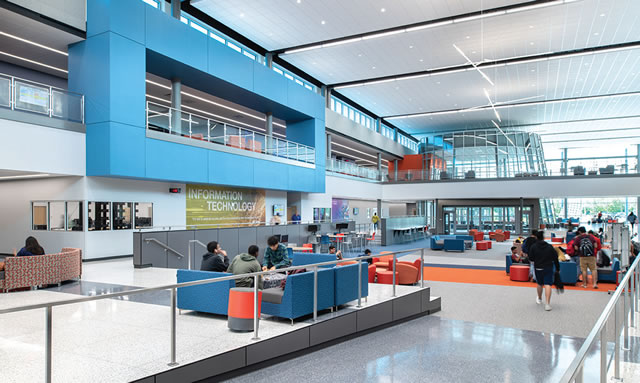
The communal plaza helps minimize the need for circulation
hallways and promotes cross- pollination of programs, providing
students with the opportunity to explore multiple career
paths. There is quite a bit of foot traffic throughout the plaza,
but the owner wanted to ensure the flooring was resilient and
could withstand the weight of heavy machinery. A ramp in the
plaza allows a vehicle to drive right into the interactive observation
lab. PBK’s designers knew the terrazzo would handle the
weight of a robot and/or large vehicle.
Luxury vinyl tile (LVT) is another avenue some schools are
integrating into high-traffic areas. While the cost is higher initially,
there is very little maintenance on the tile. This application
can be integrated utilizing bright colors, neutral colors, a
stone look and/or wood imitation. It is also available in a wide
variety of colors and styles.
Paetow High School in the Katy Independent School district,
outside of Houston, houses 3,000 students and represents a change
from the traditional high school program. PBK was tasked with
creating a contemporary environment with Next Generation
learning principles and applications that compliments the campus’
coastal setting and enables synergies that enhance the learning environment.
The progressive interiors are filled with adaptable, reactive
spaces that cater to personalized learning. The environment supports expanded curriculum
and open exploration
of educational and
career opportunities. PBK
worked with the district
to use LVT throughout the
main hallways and entrances
as a long-wearing and
low-maintenance solution.
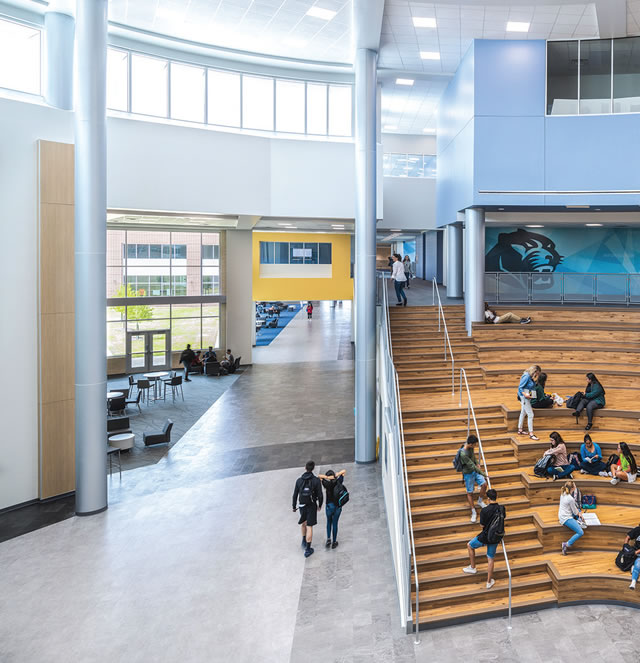
With changing educational
philosophies and
increasing usage of mobile
devices in schools, students
are not always parked at
desks — a small operational
change, but a large
impact to interior functionality.
A transition to carpet
signals the entry to the
campus’ library. Flex spaces
are designed similarly, shifting
from tile to carpet. Traditional,
closed-in libraries
have evolved into more open,
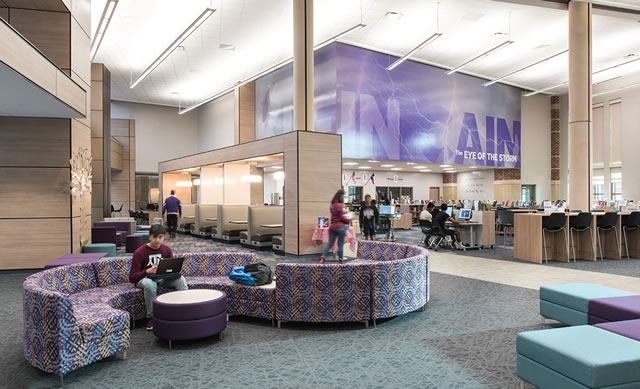
collaborative work spaces. Since libraries are intentionally quieter,
campuses like Klein Cain High School in Klein ISD opt for carpet
instead of tile to absorb and minimize surface noise.
Daily maintenance for carpets includes vacuuming and spot
removal. This is especially true for high-traffic areas including
corridors, libraries or classrooms. More than 75 percent of the
soil found in carpet is dry, particulate soil and can be removed
relatively easily with regular vacuuming. It also tends to remove
most of the dust and dirt. School carpets still need a deep
cleaning from time to time which is usually done over breaks to
minimize disruptions. By maintaining carpet, the aesthetic and
appearance will last much longer.
Recently, PBK renovated Kingwood High School in the
Humble Independent School after it flooded during Hurricane
Harvey. Since Kingwood High School was impacted by a hurricane,
it was important to replace the flooring quickly to allow
students to return to their school. Knowing the school had
previously flooded, we worked with the school to install a tile
resembling wood. It was one of the best options for water resistance,
knowing it would not buckle or lift.
School districts are more frequently considering long-term costs
for flooring applications, rather than initial costs – especially in
high-traffic areas. While a material such as vinyl composition tile
is initially more affordable, the longer-term maintenance upkeep results
in a lower overall return on investment due to periodic waxing.
Our firm is seeing more owners utilizing tile in the main
corridors. Administrators are seeing the benefits of using porcelain
or terrazzo — it’s sturdier and more durable. Terrazzo can
be customized to the campus’ unique brand and color scheme.
It is also sustainable; terrazzo is composed of naturally occurring
aggregates, recycled glass, plastic and processed cement or
epoxy binders. The binders constitute approximately 25 to 30
percent of the volume of the flooring. The remainder of the floor
is composed of aggregates, pigments and fillers. Initial life cycle
assessments of embodied energy appear extremely favorable due
to the longevity and low energy usage for maintenance.
When it comes to determining flooring surfaces, either hard
or soft, we first focus on educational responsiveness and application.
We abide by district standards, but encourage owners
to remain knowledgeable about flooring applications so we can
find the best possible solutions for their unique needs.
What to keep in mind when selecting flooring for high-traffic
areas:
- Function of space
- Safety of students and staff
- Durability / maintenance
- Cost of material and labor
- Integrating flooring with interior design
This article originally appeared in the January/February 2020 issue of Spaces4Learning.
About the Author
Richard Chi is Co-CEO of PBK and oversees the Design Studio. His strong commitment to the principles of design excellence, with emphasis on client service, has helped earn both regional and national acclaim for PBK’s projects. Richard has served as a dedicated leader and teacher in his profession, successfully completing over 300 educational projects for more than 150 educational institutions in relation to pre-kindergarten centers, elementary, junior high, high school, district administration centers, alternative education centers and higher education campuses.