A Response to COVID-19: Cleaning for Health
As coronavirus concerns mount, what should administrators and cleaning professionals know?
In late February, a private elementary school in Nevada closed due to an outbreak of gastrointestinal illnesses. While the number of children who became ill was not reported, the school did indicate it was "an alarming number," and that it was "not limited to just one grade." This suggests several children in different grades were coming down with the same disease.
Because concerns quickly mounted that this could be norovirus- or, even worse, coronavirus-related, it was determined that not only should the school be closed, but "every inch of the school" be scrubbed down and cleaned.
According to Ron Segura, a cleaning consultant called in to help the cleaning service handle the situation, "the first thing I did was have their staff wear hazmat suits to protect their own health, and then detail clean and disinfect every touchable surface imaginable." Hazmat suits are hazardous-materials suits made of impermeable materials. They are designed to be worn in situations when there are or may be contamination issues to protect workers.
Steps for Healthy Cleaning
Then the cleaning began, which included not only cleaning and disinfecting high-touch areas such as door handles and light switches, but chairs and vinyl furniture, all kitchen surfaces and appliances from the top-down, desks, ledges, tables, railings and a host of other areas around the school.
"Fortunately, I had already been working with this contractor and his staff, teaching them what [cleaning] steps to take in situations just like this," adds Segura. "[This incident] made all of us, school administrators, teachers, students, parents and the cleaning workers realize first-hand what the term ‘cleaning for health' is really all about. Thankfully, the situation now appears to be under control and the school has reopened."
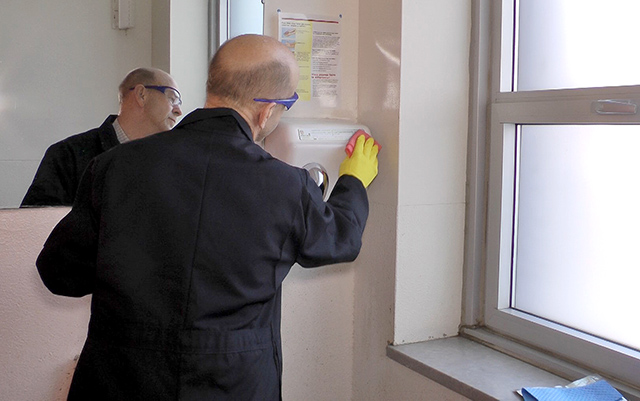
Photo courtesy Avmor Cleaning Manufacturers
While this was not the novel coronavirus (COVID-19), the steps taken here are an indication of what school and campus administrators and their cleaning staffs will likely need to take to protect the health of all building users. Among the most important, according to Segura, are the following:
- Stay informed. In the early stages of a health crisis, misinformation can happen. Select information sources based on their credibility. All administrators and cleaning professionals are encouraged to refer to the World Health Organization site for current information as well as the Centers for Disease Control (CDC) website. These and other healthcare websites are being updated daily. Stay current and utilize the latest safety precautions for yourself and your team.
- Handwashing. Frequent and thorough hand washing is our best defense. This applies to everyone on campus. Cleaning workers and all staff are also advised to wash hands before starting work, so no pathogens are brought into a facility. They should also wash hands regularly while working, and again upon leaving.
- Glove removal. Today, most cleaning workers wear gloves while working. That is now a must, but another must is knowing how to remove those gloves. If not performed correctly, pathogens on the gloves will be transferred to your hands. Pull the glove from one corner, folding it over the hand and then tossing the glove in the trash. Do not reuse gloves. Also, gloves should be changed frequently.
- Wear personal protective gear. Along with gloves, it is recommended that cleaning workers wear protective gear. This would include gowns to protect the workers' clothing. This helps prevent any pathogens from collecting on them.
- High-touch inspection audit. Administrators and members of the cleaning staff should conduct a "high-touch inspection audit." The goal of this audit is to identify all touchable surfaces throughout campus facilities and then double-check that these areas are being cleaned and disinfected. Invariably, the audit will uncover surfaces frequently touched that have been overlooked in the past. "A side benefit of this audit is that it helps everyone realize you’re a team now," says Segura. "Everyone is working together to protect the health of children and all building users."
- Cleaning tools. What is most important now is that all cleaning tools be kept clean. Mops should be laundered after each use, as should cleaning cloths. Change mops/cleaning cloths frequently. In hospitals, they are usually changed after cleaning each room. This may be necessary in campus facilities as well.
- Cleaning frequencies. Increased cleaning/disinfecting frequencies are necessary. COVID-19 is very similar to the flu in that germs become airborne and are then inhaled by someone else, or those pathogens land on surfaces that are touched by others. This is how the disease is spread. It will probably be necessary to not only increase cleaning and disinfecting frequencies, but also clean wider areas. For instance, instead of just cleaning a restroom countertop, clean the immediately surrounding walls as well. When using sanitizers or disinfectants, make sure surfaces are cleaned first and then disinfected. It's a two-step process.
- Social distance. Everyone on campus must now maintain a social distance of three feet or more from each other. Certainly, this will prove difficult with young children, but they must be educated on how important it is right now. “Plus, now is the time for administrators to instruct students on how to cough or sneeze so as not to spread germs,” Segura says. “Cover your mouth and nose with a tissue or the crook of your elbow. And remind people to avoid touching their eyes, nose, or mouth and to stay home if not well.”
About the Author
Robert Kravitz is a frequent writer for the professional cleaning industry. He can be reached at [email protected]