COVID-19, Cleaning and Schools
School and campus administrators throughout North America are very concerned about coronavirus and its impact on their facilities, students, teachers and staff. And there is good reason.
School and campus administrators throughout North America are very concerned about coronavirus and its impact on their facilities, students, teachers and staff. And there is good reason. As of March 14, 2020, here some stats we should be aware of:
- The total number of cases worldwide is approaching 125,000. In the United States, by comparison, the number is about 4,000 but growing fast.
- Death rates in China, where the outbreak began, have declined; that’s the good news. However, they are going up in most other areas of the world.
- Younger people tend to have very mild symptoms, and the fatality rate of people under 29 is 0.09 percent. Again, good news. However, fatality rates jump to more than 3 percent for people over the age of 60.
- The number of schools closed or planning to close due to the virus has surpassed 3.5 million.
Complicating matters, the U.S. is behind the curve as far as testing. As of March 11, 2020, there have been only 23 tests per million people in this country, which has a population of 329 million. Compare that with South Korea, with a population of 51 million. In South Korea, there have been 3,692 tests per million people.
Testing is essential. If someone has tested positive, that person must be quarantined. That way, they do not spread the virus to others.
Is There a Single Effective Solution?
At this point, most school and campus administrators are aware of the many health benefits of effective cleaning. However, right now, many may be hoping there will be one product, one system, or one technology that will prove most effective.
Unfortunately, there is none. For example, recently, manufacturers have been touting the use of misters that spray a disinfectant over surfaces to kill germs, viruses and bacteria as an effective option. These are being used in schools and on campuses and can prove valuable. However, there is one caveat: in most cases, the surfaces must be cleaned first before the mist can be applied.
The reason for this goes back to standard cleaning and disinfecting “best practices.” Cleaning first means using an all-purpose cleaning solution to remove soils. This allows the disinfectant, which is used next, to work more effectively.
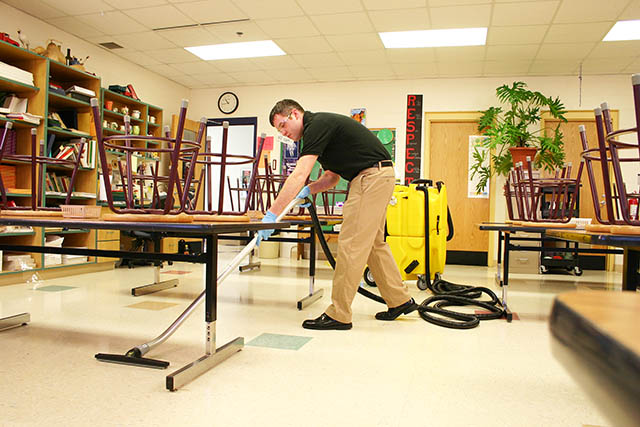
Photo courtesy of Kaivac
The Need for a Systems Approach to Cleaning
Because no one product or procedure will do the job, what many experts in the professional cleaning industry recommend for fighting the spread of COVID-19 is a “systems approach” to cleaning. This approach differs based on how facilities are being cleaned. If manually cleaned, the approach would include the following tools and procedures:
- Cleaning solution: There have been no recommendations from the CDC or the EPA as to what types of cleaning solutions to use. The CDC just suggests “using a detergent or soap and water prior to disinfection.”
- Disinfectants: The EPA has released a list of disinfectants recommended to fight COVID-19. The CDC also recommends them. These can be found here.
- Cleaning cloths: Microfiber is recommended because it tends to be more absorbent, but it must be changed frequently. What are called “smart towels” are made of microfiber are also suggested because they can be folded into eight unused quadrants. They do not need to be changed as frequently.
- Mops: While using mops to clean floors is not recommended — because they spread contaminants as they are used — they are a standard part of a manual cleaning system. Always use new or freshly laundered mops; change them frequently and avoid using the same mop in more than one classroom. Consider implementing the "one room/one mop" policy. This is a policy adopted in many hospitals. A fresh mop is used to clean each patient room. Considering the seriousness of COVID-19, a similar policy should be put into place in school and campus facilities.
- High-touch cleaning: School and campus facilities have many high-touch areas that will need to be cleaned. First, conduct an audit to identify all these areas. Then determine how often they should be cleaned. In many cases, this will be two or three times per day.
An Automated Systems Approach to Cleaning
Some of the items listed above will be needed when using an automated systems approach. For instance, only use EPA-recommended disinfectants. Additionally, high-touch cleaning is required. Microfiber towels and smart towels are suggested. Flat-surface cleaning systems are also recommended due to their increased effectiveness at removing pathogens. These systems include microfiber, a window squeegee, and chemical injection technologies to remove contaminants on surfaces such as tables and counters.
The big difference in automated cleaning, however, is the use of what ISSA, the worldwide cleaning association, calls spray-and-vac (no-touch) cleaning systems. Many school districts, colleges and universities in North America are already using these systems.
While different manufacturers now make similar systems, it appears that only one has been thoroughly tested and evaluated over the years and proven to be effective at removing bio-pollutants. No-touch machines apply cleaning solutions to surfaces to be cleaned and then pressure-rinse the same areas. Some systems then vacuum up moisture and soils. This is advised because it helps remove them completely from the area just cleaned.
Cleaning’s Future
Interestingly, as dire as the situation looks right now, many believe there will be several benefits for the cleaning industry. For instance, the mantra “cleaning for health” will really mean something. But even more, cleaning professionals will learn new ways to clean and clean more effectively. As Ron Segura, a leader in the professional cleaning industry pointed out, “our industry will never be the same after this… we will be better.”
About the Author
Robert Kravitz is a frequent writer for the professional cleaning industry. He can be reached at [email protected]