UCSD Forges Ahead on Two "Neighborhood" Projects
- By Dian Schaffhauser
- 06/03/20
While the University of California San Diego has put some projects on hold due to financial constraints introduced by the pandemic, the university is forging ahead with construction work on its North Torrey Pines Living and Learning Neighborhood and planning for its Future College Living and Learning Neighborhood.
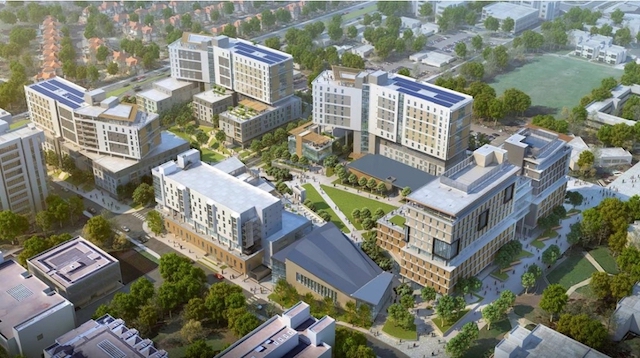
The first, the North Torrey Pines site, is a 10-acre "neighborhood" that will become the new home of the university's Sixth College and two new academic buildings, one for the Division of Social Sciences and another for the Division of Arts and Humanities. That campus will have 995,000 square feet of classrooms, recreation, lecture halls and dining facilities along with new housing for 2,000 undergraduates. A craft center will have a public-use gallery space and community-led classes and events. An auditorium will seat 600 in a concert-caliber structure.
The student housing will be ready for fall 2020, with the academic programs space completed by the end of the year.
The project is pursuing Platinum LEED certification. The contractor is Clark Construction. A February 2020 drone flyover video of the project is available on YouTube.
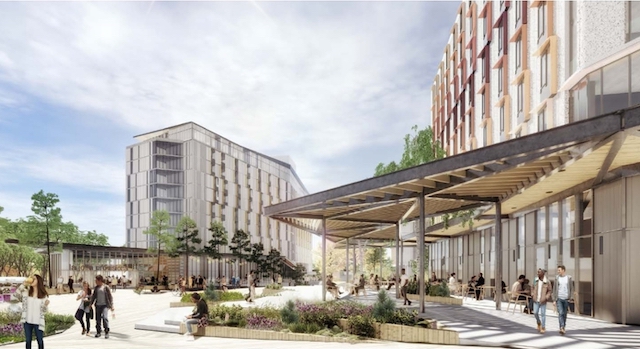
The second neighborhood, Future College, is also designed to accommodate residential life for 2,000 undergraduate students as well as academic space for a new undergraduate college. According to the university, the project will also improve the university's theatre district with meeting space, retail, dining, underground parking for 1,200 cars and a significant amount of open space and outdoor gathering areas, some with ocean views.
The project is pending UC Regent approval, with the goal of opening in the fall of 2023 as the university's eighth college.
That campus would feature five buildings ranging in height from nine to 21 stories with about 900,000 gross square feet. The contractor is Kitchell. If approved, construction was expected to begin in fall 2020 with completion in fall 2023.
The university will pursue Gold LEED certification for Future College. Sustainability measures include the use of natural ventilation, drought-resident landscaping, high-efficiency features, high-performance HVAC, low-power density lighting, an anaerobic digester system for treating sewage and a photovoltaic array for solar power production.
The projects are intended to keep pace with institutional enrollment, which was 30,000 for the 2018-2019 academic year but was expected to grow to about 42,000 in five years, according to reporting by the San Diego Union-Tribune. That story quoted Chancellor Pradeep Khosla as saying that although the number of students living in dorms this fall could drop by 2,000 due to changes driven by the coronavirus, he expected the downturn to be temporary.
About the Author
Dian Schaffhauser is a former senior contributing editor for 1105 Media's education publications THE Journal, Campus Technology and Spaces4Learning.