Bradley Corp. Releases Stainless Steel Hand Sanitizer Solutions
The Bradley Corp., based in Menomonee Falls, Wis., has released a new series of stainless steel hand sanitizer dispensers and stands for quick, convenient access to hand-cleansing products. Touch-free and resilient, the commercial-grade dispensers can be placed in high-traffic areas like doorways, stairwells, lobbies, cafeterias, and more.
The new 6A series consists of three models: the 6A00 Liquid/Gel Sanitizer Dispenser, the 6A01 Foam Sanitizer Dispenser, and the 6A02 Liquid Spray Sanitizer Dispenser. This flexibility allows users to fill and refill with their sanitizer of choice—users can even choose their own brand instead of relying on proprietary cartridges. With a capacity of 27 oz. and tested in bustling areas across hundreds of thousands of cycles, the products are intended to serve as durable, long-term solutions.
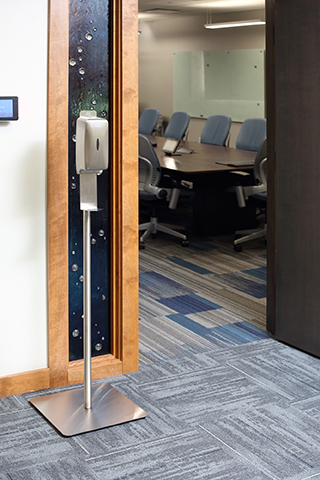
For placement in areas with no wall or counter to mount them on, the 6A20 dispenser stand offers a sturdy solution for freestanding placement. The stand is ADA-compliant, offers easy assembly, and even features a built-in drip tray to keep floors clean.
“Bradley’s hand sanitizer stations are an economical choice for facilities,” said Bradley Corp. senior product manager Laura Stang. “In only a matter of months, facilities using Bradley’s hand sanitizer dispensers will achieve a 65-80% consumable cost savings, so the stations will quickly pay for themselves, while keeping building occupants and visitors’ hands sanitized.”
During the coronavirus pandemic, when cleanliness and hygiene are more important than ever, Stang noted that the dispensers are not only highly functional, but also symbolic: “As more businesses and facilities reopen,” she said, “Bradley’s hand sanitizer stations are not only a reliable solution for dispensing hand sanitizer, they offer a visual reminder for people to sanitize hands throughout the day and provide peace of mind that facility management supports hand hygiene for all.”
About the Author
Matt Jones is senior editor of Spaces4Learning. He can be reached at [email protected].