N. California District Cuts Electric Fleet Charging in Half
- By Dian Schaffhauser
- 04/07/21
A school district in Northern California will be adding new infrastructure to bring down the cost of recharging its electric school bus fleet. Palermo Union Elementary School District has signed with AMPLY Power, which will supply energy management intended to reduce the cost to a dime per kilowatt hour versus 19 to 39 cents/kWh under the previous charging program. According to AMPLY, that converts to paying about $1.19 per gallon of gasoline to power the buses.
The district's electric fleet began in 2018 when the state started a Rural School Bus Pilot Project, which helped a number of rural districts replace and upgrade their aging buses to reduce diesel particulate pollution in the communities they served. Replacement vehicles used either zero-emission technology or hybrid or internal combustion engine technology running on renewable fuel types.
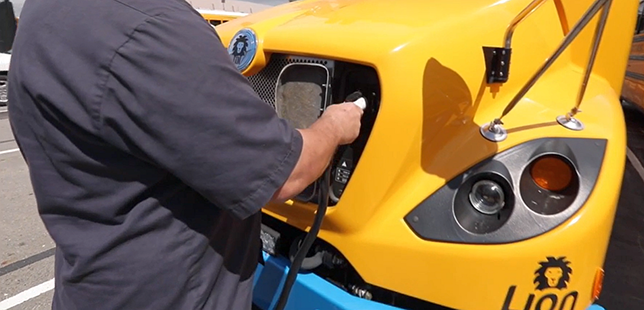
A district employee plugs in an electric school bus.
Photo credit: PG&E's EV Fleet program
Palermo chose electric, which now makes up 80% of its total fleet, including five Lion C electric buses. Later this year, the district expected to add a type-A or smaller electric bus from Blue Bird.
The hardware for the installation at Palermo includes six 16.2kW Level 2 chargers and about 700kWh of lithium-ion battery storage. To fund the project, the district secured $49,839 from the Butte County Air Quality Management District through a Community Air Protection Incentives program and another $35,488 in charger rebates and "make ready" electric vehicle supply equipment (EVSE) incentives from PG&E. Palermo participated in utility PG&E's EV Fleet program, which works with customers to convert medium-duty, heavy-duty and off-road fleets to clean electric vehicles. PG&E helped the school district by designing, paying for and building out a large portion of the electrical infrastructure for its EV charging stations.
The district used AMPLY for help in identifying possible funding sources, installing charging stations and onsite energy storage, managing electric bills and related services related to uptime and resilience. AMPLY runs a "charging-as-a-service" program, which is intended to provide fleet owners with a way to gain consistent cost for electric fuel via access to electricity markets and real-time energy-flow management.
"Although the coronavirus pandemic created a number of obstacles for us, we were able to start using our electric fleet in November of 2020 as our schools were opened for in-person instruction four days per week. On March 10, we returned to five-day, in-person instruction, which allowed for more students to be on campuses and more students requiring transportation. Everyone is grateful to be back to school, and our drivers are especially excited about our electric fleet," said Carlos Aguilar, district director of Maintenance, Operations & Transportation, in a statement. "While transitioning to electric can be intimidating and costly, AMPLY's comprehensive and scalable charge management services are taking the planning and management burden off our staff and replacing it with confidence in our fleet's performance and predictable, fixed fuel pricing."
"Palermo Union School District's collaboration with AMPLY achieves our goals of prioritizing zero-emission infrastructure and reducing exposure to air pollution at schools," added Jason Mandly, senior air quality planner for the Butte County Air Quality Management District.
About the Author
Dian Schaffhauser is a former senior contributing editor for 1105 Media's education publications THE Journal, Campus Technology and Spaces4Learning.