Four Ways to Recover Pandemic Learning Loss
By Sara Rich
For anyone who has been in close proximity to the educational landscape since March of 2020, it comes as no surprise that the COVID-19 pandemic caused shockwaves that will leave permanent effects. Multiple reports have put children’s learning loss at almost 6 months as of July 2021. Children that attend Title-1 schools are tipping the scales at close to a year of learning loss. McKinsey reports that the effects of the pandemic on education will continue for a generation, with students affected earning $49K to $61K less in their lifetime as compared to similar cohorts if the pandemic had never occurred.
This learning loss begs the question: How can schools and districts help students recover with innovative literacy strategies? Here are four steps for recovering learning loss by focusing on literacy, fun and parent engagement.
1. Focus on Phonics and Lending Libraries
Children should have access to quality decodable readers at a young age and increasingly more complex texts as they grow in their capabilities. These books should be not only decodable, but also culturally relevant and responsive in their material—and, of course, fun!
We know that direct and explicit phonics instruction is best in teaching children how to read and feel successful. To foster this success and love of reading, students should have access to these quality texts both at school and at home. Consider creating a robust library lending system at school that allows students to take home a constant stream of new content without penalty.
2. Personalize Literacy and Learning
Students should be able to have a personalized reading experience by picking out books based on their reading work that also interest them. Children love to see themselves reflected in the books they read and the work they do. This personalization helps students feel more connected to their reading. Research continually shows that students learn more when they are interested in what they are learning and they feel a connection to their books. Students excited to read are also excited to share their new learning and new books with family members, therefore creating a clearer pipeline between home and school.
3. Share Take-Home Reading Kits and Utilize Technology to Involve Parents
Providing students with at-home reading kits provides families with clear materials and books to read with their children. These reading kits can hold high-quality decodables and activities at any students’ level. Research has shown that homework has no effect on students’ academic performance, but giving students access to high-quality texts that they both see themselves in and are able to reread has a direct effect on students’ academic success.
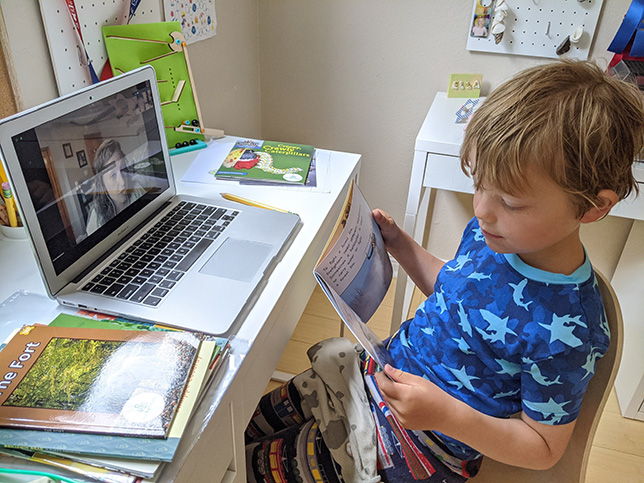
COVID-19 has helped reshape the way technology is seen both inside and outside of the classroom. Many schools were no longer able to have parents in the classroom or having direct contact with the teacher and school. Focusing on technology can open the door to using these new ideas in a home-to-school pipeline. Uploading videos to YouTube can help bring parents into what is happening in the classroom. Teachers can give instructional videos, show new book kits, read a bedtime story or tell parents about what’s happening at the school.
4. Make Learning Fun and Have Kids Laugh
Now that children have reentered school, there needs to be a new wave of teaching and learning that puts fun at the center. When children are relaxed and having fun while learning, we know they retain more information! Neuroimaging as well as measurement of brain chemical transmitters show that when students are relaxed, engaged, have little stress, feel motivated and are having fun, there is a direct influence on how much information a child can store in their brain!
Not only are students able to retain more, they’re also better able to have information flow through the affective filter in the amygdala. This means students make more connections, so all those lightbulb moments that teachers look for in children happen more often when students have fun. Students naturally make more connections when having fun, so how can teachers make simple shifts to infuse their classrooms with more fun? Some of the simplest ways to do this are through giving students books and activities that make them laugh and that they relate to.
Sara Rich is the CEO of Just Right Reader, an innovative early literacy company that is transforming how school districts and families support student literacy growth. Just Right Reader’s products include Family Literacy Boxes of personalized books (that actually teach children to read!) and the Just Right Books Collection of culturally relevant decodable and early reader books.