Best Practices for Ballistically Protecting Your School
Ballistically protecting a school can be a daunting and complicated task. Focusing on practical best practices streamlines the process and makes your efforts more effective.
When adding ballistic protection to schools, the main goal is to delay entry and limit free movement. Shootings that take place inside school buildings are three times more deadly than shootings that take place on school grounds (Government Accountability Office). Preventing access to the school’s interior is one of the most critical ways to prevent an attack from escalating and save lives.
If an intruder does manage to enter the school building, strategically-placed barriers should contain them and prevent further progress into the building and causing more harm. The best practices in this article all support this delay-and contain-principle.
Best Practice #1: Secure the Main Entrance with an Entry Vestibule
Entry vestibules (also colloquially known as “man traps”) are typically made of two sets of doors, one exterior and one interior. When an intruder enters, both sets of doors lock, preventing them from getting further into the building or running and getting away. Both sets of doors, as well as any glass sidelites beside the doors, should be ballistically rated to prevent an intruder from shooting out the glass. Many schools find UL Level 3 barriers sufficient for this application, which protects against three rounds of handgun fire. However, many schools are opting for Levels 4 and 5, a higher level of protection that covers shots from high-powered rifles.
Many schools have an entry vestibule in place already, especially in regions that require climate control. In these situations, all schools have to do is replace the existing structure with features that are ballistically rated. Ideally, the updated doors will look exactly the same as the originals, maintaining the school’s aesthetics. If your school does not have a vestibule that can be replaced with a ballistically-rated version, consider working with a manufacturer who can design a vestibule that blends in with the school’s architecture.
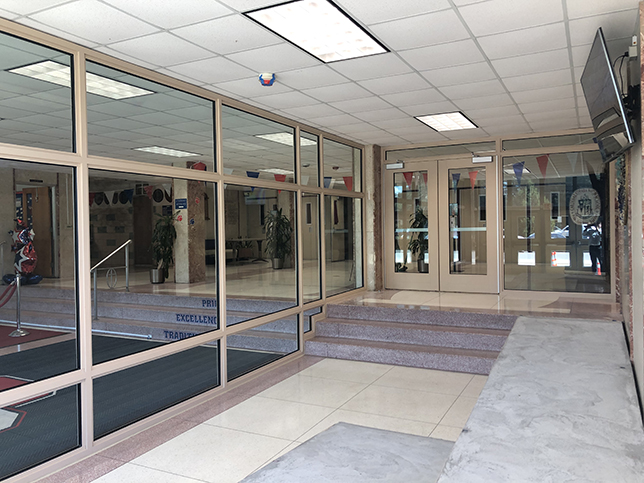
Photo Courtesy of Total Security Solutions
Best Practice #2: Use Locking Interior Doors to Contain Movement
Schools use fire doors to seal off hallways and prevent fires from spreading. Making these doors ballistic prevents a shooter from progressing down a hallway to classrooms and other vulnerable areas of a building. Containing an active shooter also makes it easier for the authorities to apprehend them once they arrive on scene.
Best Practice #3: Use Bulletproof Glass to Protect People and Security Window Film to Protect Property
If you’re concerned about the cost of these security upgrades, using bulletproof glass and security window film strategically can make the most of your budget without compromising safety. A good rule of thumb is to use bullet-resistant glass to protect people and security window film to protect property.
Bulletproof glass is the most reliable way to protect students from bullets, which easily penetrate security window film. Security window film is designed to delay entry by preventing glass from shattering out. It does not offer any protection from bullets, so only use this product in locations that don’t have people behind the glass. If you have any questions about how to use security window film and bulletproof glass in your facility, you should speak with a security consultant.
Best Practice #4: Make Bulletproofing Budget Allocations Over Several Years
After a highly-publicized tragedy, there can be incredible pressure to implement every possible solution as quickly as possible. For most schools, tight budgets make this an impossible task. Instead of focusing on adding every possible solution at once, speak with a security consultant to determine the most vulnerable points in your building and create a plan for adding ballistic protection over the next few years.
We typically recommend schools start with securing the entryways. However, a security consultant can help you prioritize physical security upgrades and make the most of your budget.
Best Practice #5: Take a Systems Approach to Ballistic Security
No one bulletproof barrier will be enough to stop an intruder. To effectively protect your school’s students, faculty, and staff, take a systems approach. This means thinking about your school as a whole and implementing multiple solutions, such as a silent alarm system, mag locks on doors, and a camera system. Your safety plan should include a policy regarding keeping exterior doors locked; the local and state police often have guidelines that schools can use to develop their unique safety plans.
Ballistic Protection is a Process; the Best Time to Start is Now
Adding ballistic reinforcements is an enormous endeavor, both emotionally and financially. Simply thinking about how to make your school safer and adding active shooter responses to your safety plan is a good start. In many cases, something is better than nothing. As you continue researching your options, we can’t stress enough the value of speaking with a security consultant who can help you walk through your facility and make informed decisions.
About the Author
Jim Richards is the CEO of Total Security Solutions.