Whitman College Aquatic Facility Adopts Atmosphere Audio Control System
Located in the heart of Washington state’s wine country, Whitman College in Walla Walla boasts an impressive academic record and an even more outstanding array of state-of-the-art facilities to attract and retain students and faculty. One of the most popular facilities on campus is the Louise and Harvey aquatic facility, or indoor pool, which provides students a place to exercise—and, for the college’s swim team, a place to compete.
When the aquatic facility’s existing AV system began to fade, Whitman College’s Multimedia Services Consultant Tristan Rupert, looked to AtlasIED and its Atmosphere Audio Distribution platform for a user-friendly, high-performance solution.
The impressive 30-meter swimming pool features eight competitive lanes, three practice lanes and an elevated area for spectators. The center is home to both a men’s and women’s swim team, who compete in the NCAA Division III Northwest Conference. Outside of hosting the college’s competitive swim teams, the pool serves as home to the club water polo team, student kayak practice and recreational swimming. The mix of pool activities introduces an array of needs for the pool’s sound system, including public address announcements, event music, background music, paging and more.
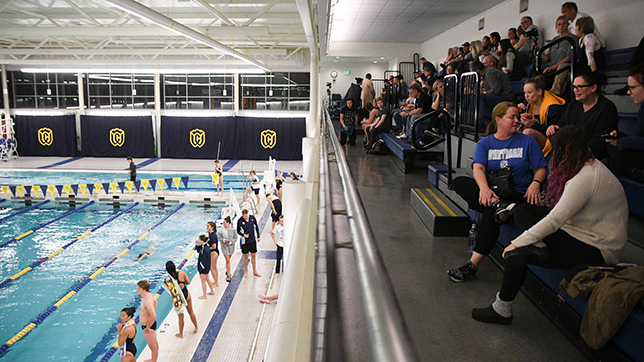
Image Courtesy of Brand Definition
“The existing amplifier in the space featured a small, rudimentary control panel with tiny buttons and peculiarities that always made it a problem to use,” said Rupert. “When the unit began to fail, we knew we needed a powerful yet simple and flexible system. AtlasIED exceeded our most important requirements—performance, intuitive user access control, simplicity, and reliability."
Rupert selected AtlasIED’s DPA804 800-watt networkable four-channel power amplifier and Atmosphere Audio Processing and Control System. The Atmosphere AZM4 four-zone audio processor offered the ideal control for the pool's sound system. In addition to simplifying basic AV tasks, Atmosphere’s sophisticated features help to ensure all system functions are user-friendly.
Even with straightforward, intuitive functionality, it was vital to define system use parameters such as access limits and standard volume levels to help eliminate the potential for user mistakes. Limiting who can adjust the system and how much is an incredible time saver for Rupert and his team, as it cuts down on the human errors that often lead to time-consuming technical support and costly maintenance.
"I can't even recall the last time I've received a support call or tech ticket to address a sound issue in that space since installing the system," said Rupert. "With the previous system, we regularly got calls for sound system help from the pool area. Invariably, it would be due to some operator error or changing or adjusting a setting they shouldn't have needed to touch or access. We no longer have those kinds of issues, and that's a significant benefit."
In addition to system ease of use, Rupert and his team required a system to distribute sound appropriately in the two main areas of the aquatic facility—the pool and the spectator seating area. “Swimmers and athletes like to hear the motivating music above the splashing to sustain their energy and drive,” notes Rupert. “The high speaker volume, however, often drives spectators away from swim races and events."
With Atmosphere’s zone source and volume controls, all listeners—from swimmers and lifeguards to visitors and spectators—receive an optimum listening experience. The facility team installed an Atmosphere A-BT remote Bluetooth™ audio input, which connects directly to the AZM audio processor. This audio input provides a Bluetooth receiver for facility staff to connect their personal mobile device to the system to play the swim team’s favorite warmup and cool down music.
With simple installation and ease of use that matches the requirements and skill levels of all in the Whitman College community, Rupert looks forward to enhancing the capabilities of its AtlasIED system in the future.
About the Author
Tim McDowd is the Director of Brand Communications at Brand Definition.