Facility Focus: WSU's Woolsey Hall Shapes Next Generation of Business Leaders

Courtesy of Gensler

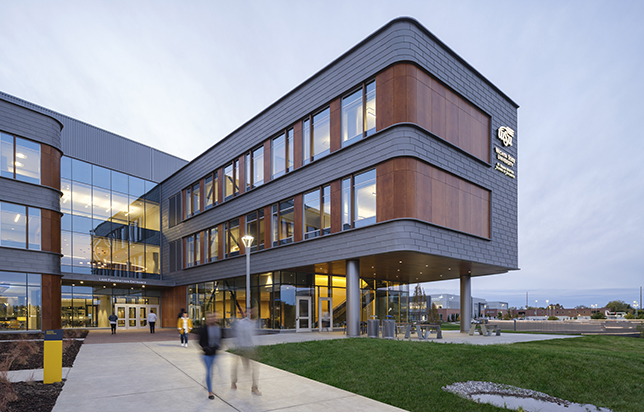
Home of The Barton School of Business, Woolsey Hall at Wichita State University (WSU) bridges the traditional academic campus with a newer complex of makerspaces, labs, and research facilities. Merging the interior with the exterior, the design exudes connectivity and cohesion, pulling campus paths through the building, and providing new gathering spaces for students from all departments.

The Barton School’s aim is to prepare students for future jobs through professional, real-world learning experiences, giving extra support to WSU’s notable percentage of first-generation students. With areas for collaboration, focus, and outdoor space, the design of the building reflects a sophisticated workplace, nodding to the aspirations of those working towards degrees in business.

Photos credit:©Jason O'Rear | Designed by Gensler in collaboration with GastingerWalker&
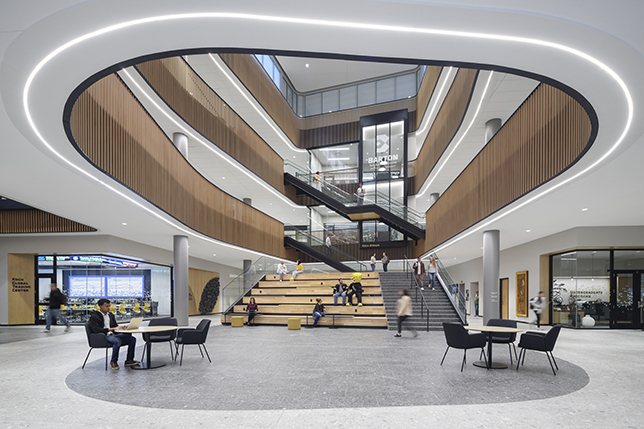
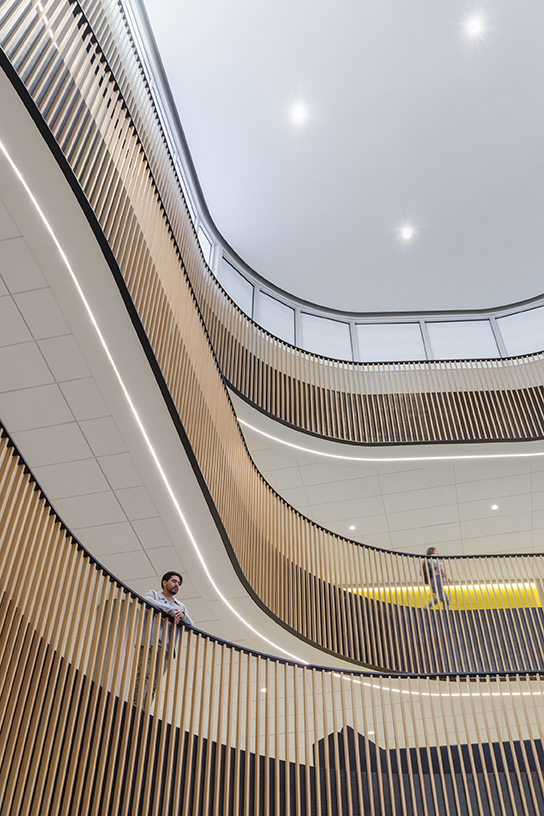
Materials celebrate the contrast of industry and nature. An outer zinc shell with interlocking panels wraps the building, inspired by the forms and textures of the aerospace industry, an integral part of the Wichita economy. An inner layer of wood wraps the façade and interior atrium, welcoming students and visitors into the school while expressing the golden color and texture of surrounding wheat fields.

Positioned at the edge of a lake, the building’s location and its organic form create an impactful juxtaposition to the modular, geometric housing facility nearby. A bridge serves as a literal and metaphorical path over the water. It symbolizes a student's journey from student to professional punctuated by a space to take in the view and celebrate academic milestones.

Featured

  • TCU Marks Campus Expansion Milestone

    Texas Christian University in Fort Worth, Texas, recently held a topping-out ceremony to mark progress on a major campus expansion effort including four new residential facilities and a five-story parking garage, according to a news release.

  • Rethinking K-12 Schools as a Continuous Learning Experience

    Most students move through three or more separate facilities during their K-12 journey, yet the built environments they encounter at each stage have traditionally been designed in isolation, with little continuity in spatial language, learning philosophy, or physical resources. Each new school is a reset with different layouts, learning models, expectations, and ways of moving through a building. The next generation of school design is making the case that the first day of kindergarten and the last day of high school can and should feel connected through common support systems and infrastructure in the physical environment.

  • Q&A: How to Prevent Kitchen Grease Fires in Commercial Kitchens

    School cafeterias and university dining halls serve thousands of meals daily, relying on high-heat equipment like fryers, grills, and ovens. While these operations keep students fed, they also generate significant grease-laden vapors. Without proper controls, this grease becomes a silent fire threat. As a certified exhaust cleaning specialist and business coach who has helped hundreds of institutional facilities achieve NFPA 96 compliance, I emphasize that proactive grease management isn’t optional; it’s a core fire/life safety practice.

  • Designing Third Spaces That Do What AI Can't

    In 2026, education is evolving faster than ever. With AI reshaping everything from lesson planning to personalized instruction, schools and universities are turning their attention to what AI can’t replicate: spaces that foster collaboration, community, and creativity.