Transforming a Static Library into a Dynamic Learning Space
By Nick Perry
Home to some of St. Louis’s brightest young minds, the Idea Center on the campus of Lindbergh High School transforms a static, decades-old library into dynamic learning spaces where design facilitates community, and every space encourages exploration, collaboration, and hands-on learning.
Designed by global architecture and design firm Perkins&Will, the two-story Idea Center brings together elementary school students and teachers formerly scattered across the district into a connected community with a dedicated place that gifted students can call their own. The design drew inspiration from Perkins&Will meetings with a wide range of stakeholders: administrators, faculty, parents, students. During renovation and construction on the Lindbergh High School campus, t here was widespread agreement that the aging circle-shaped building resembling a modernist-style drum with a prominent skylight in the center should be retained, but thoroughly reimagined . Today it is a full-time school for students in the St. Louis Regional Program for Exceptionally Gifted Students (PEGS), who attend five days a week, and elementary school students in Lindbergh’s LEAP program for gifted students, attend once a week. (A new high school library was built as part the high school renovation project.)
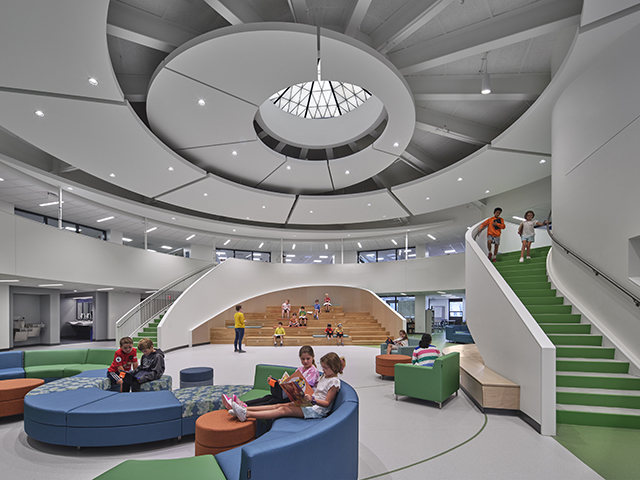
Lindbergh High School Idea Center
Photo credit: Todd Mason
Apart from its shape, the Idea Center is unrecognizable from the former library, which featured conventional study tables on both floors, stacks of books along the perimeter, a short staircase between floors, and a color scheme of beige and light green. Now, the space is a bright, swirling hub of activity, with the oculus-like dome bringing in natural light, and enhanced with folds of ceiling panels with embedded lights. Students for both programs - PEGS on the first floor, LEAP on the second - enter through a secure reception area that leads to the core of the building - a central commons area.
The commons with its brightly colored orange, green and blue soft seating provides flexible options for students to gather informally in small groups or to study. Stadium-style seating on the learning stair opens opportunities for lectures and presentations. Another standout feature: a glass enclosed room underneath one of the staircases for student-teacher meetings. All told, the central space promotes collaboration and learning by doing, two of the main tenets of the Idea Center.
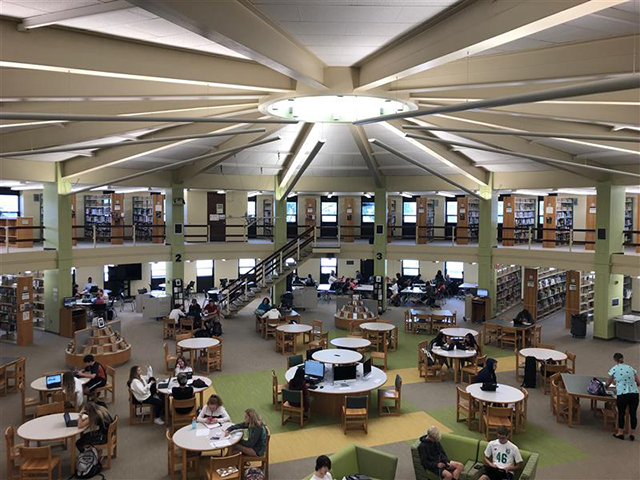
Lindbergh High School's library before the transformation
Photo credit: Todd Mason
“The new design shifts geometries from perfect circles to more complex parabolas inspired by the St. Louis Gateway A rch and orbits of planets,” said Steve Turckes, Perkins&Will principal in the PreK-12 Education Group. “Focus shifts from the singular to a space where multiple elements start to influence and interact with each other. A new parabolic learning stair is in dialogue with small group spaces and a new ceiling that spirals into adjoining spaces.”
Multi-functional classrooms line the perimeter of the first floor. Classrooms contain both dedicated space with traditional desks and chairs for focused, teacher-led instruction together with flexible areas where students can work independently or explore and collaborate on projects that bring their ideas to life. Exterior windows look out on the playground and adjoining outdoor areas; many interior walls are transparent glass, allowing a direct sightline to the center of building, further promoting the concept of community throughout. “Clean lines of sight allow teachers and staff to respond quickly to children’s needs,” says Dr. Tracy Bednarick-Humes, gifted education coordinator for Lindbergh Schools.
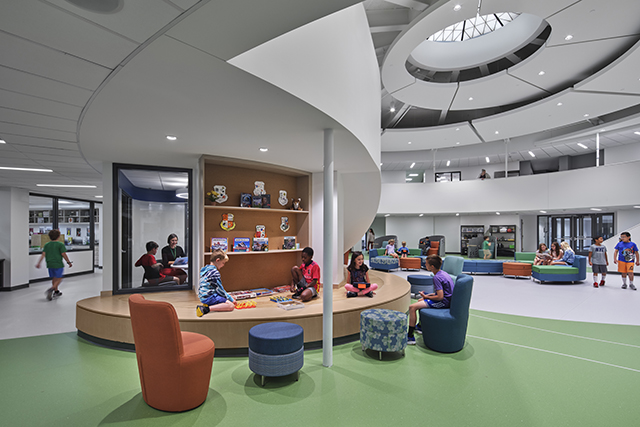
Photo credit: Todd Mason
Two winding staircases lead from the commons area to the second floor, where there are six additional classrooms for LEAP students. The classrooms and open spaces are designed to support enrichment opportunities for district students with a curriculum of thematic, multidisciplinary units that encourage exploration and investigation, critical thinking, problem solving and creativity.
Classrooms are primarily “maker spaces” facing each other with co-teaching opportunities. Students can move easily between these spaces, adapting to different course material throughout the day, creating an environment of learning in motion. All glass-enclosed classrooms open into a wide hallway with a variety of spaces for small group discussions and hands-on learning following co-led instruction.
“This is exactly what we wanted to see emerge from a new flexible teaching and learning environment,” says Dr. Tara Sparks, chief academic officer for Lindbergh Schools.
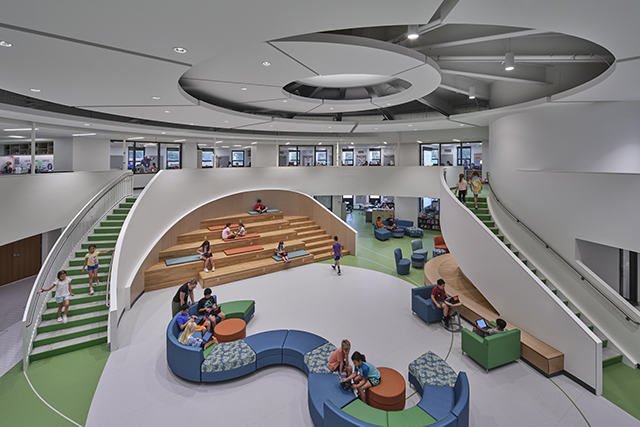
Photo credit: Todd Mason
A key benefit for students are links to the high school. A breezeway connects the Idea Center to the high school campus where LEAP and PEGS students use the gym and athletic fields for PE and recess, art studios for related-arts classes, quiet rooms for testing, and eat lunch in the cafeteria. The proximity to the high school fosters collaboration with high school students, who volunteer and lead programming, such as virtual reality and coding days, with the students at the Idea Center.
“The biggest impact that our new Idea Center space has had is how the space fosters teamwork among the students,” said Bednarick-Humes. “Our students have affectionately named the open space in the middle of our building ‘the donut hole.’ This space fosters collaboration, but also allows for quiet independent learning. In fact, the overall open concept encourages collaboration amongst the teaching staff as well. It's really great having our entire elementary gifted team together in one space!”
Nick Perry, AIA, LEED AP is a Senior Associate with Perkins&Will in Chicago. Nick believes in the power of design to inspire, educate, and enrich the lives of others. As an experienced architect, Nick has collaborated with K12 and higher education institutions across the country to transform their learning environments to agile and dynamic places to learn and grow.