University of Wisconsin-Milwaukee Debuts New Chemistry Building

The University of Wisconsin-Milwaukee in Milwaukee, Wis., recently celebrated the grand opening of a new Chemistry Building, according to a news release. The facility measures in at 163,400 square feet, stands four stories, and has the capacity for about 5,000 chemistry and biochemistry students. The university partnered with Kahler Slater and CannonDesign for the project’s design and with VJS Construction Services, Inc., for its construction.
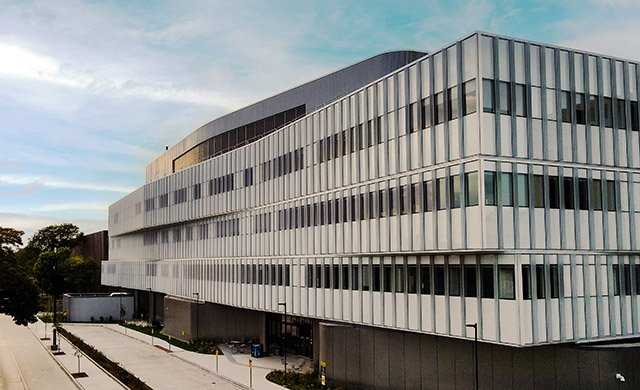

Photo courtesy of Kahler Slater

The previous building had aged out of usefulness, and the new one was designed to provide advanced learning environments for more modern healthcare and STEM-related courses and research. According to the news release, the building’s structure resembles protein and lattice structures found in chemical research. Amenities include academic spaces, lecture halls, offices, formal and informal collaboration space, and modern lab spaces separated by breakout zones.

According to the news release, the building’s interior features glass walls to foster collaboration and create transparency. The ultimate goal of the space is to “offer flexibility and adaptability to support teaching and research innovation and connect researchers, students, and the community through science,” the news release reports.

About the Author

Matt Jones is senior editor of Spaces4Learning. He can be reached at [email protected].

Featured

  • Year-Round Schools Require Year-Round Indoor Air Quality Planning

    While many schools are out for the summer, year-round schools follow a more “balanced” schedule with shorter, more frequent breaks spaced throughout the school year. Even though this offers educational benefits, these facilities have less downtime for building maintenance. This can become an issue when facilities managers overlook the importance of routine HVAC maintenance and air duct cleaning services.

  • Designing the Bridge Between Inclusivity and Independence in K–12 Schools

    Fostering independence is fundamental to learning and development for K–12 students. It offers many proven benefits, such as enhanced confidence, problem-solving, decision-making, and social skills. However, this foundational objective loses its impact if it’s not accessible and adaptable to all students. Inclusivity plays a critical role in cultivating independence and healthy autonomy for students, fostering positive student learning outcomes by uniting pedagogy with the physical learning environment.

  • Washington State University Debuts New Engineering Hall

    Washington State University recently celebrated a dedication ceremony for the new Schweitzer Engineering Hall on its Pullman campus in Pullman, Wash., according to university news. The facility measures 66,288 square feet, and its completion marks the first milestone in a larger university effort to modernize the engineering and design district.