New Tornado Wind Load Design Criteria in IBC Offer Improvements to Life Safety
- By Frank Woeste, P.E., Scott D. Coffman, P.E.
- 08/26/25
For the first time in U.S. building code history, the 2024 International Building Code (IBC) includes tornado wind load design criteria, marking a significant advancement in life-safety provisions. Tornado load requirements apply to Risk Category III and IV structures located in the tornado-prone region, generally east of the Continental Divide. Risk Category III includes buildings like schools or Group E/I-4 occupancies with an occupant load over 250.
Building professionals — from architects and engineers to building officials and contractors — as well as community leaders, can proactively promote the adoption of the most recent code edition and life-safety design provisions. This is particularly vital in jurisdictions that have not yet adopted the 2024 IBC, where there may be a lag of 3–10 years. For example, for a new school project in a jurisdiction still using the 2015 IBC, the public entity, school board, and community leaders could investigate the costs and benefits by voluntarily requiring Risk Category III and the 2024 IBC tornado design provisions.
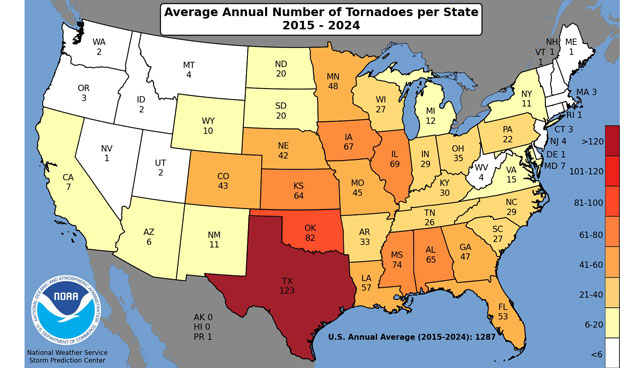 Source: NOAA National Weather Service Storm Prediction Center
Requiring Category III (or IV) wind design instead of Risk Category II would translate into stronger building and thus better protection against environmental hazards, such as extreme wind and tornadoes. The pathway for building safety improvements above the currently adopted code for the jurisdiction would likely require an assessment of additional costs of design options by an architect and structural engineer in the early planning stages. The benefits should be:
- Stronger building that would better protect the children and staff during a severe and unpredictable storm event, guarding against a community disaster;
- Due to a more resilient building, lower recovery costs in case of a severe storm event; and
- Potentially lower insurance premiums.
Equipped with the increased project costs (by percentage) and consideration of the commensurate benefits, government and school officials, school board members, and the community at-large can make thoughtful decisions about what is best for their community. Visit https://www.iccsafe.org/building-safety-journal/bsj-technical/2024international-building-code-tornado-loads-and-community-based-implementation/# for details.
About the Authors
Frank Woeste, P. E., Professor Emeritus, Virginia Tech, frequently consults with the public, design professionals, contractors and building code officials on various aspects of engineered-wood construction and residential construction, including decks and balconies. He can be reached at [email protected].
Scott D. Coffman, P. E., Senior Engineer REI Engineers, Inc. in Westminster, SC, has over forty years of experience that included structural and wood truss design, field investigations, construction related issues, building envelope, structural evaluation, and product application and serviceability. He can be reached at [email protected].