Building a Future-Focused Career and Technical Education Center
A district superintendent shares his team's journey to aligning student passions with workforce demands, and why their new CTE center could be a model for districts nationwide.
- By Jonah M. Schenker, Ed.D.
- 11/25/25
 Photo courtesy of Ulster BOCES
When Ulster BOCES set out to transform a former IBM headquarters into our new career and technical education center known as iPark 87, our goal was to open a state-of-the-art facility that would spark a systemic shift in how we think about education, workforce development, and community connection. iPark is more than a building; it's a living ecosystem designed to bring together historically siloed entities: K-12 education, postsecondary institutions, county government, and industry. The goal is to create a new definition of career readiness, one that prepares students for what's next by placing equity and belonging at the center.
Reframing and Realigning CTE
Over the years of planning for the Ulster BOCES Career Academies at iPark 87, our team has worked hard to reframe career and technical education as a high-value, future-forward option for all students, not just those who've been historically tracked into trades. Around the country and certainly in New York State, school enrollment is declining, while CTE programs are seeing exponential growth. Why? Because students are finding deeper engagement in career and technical centers where they can align their passion and purpose with hands-on, industry-connected learning.
To build and maintain that connection, iPark 87 is supported by a steering committee including representatives from industry. We have a number of career clusters, and workplace learning coordinators serve as the caretakers of industry relationships for each of those clusters, while also ensuring that daily learning is informed by real-time input from these essential stakeholders. This kind of alignment allows us to put the ideals of civic readiness and global citizenship into practice every day. The Ulster BOCES Career Academies at iPark 87 is about engineering alignment, not just between subjects, but between school and society.
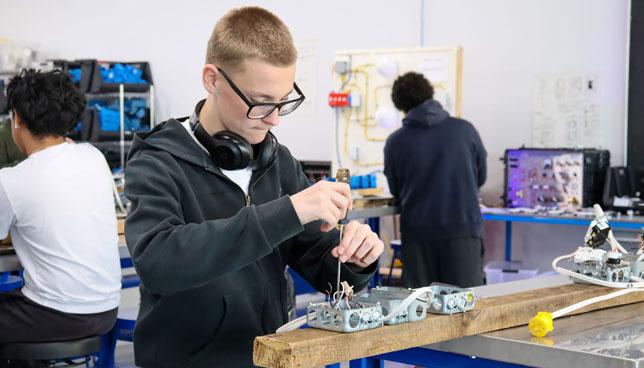 Photo courtesy of Ulster BOCES
Equitable Pathways to the Future Workforce
Today's students have multiple pathways they can follow to prepare for their careers. Some attend four-year colleges, others choose two-year colleges. Still others go straight into the workforce. According to the traditional, industrial-era education system, students required different skills to pursue each of these pathways. I don't believe this applies to today's students. I believe there are foundational skills — such as global citizenship, academic mindset, leadership, creativity, and self-direction — that all schools should teach in order to prepare students for their future. Beyond preparing students for their future, I think we need to be looking at the skills that allow students to be the designers of a new future.
Determining what these skills are starts with asking questions of the industry partners, who we hope will be hiring our students someday. We've built a regular cadence to engage in conversations about emerging technologies and needs, to ask local employers, "What do you need to see in the students who will one day join your workforce?" These conversations drive the pedagogical decisions we make on a daily basis to create experiences that prepare students to meet those needs.
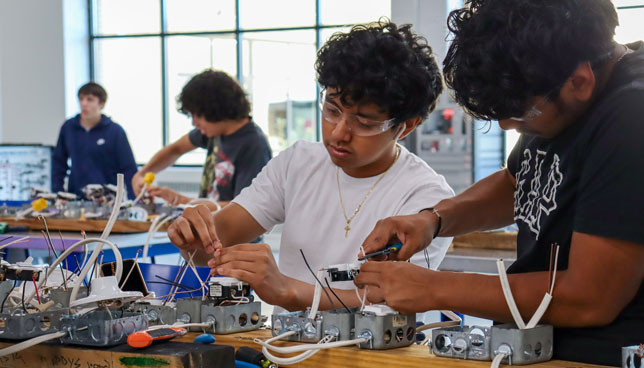 Photo courtesy of Ulster BOCES
Benefitting the Community at Large
Our integrated approach to career and technical education centers our students as our future, but it also has benefits beyond the walls of the school. The iPark 97 revitalization project has created a new sense of belonging and purpose for the people who inhabit our community.
I believe a project like this can have broader implications as a model for what educational institutions and schools can do when they collaborate. At a time when public education is faced with enormous uncertainty, listening to the stories of students who are in programs like those available at the Ulster BOCES Career Academies at iPark 87, where they are connected to their work, where they feel excitement and belonging and joy, provides a much-needed feeling of optimism. It shows how a community can invest in their future collectively, and I believe that's worth funding, building toward, and replicating.
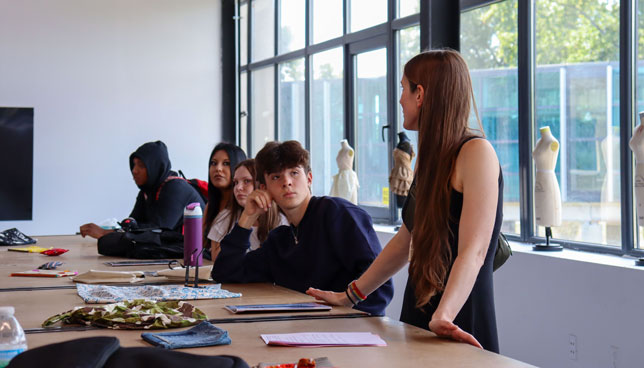 Photo courtesy of Ulster BOCES
Building a Lighthouse for Learning
As we prepared for the opening of the Ulster BOCES Career Academies at iPark 87, we were intentional about codifying and curating our process so that we have a blueprint for ourselves and others. We don't want to wake up months or years from now and say, "How did we do this?"
What we've created at iPark 87 is the physical representation of an interconnectedness that is systematic, structural, and most importantly, isn't about any one human that's tasked with caring for it. My vision is for the Ulster BOCES Career Academies at iPark 87 to become a lighthouse for a new, sustainable way of learning. Success won't be measured by a ribbon cutting or a shiny new program, but by whether we've built something lasting, something that doesn't depend on one leader, but instead reflects the collective investment of an entire community in its young people. If we do this right, our relocation to iPark 87 will not only reshape Ulster County — it will offer a blueprint for what's possible across the country.
About the Author
Jonah M. Schenker, Ed.D., is the district superintendent of Ulster BOCES. Schenker serves a dual role as the state education commissioner's representative for the eight local component school districts in the Ulster BOCES region and as chief executive officer of Ulster BOCES.