Designing for Belonging: Why Student Wellness Starts with Space
From walkable site planning to flexible interiors, intentional design choices play a critical role in how students experience comfort, connection, and community.
- By Christopher Meyers, FAIA, LEED AP, NCARB
- 01/08/26
Wellness is a design responsibility, not an amenity and certainly not an afterthought. The spaces we shape as architects and planners have the power to either energize people or quietly deplete them. They can help students feel seen, safe, and grounded, or leave them feeling like outsiders in their own environment. When we get that part wrong, no program or initiative can fully repair it. Design sets the tone.
At Meyers+Associates, we consider student wellness something that begins long before you step inside a building. It begins with how students move across campus — on foot, by bike, along shaded walkways or open greens. Site design plays a critical role in how students experience community. Are buildings connected by trails or isolated by parking lots? Are fitness amenities tucked in a basement or visible and inviting from the outside? Do pathways lead to shared destinations or just get students from one class to another?
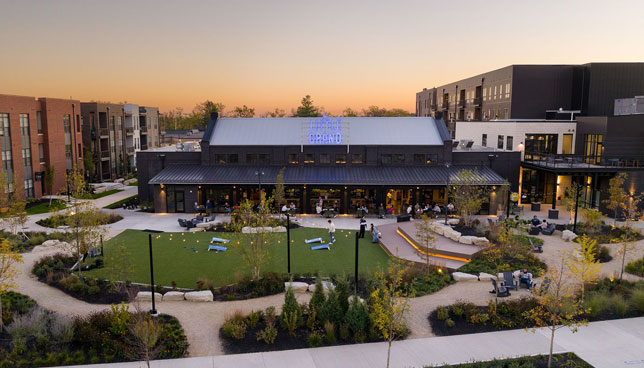 The Little Grand Market
Image courtesy of Meyers+Associates
Learning from Community Spaces
One example of wellness-focused design is The Little Grand Market, a food hall and market space in Columbus, OH, that brings together a curated mix of restaurants and small retailers around a central, three-acre park. It functions as a neighborhood commons, much like a campus quad or student union. When we approached the design, our mindset was rooted in creating a shared experience that encouraged residents and visitors alike to step out of their private spaces and engage with one another. Walkability, outdoor seating, and visual transparency to the park were all intentional design moves, meant to create a rhythm of daily interaction. The outcome? A place that blurs the lines between public and private, much like the connective tissue we seek in our campus work. That philosophy of building community through design is the same lens we bring to educational environments every day.
 The Little Grand Market
Image courtesy of Meyers+Associates
Designing for wellness means thinking on two levels: the immediate sensory details (light, acoustics, seating) and the broader spatial choices that encourage connection and ease. For example, we leaned into that philosophy for the 2nd & 7 Foundation Reading Room, a space housed within a youth-focused community center that was conceived as part library, part lounge, part learning lab, a flexible environment for reading and mentorship. What it became was even more meaningful than the sum of its parts: Kids rearranged furniture, stretched out on couches, and claimed the space in ways we hadn't fully anticipated. That kind of behavioral freedom is a critical part of wellness.
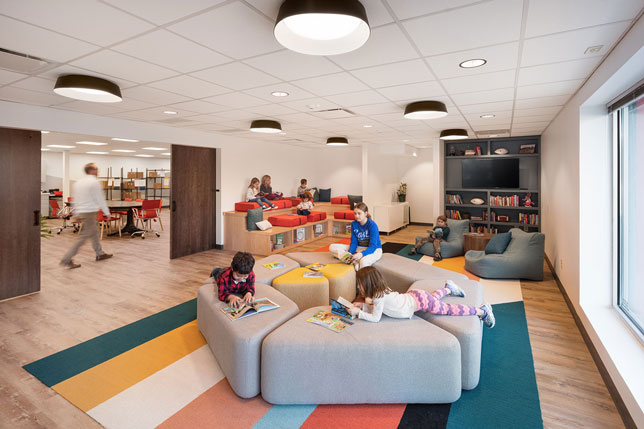 2nd & 7 Foundation Reading Room
Image courtesy of Meyers+Associates
We've seen that same effect with something as simple as a hammock room in student housing. It wasn't overthought. Just a quiet, soft space where students could rest or unplug. But it quickly became a magnet. It worked because it gave students permission to show up as they were.
Creating Spaces Where Students Want to Be
Wellness and belonging go hand in hand. Too often, design discussions focus on metrics (such as square footage, seat counts, and utilization rates), but miss the bigger question: do students actually want to be there? A student center can hit every programmatic note and still fall flat if it doesn't feel right. Intuitive wayfinding, sightlines that support safety, and outdoor spaces that encourage pause are just as critical as the right number of chairs.
The good news is, these changes are rarely expensive. Small, thoughtful moves can transform how a space is used within days. And when we get the foundational pieces right, the space tends to evolve into what it needs to be.
Our team doesn't design with a rigid endgame in mind. We leave space for behavior to shape the outcome. We design for light, comfort, circulation, connection — and let students take it from there.
About the Author
Christopher Meyers, FAIA, LEED AP, NCARB, is principal architect and founder of Meyers+Associates.