Designing Third Spaces That Do What AI Can't
- By Dana Pucillo, Cyndie Goss
- 06/16/26
In 2026, education is evolving faster than ever. With AI reshaping everything from lesson planning to personalized instruction, schools and universities are turning their attention to what AI can’t replicate: spaces that foster collaboration, community, and creativity.
Highlighting this shift, Gensler’s 2026 Design Forecast states, “Campuses must do what AI can’t: foster collaboration, community, and creativity… Third spaces prioritize hands-on, project-based, and team-driven work, and underscore the social experience of learning.” These “third spaces,” or environments outside traditional classrooms and formal learning zones, are becoming an essential part of next-generation education.
What Are Third Spaces?
In the education context, “third spaces” refer to areas that sit between home (the first space) and the classroom (the second space). These are the in-between environments where students gather, explore, experiment, socialize, and solve problems together. They’re flexible, cross-disciplinary, and designed to spark curiosity.
Unfortunately, third spaces have been gradually disappearing from many communities as digital technologies reshape how people connect, yet they remain an essential part of socialization and wellbeing for young adults, especially students. The rise of smartphones, social media, and digital entertainment has created virtual alternatives to physical gathering spaces.
According to the National Library of Medicine, young adults now spend an average of 7 to 10 hours each day on screens, time that earlier generations often devoted to in-person interaction and community engagement. While digital platforms offer connection and convenience, they can also contribute to social isolation and unhealthy social comparison, both of which are associated with declining mental health.
Schools and designers have a powerful opportunity to reintroduce and prioritize third spaces through intentional design, creating more opportunities for students to connect off-screen.
Educational third spaces can include:
- Libraries
- Incubation labs and innovation hubs
- Makerspaces
- Collaborative lounges
- Group study areas
- Student life hubs
- Transition zones and corridors that double as meeting places
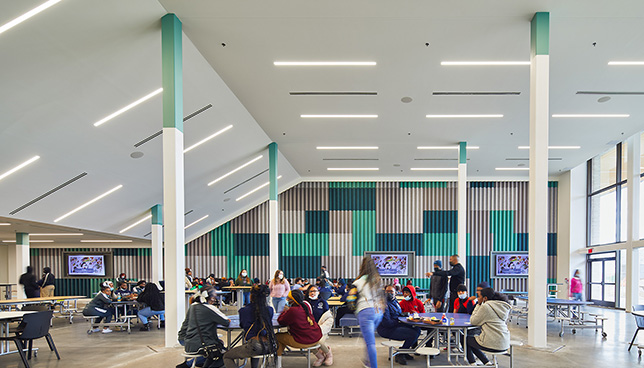 KIPP D.C. Legacy College Prep High School
Images courtesy of Acoustic Solutions at Carnegie
Why Educational Third Spaces Matter
As AI becomes more embedded in academics, the role of physical space is shifting to become more human-centered. While digital tools can enhance efficiency and access to information, they cannot replicate the spontaneous interactions, emotional connections, and sensory experiences that occur in shared environments.
According to Gensler, “Primary educators are contending with AI, so they’re looking for spaces that foster in-person collaboration and community.” This shift underscores a growing recognition that learning is not only about content consumption, but also about communication, experimentation, and relationship-building.
Educational third spaces support this evolution by offering environments that encourage more interactive, immersive, and socially driven learning. Key benefits include:
- Increased peer-to-peer learning: Open, flexible environments naturally encourage students to exchange ideas, problem-solve together, and learn from one another in real time, often leading to deeper understanding than isolated study.
- Reduced academic stress: Thoughtfully designed spaces that incorporate beauty, comfort, and sensory support can help regulate stress levels, creating a more welcoming and restorative atmosphere for students.
- More intuitive interdisciplinary learning: When students from different backgrounds, cultures, socioeconomic levels, races, ethnicities share common spaces, connection happens more organically—breaking down social barriers and fostering empathy, as well as a stronger sense of belonging.
- Support for neurodiverse learners: Incorporating varied textures, acoustics, and spatial experiences helps create inclusive environments that accommodate different learning styles and sensory needs.
- Stronger campus community: By creating spaces where students want to spend time, institutions can strengthen social bonds, which is an essential factor in student wellbeing, engagement, and long-term retention.
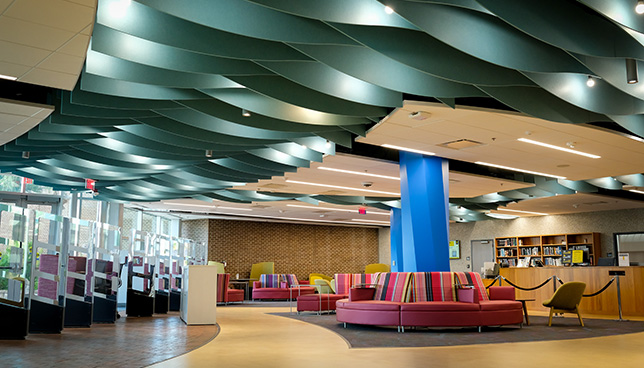 UCF Library featuring Custom Spline Baffles in Duck Egg
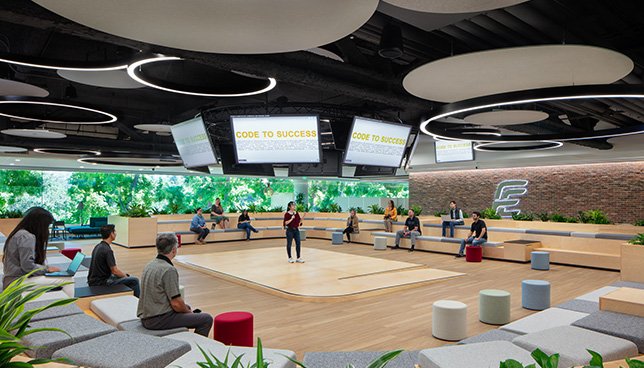 SAP Academy for Engineering featuring Custom Cut Clouds in Smoke, Pebble, and Sage
How Materials Shape Third Spaces
Because educational third spaces are so impactful on the holistic experience of students, designing for these spaces isn’t optional anymore. It’s a differentiator. Designing effective third spaces requires more than furniture layouts and flexible programming. The materials chosen for walls, seating, and acoustic surfaces directly influence how students feel, collaborate, and engage within them. Below are five material considerations designers should prioritize:
- Durability That Withstands Constant Use: Third spaces invite movement. They flex from study lounges to club meetings to group huddles, and need materials that can keep up without looking worn or dated. High-performance woven solutions excel in these conditions. Woven solutions engineer performance materials into the yarn, not as an applied finish. This allows them to resist abrasion, stains, and daily wear in a way that preserves both beauty and function. Its long lifecycle also means fewer replacements and a lower total cost of ownership, a key factor for education designers working within tight budgets.
- Acoustic Performance That Supports Focus and Collaboration: Third spaces must strike a delicate balance: energetic enough to feel social, but controlled enough to support concentration. Materiality is often the key to achieving that equilibrium. Acoustic solutions such as sculptural wall tiles, ceiling-suspended baffles and floating acoustic clouds help dampen reverberation while adding visual rhythm and dimension to the space. When sound is managed well, students stay longer, engage more deeply, and feel more connected.
- Sensory Richness That Encourages Comfort and Creativity: The most successful third spaces aren’t sterile, they’re sensorial. Texture, pattern, and tactility help students feel grounded, especially in high-stimulus environments. Upholstery brings warmth and touchability to soft seating areas, from reading lounges to active learning zones. Performance velvets, boucle-inspired weaves, and nature-influenced patterns add depth and comfort while remaining bleach-cleanable and inherently durable. This sensory richness supports neurodiverse learners, reduces stress, and quietly boosts creativity.
- Cleanability and Practicality for High-Traffic Spaces: Cleanability and hygiene in education environments are essential, especially in areas with continuous student traffic. When specifying materials, designers should look for fabrics that offer easy maintenance and can be cleaned with nothing more than water, bleach, or gentle cleaners, requiring no coatings or finishes that degrade over time. Cleanability ensures spaces stay welcoming, not worn.
- Healthier Materials That Support Student Wellbeing: As campuses rethink their role amid AI-driven change, wellness becomes a core design priority. Students spend long hours in these third spaces, so material transparency and healthy chemistry are non-negotiable. PVC-free, PFAS-free, Red List Free materials allow designers to meet stringent sustainability and wellness criteria without trade-offs in performance. These choices quietly reinforce trust, safety, and long-term stewardship in environments dedicated to human growth.
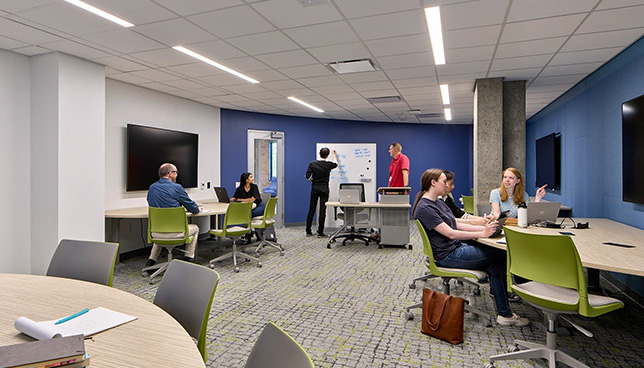 Rutgers Newark Dana Library Featuring Xorel Meteor Wallcovering
Building What Technology Can't Replace
Campuses are increasingly being asked to provide what AI cannot: connection, community, creativity, and the social experience of learning. As a result, third spaces—libraries, makerspaces, lounges, and hybrid learning hubs—are becoming central to that mission. These spaces allow students to move beyond passive engagement and take a more active role in how they connect, collaborate, and grow.
By selecting materials that balance durability, beauty, acoustics, and performance, designers gain the tools to create spaces that feel distinctly human. Thoughtful consideration of sustainability, tactile experience, and long-term resilience ensures these environments not only support learning today, but help shape a better future for students. As AI continues to reshape the academic experience, the most future-forward schools will be defined by the quality of spaces built for the humans who inhabit them.