Building Beyond Simulation: Creating Immersive Ecosystems for Healthcare Education
Healthcare simulation facilities used to be planned around rooms: skills labs, simulation bays, control rooms, standardized-patient suites, and debriefing rooms. Those spaces remain essential. But as AR/VR, virtual patients, remote participation, telehealth, and more data-rich assessments enter the curriculum, the central planning question is shifting from “How many labs do we need?” to “What ecosystem helps learners demonstrate competence, repeatedly and credibly, across settings?”
Student progress is measured by the objective structured clinical examination (OSCE), a structured, repeatable assessment in which learners rotate through timed clinical scenarios and are evaluated against common performance criteria. That is the next step after aligning curriculum and construction. A learning model should drive room types, adjacencies, workflows, and equipment—not the reverse. Yet the learning model now extends beyond individual rooms. The future-ready simulation center is a competency ecosystem: a coordinated network of physical, virtual, and hybrid experiences tied together by observation, reflection, assessment, and operations.
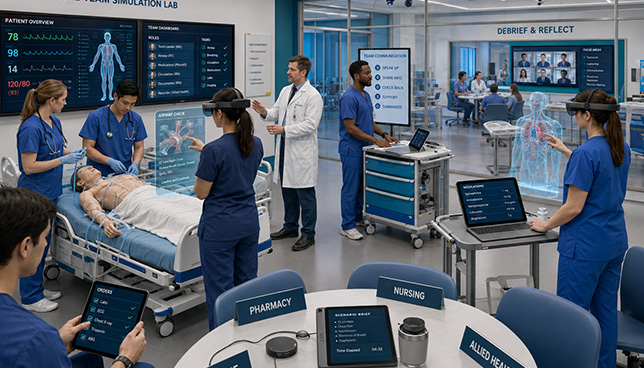 Image courtesy of Craig Park
AR/VR Changes the Mix—Not the Need for Learning
Extended reality brings genuine advantages. It can give learners repeated exposure to uncommon, high-consequence, or logistically difficult situations without tying up a clinical room, a manikin, or a standardized patient for every repetition. A 2025 meta-analysis of 24 studies involving 1,812 participants found that immersive VR improved knowledge, skills, and problem-solving measures in nursing education, while also flagging motion sickness as a practical consideration. The takeaway, however, is not that a headset replaces a simulation center.
Physical simulation and immersive technology do different work. Task trainers and manikins support hands-on practice. Standardized patients support communication, empathy, and the management of interpersonal uncertainty. Team simulations make roles, handoffs, and the pressures of a real care environment visible. Virtual patients and VR can efficiently extend repetition, decision-making, visual immersion, and exposure to situations that are difficult to stage safely or consistently. Research on virtual patient simulations suggests potential benefits, but also marked variation in technical design, instructional duration, and study quality.
The right question is therefore not, “Should we build a VR lab?” It is: “Which competencies require which combination of physical, virtual, and human experience?”
For every scenario, planners should ask:
- What can learners practice independently and repeatedly?
- What requires touch, interpersonal communication, or team coordination?
- When and where will faculty observe, coach, and debrief?
- What evidence must be captured to support a high-stakes assessment?
OSCEs Make the Planning Consequences Visible
The objective structured clinical examination, or OSCE, is where this transition becomes especially consequential. An OSCE is not merely a group of exam rooms. It is a repeatable operating system: check-in, orientation, pre-briefing, encounter, observation, scoring, review, reset, and secure movement through the process.
That operating system affects the credibility of the assessment. Room geometry, acoustics, timing cues, AV capture, privacy, access control, scoring workflow, and turnover space all influence whether the encounter is sufficiently consistent to be assessed fairly. Adding VR creates a new kind of station rather than removing these requirements. Devices must be ready, cleaned, charged, connected, supported, and reset at the cadence of the examination.
Early evidence is promising but appropriately modest. In a 2025 randomized controlled trial, a VR-based emergency medicine OSCE station was feasible within the tight timing constraints of an established examination and demonstrated comparable or better item discrimination than its physical counterpart. That is meaningful. It does not mean every OSCE should become virtual. It means institutions can begin to use VR selectively where it improves consistency, gives access to scenarios that are otherwise difficult to reproduce, or produces useful performance evidence.
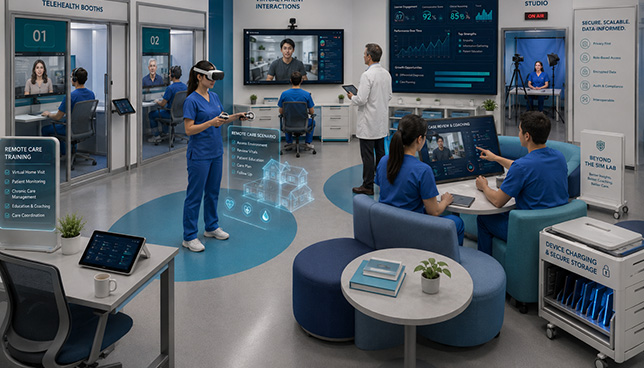 Image courtesy of Craig Park
Design the Ecosystem in Four Layers
First, design the learner journey, not a collection of rooms. Map the route from arrival and pre-brief through scenario, observation, debrief, remediation, and reset. A headset station may sit inside that journey, but the learning value is created by the scenario design, faculty facilitation, and reflective review that surround it.
Second, build adaptable encounter environments. Rather than dedicating a prominent, permanent space to a single current headset platform, plan flexible simulation studios and assessment rooms with clear floor area, movable furnishings, controllable lighting, reliable acoustics, and adjacent storage. A compact XR deployment area should provide space for safe movement, seating for orientation, quick device exchanges, and clear sightlines for support.
Just as important are small, well-designed spaces for pre-briefing and debriefing. INACSL’s current standards identify both planned debriefing and the systems and infrastructure needed to sustain operations as core elements of simulation quality.
Third, make the technical foundation more durable than the devices. AR/VR hardware will refresh faster than the building. During new construction or renovation, provide cable pathways, network backhaul, wireless coverage designed for active learning, sufficient power and managed charging, AV capture and playback capacity, secure equipment storage, and service access. Consider where content is loaded, how devices are managed, where carts are staged, and how the space will operate when a platform is unavailable. The visible headset is the least expensive and least durable part of the system.
Fourth, plan the operating and data model. A competency ecosystem needs named responsibility for scenario content, device management, cleaning, technical support, faculty preparation, scheduling, and technology refresh. It also produces data: video, scores, user activity, and sometimes sensitive learner-performance records. Institutions need clear policies for access, retention, reporting, and the appropriate use of automated analytics. A platform that captures more information than faculty can interpret—or governance can protect—does not create a stronger assessment system.
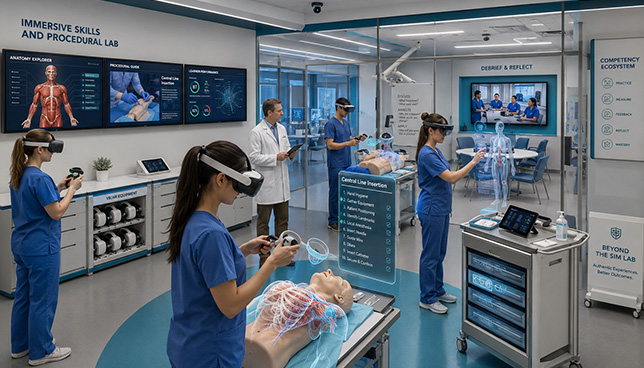 Image courtesy of Craig Park
For campus leaders, that expands the project team. Academic leadership, simulation educators, standardized-patient managers, AV/IT, facilities, architects, and privacy or compliance staff need to make decisions together before room counts and capital budgets harden. Their work is less about selecting a device than about agreeing on performance expectations: the learner experience, evidence of competency, operational capacity, and the investment needed to sustain them.
Specialize with Discipline; Preserve Flexibility Deliberately
The most resilient facilities will be neither generic nor over-specialized. They will protect the spaces that must be dependable: procedure training, standardized-patient encounters, control and support, storage, and debriefing. Around that core, they will keep the technology layer modular. Mobile XR carts, adaptable rooms, interoperable AV and capture systems, and refreshable software can evolve without having to reopen walls.
This also has an interprofessional benefit. Nursing, medicine, pharmacy, respiratory care, EMS, and allied health programs can share infrastructure when the facility is organized around common competency workflows rather than department-specific ownership. The result is higher utilization and more realistic team learning, not simply more equipment.
A practical first move is a pilot. Choose one high-value competency that is hard to deliver at scale or difficult to assess consistently. Run it through the complete experience: orientation, scenario, observation, debriefing, assessment, reset, faculty workload, and technical support. Then measure more than learner satisfaction. Track throughput, reliability, faculty adoption, assessment quality, time to reset, and the operational burden on staff. Those findings should shape the next room, the next technology purchase, and eventually the long-term facility plan.
The important shift is not from manikins to headsets. It is from a facility conceived as a collection of specialized rooms to one conceived as a living system for repeated practice, observable performance, and continuous improvement. Colleges and universities that adopt that system will be able to use AR/VR and VR-enhanced OSCEs where they add value—without allowing the technology of the moment to dictate the facility's future.