Did You Hear Me?
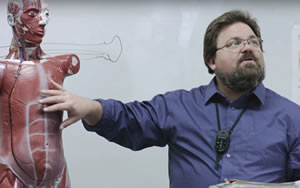
IMAGES COURTESY OF AUDIO ENHANCEMENTS, INC.
Based on gains in student achievement and teacher effectiveness many school districts across the
country now include audio reinforcing technology in every
classroom.
Most of us can relate to conferences in large hotel rooms where
the presenter fumbles with a wireless microphone questioning “Can
you hear me now?” until someone in the back of the room acknowledges
the volume is satisfactory. We have all been frustrated when a
member of the audience states a question that no one hears and the
presenter answers without repeating it. As adults we ask for presenters
to speak up, adjust equipment or repeat the question because we
are there for a purpose and the information is important to us.
Though the audience in a school classroom knows the information
is just as important, the confidence and skill set needed to
speak up and ask the teacher to do anything different is not likely
to exist. If there is background noise, if the teacher speaks in low
tones, speaks while facing the board, has an accent or talks fast, or
if some children are hearing impaired; it is possible some students
will not receive the information. Unlike adults, it is unlikely the
child will complain they cannot hear or make a request for the
teacher to repeat information they did not hear.
In the early 80’s, educational facility planners began using audio
enhancement, or sound field systems in classrooms to address
this issue. With nearly 40 years of technological innovations, the
equipment side of the puzzle has come a long way. Many districts
have long since made a decision to include audio enhancement as standard equipment for all new construction and in many
cases, all classroom spaces across the entire district. Lauren Roth,
facilities communications manager for Orange County Schools in
Florida, stated, “For several years now we have included sound enhancement
technology in in our construction specifications. As a
result, over half of Orange County’s 257 schools are now equipped
with this well-liked and simple technology.”
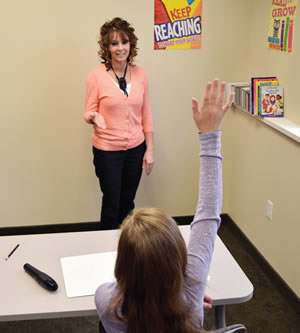
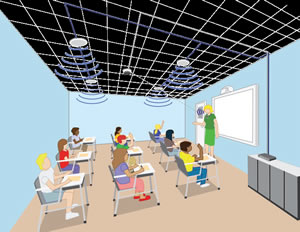
Typically a sound amplification system for classrooms consists
of a pendant worn around the teacher’s neck containing a microphone.
There is a wireless receiver that distributes the voice signal to
a number of audio speakers mounted in the ceiling throughout the
classroom. The teacher is able to speak in a normal tone of voice and
the sound is distributed evenly throughout the space. Most systems
are also capable of utilizing microphones for student use. Denton
Anderson, vice president and director of sales for Audio Enhancement
Inc., described his company as a pioneer in the industry. The
company was founded by Claudia Anderson in 1978, when she developed
sound equipment to be used in the classroom for two of her
hearing impaired sons. Since that time, product development has
seen many changes, most notably a groundbreaking move in 2000
from RF (radio frequency) to IR (infrared) technology to increase
overall efficiency with transmission of the audio signal.
Extensive research on the use of audio enhancement consistently
indicates significant benefits for education, particularly
with academic achievement and test scores. Beginning with the
Mainstream Amplification Resource Room Study (MARRS) in
1981, numerous studies have shown that aside from academic
performance there are other benefits as well. Teachers are less
likely to strain their voices during the school day as they address
the classroom in a normal tone. Because they do not have to raise
their voices to reach students in the back of the room, teachers are
perceived as less threatening. They report being less tired at the
end of the day and more efficient due to not having to continuously
repeat their statements. Having equivalent sound levels in all areas
of the learning environment reduces the need for scheduling or
seating of children based solely on their ability to hear.
Audio enhancement systems in today’s classrooms have
survived the test of time. The industry has initiated numerous
design improvements and cost efficiencies that offer a product
selection that can easily meet the school district’s design requirements
at a reasonable price. Most systems can be installed within a
price range between $1,000 and $2,000 per classroom. Equipment
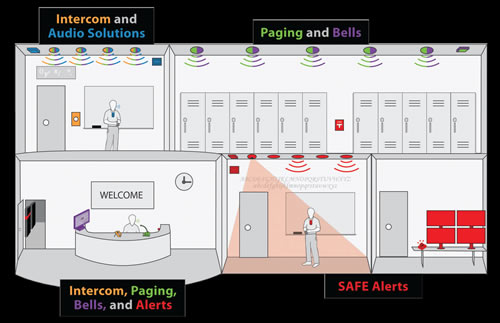
providers have developed a variety of additional features currently
available with sound amplification systems that enable the equipment
to interact with audio distribution used for other instructional
technology systems in the classroom. There is also an option
allowing a teacher to activate a duress notification to the office by
pressing a button on the pendant microphone.
Sounds good. Research on the use of audio enhancement tools
consistently indicates significant benefits for education, particularly with
academic achievement and test scores. Other benefits include the fact
that teachers are less likely to strain their voices during the school day and
that having equivalent sound levels in all areas of the learning environment
reduces the need for scheduling or seating of children based solely on
their ability to hear. Consequently, many districts have decided to include
audio enhancement as standard equipment for all new construction and,
in many cases, all classroom spaces.
One of the greatest challenges with sound enhancement is
insuring that teachers are comfortable using it on a daily basis.
There are a variety of reasons why this does not always happen.
Often, it can be as simple as whether or not sufficient training has
been provided. Once all initial adjustments have been made, it is
as simple as wearing the pendant and turning it on. Normally, it
should not be necessary to make volume adjustments since the
initial installation includes a pre-set for each individual learning space. Some teachers express discomfort
in hearing their amplified voice and have
concerns that it will bleed over to adjoining
classrooms, hallways or other spaces.
Depending on the acoustical design of the
facility, this can be an issue although it is
typically less of a problem than expected.
Sound enhancement systems are not loud.
The teacher does not have to raise his or
her voice to be heard. A normal voice tone
is simply distributed evenly throughout
the room. When operated properly, sound
amplification equipment can contribute to
a classroom actually being quieter.
It is essential for the equipment to be
installed properly and tested. It is equally
important to include a routine maintenance
and operations program for all
components. Pendant microphones are
handled frequently day in and day out. As
a result, sometimes they are damaged, lost,
or batteries become discharged and need
to be replaced. An inoperable pendant can
be stuffed into a desk drawer and forgotten,
essentially wasting the investment of the
audio enhancement system. Unfortunately,
this will allow the learning environment to
return to one where children miss out on
key information simply because they cannot
hear what is being said by the teacher.
There is another critical management
aspect to the successful use of audio enhancement
systems in classrooms that also must be
addressed. If the district has made the commitment
to purchase and install the equipment,
it is not likely that use of the equipment
was considered to be an option based on
teacher preferences. In order for the system to
be effective, it must be used. This may require
a mandate from district leadership and subsequent
enforcement by principals.
We can now easily say that sound amplification
systems for education have been
around a long time. The research is solid.
The cost-benefit analysis is higher than
most technology based classroom innovations.
Districts that have decided to equip
every classroom characterize their decision
as a no brainer. Those districts have essentially
addressed the issue of hearing in the
learning environment and are now looking
for any improvement that could yield as
good or better return on investment.
For the districts that are still wondering
if this is a good idea, maybe they need to
adjust their hearing.
This article originally appeared in the issue of .