Pittsburgh Playhouse Opens at Point Park University

The new Pittsburgh Playhouse continues Point Park University’s long tradition of historic preservation and creative reuse, incorporating two historic structures: the University Center originally designed by Frederick J. Osterling for the Colonial Trust Company, and the Stock Exchange Building, originally designed by prominent architect Charles M. Bartberger. Careful to consider the aesthetic of its location, DLR Group|WRL designers created an exterior façade that complements the Playhouse’s historic Pittsburgh, PA, setting architecturally.
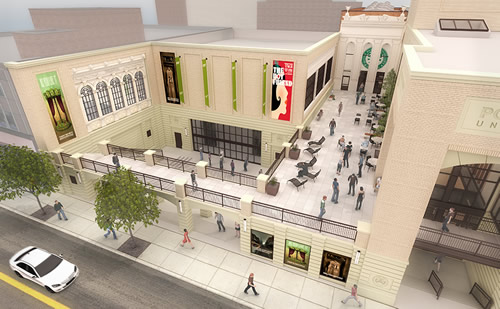
Pittsburgh Playhouse

Situated on 1.5 acres at the university’s downtown Pittsburgh campus, the 90,411-square-foot complex is a substantial addition. The project features three new theaters: a 550-seat proscenium/thrust main stage and multi-form 212-seat “transformational thea­ter,” both of which feature variable enclosures that allow each venue to play to its urban neighborhood, and a 102-seat black box venue. It also houses a sound stage, scenery shop, prop shop, paint shop, costume shop, television studio, scenic design and general classrooms, rehearsal halls, acting studios, classrooms, and faculty offices as well as public amenities such as lobbies, concessions, ticket/business office, and performer support. Other labs and shops and studios are exposed to the internal circulation system and to the street itself, communicating the vitality of making, fabrication, experimentation, and creativity.

Featured

  • Houston K–12 District Opens New Elementary School

    The Lamar Consolidated Independent School District (Lamar CISD) recently announced the completion of a new elementary school in a western suburb of Houston, Texas, according to a news release. Haygood Elementary School measures in at 110,000 square feet, has the capacity for 854 students, and is the first of three new schools scheduled to be built in the Cross Creek West community.

  • Different Starting Points, Same End Goal

    Higher education campuses can enhance student experience by implementing mobile credentials to streamline building access, on-campus payments, and access to other amenities. This enables students to connect to their campuses through the technology they use most: their mobile devices.

  • Preparing for the Next Era of Healthcare Education, Innovation

    Across the country, public universities and community colleges are accelerating investments in healthcare education facilities as part of a broader strategy to address workforce shortages, modernize outdated infrastructure, and expand clinical training capacity. These projects, which are often located at the center of campus health and science districts, are no longer limited to traditional classrooms.

  • Spaces4Learning Trends & Predictions for Educational Facilities in 2026: Part I

    We asked, you answered, and the results are in! Last year, we put out a call for submissions to collect our readership’s opinion on trends and predictions for K–12 and higher education facilities in 2026.

Digital Edition