IMETCO Launches New Line of Architectural Roof Panels

Metal product manufacturer IMETCO recently launched a new line of architectural metal roof panels, according to a news release. The Batten-Tile panels are designed for vertical walls or slopes of 3 inches or more, and they come in smooth or embossed surfaces in a wide variety of metals.
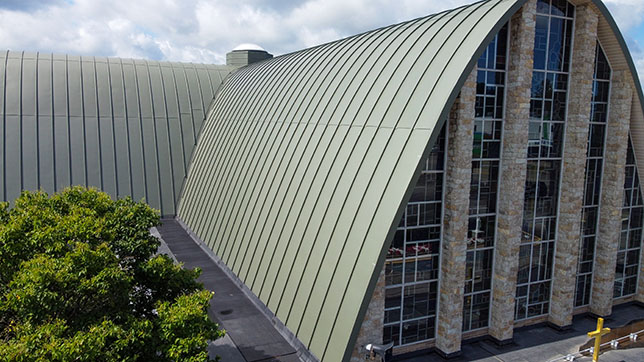

Photo courtesy of IMETCO

The batten-style ribs are 1.875 inches high and come in custom widths of up to 44.5 inches. Materials include aluminum, galvanized or stainless steel, copper, and zinc featuring either mill or fluoropolymer coatings. “With options such as conical tapers, convex, and concave curves and domes available, and panels as long as 45 feet, this versatile roofing panel is ideal for complex roofing projects with the highest aesthetic requirements,” said Jonnie Hasan, P.E., Director of Engineering and Sales Support for IMETCO.

The system meets ASTM E330 and ASTM E331 requirements, and it has been UL-tested and FBC approved, the news release reports. The roofing panels can be applied to plywood or gyp board with rigid insulation over decking. The news release does caution that installation requires appropriate IMETCO roofing underlayment per project-specific conditions.

About the Author

Matt Jones is senior editor of Spaces4Learning. He can be reached at [email protected].

Featured

  • Designing the Bridge Between Inclusivity and Independence in K–12 Schools

    Fostering independence is fundamental to learning and development for K–12 students. It offers many proven benefits, such as enhanced confidence, problem-solving, decision-making, and social skills. However, this foundational objective loses its impact if it’s not accessible and adaptable to all students. Inclusivity plays a critical role in cultivating independence and healthy autonomy for students, fostering positive student learning outcomes by uniting pedagogy with the physical learning environment.

  • Rethinking K-12 Schools as a Continuous Learning Experience

    Most students move through three or more separate facilities during their K-12 journey, yet the built environments they encounter at each stage have traditionally been designed in isolation, with little continuity in spatial language, learning philosophy, or physical resources. Each new school is a reset with different layouts, learning models, expectations, and ways of moving through a building. The next generation of school design is making the case that the first day of kindergarten and the last day of high school can and should feel connected through common support systems and infrastructure in the physical environment.

  • Minnesota District Converts Middle School into Community Hub

    White Bear Lake Area Schools in White Bear Lake, Minn., recently announced the end of a major renovation project that converted a former middle school into a new centralized district and community hub, according to a news release.

  • ed tech conference calendar

    Upcoming Awards, Events & Webinars