Nathan Bishop Middle School Makes Transformation with Help From Acentech
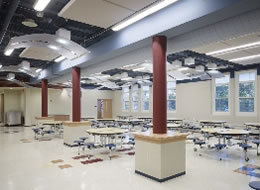
Nathan Bishop Middle School Makes Transformation with Help From Acentech 

Acentech worked with Ai3 to upgrade the acoustical standards of Nathan Bishop Middle School in Providence, R.I.

After a three year, $35 million renovation, Nathan Bishop Middle School transformed from a decaying, struggling institution into one of the most sought after public middle schools in Providence, R.I.

During the renovation, Acentech worked closely with Ai3 Architects to upgrade the original 1920s building to the acoustical standards of the 21st century. Following the acoustical goals established by the Collaborative for High Performance Schools in New England and the ANSI S12.60-2002 American National Standard of Acoustical Performance Criteria, Design Requirements and Guidelines for Schools, Acentech focused its recommendations on room acoustical treatments, sound isolation and mechanical systems noise control. We ensured that acoustical treatments, in the classrooms as well as other activity spaces (e.g. gymnasium, cafeteria and auditorium), were suitably selected and distributed in order to control the reverberation time, achieve high speech intelligibility and overall acoustical comfort.

Acentech specified wall and floor/ceiling constructions as well as door and window systems to provide an adequate degree of sound isolation between adjacent spaces. Finally, Acentech worked with the mechanical engineering team to ensure that the noise from the mechanical systems were quiet and did not have a negative effect on the learning environments.

Acentech
www.acentech.com

This article originally appeared in the School Planning & Management August 2013 issue of Spaces4Learning.

Featured

  • Building Beyond Simulation: Creating Immersive Ecosystems for Healthcare Education

    Health sciences education is one of the fastest-growing facility types in colleges and universities. The demand for medical, nursing, and allied health professionals is driving the creation and renovation of medical simulation training facilities that provide students with real-world experience through advanced simulation-based learning.

  • How Proactive Maintenance Can Transform Athletic Facilities into Strategic Assets for College Sports

    College athletics is entering one of the most transformative periods in its history. With NIL reshaping financial models and competitive expectations, athletic departments across the country are being asked to do more than ever with increasingly constrained resources.

  • Rethinking K-12 Schools as a Continuous Learning Experience

    Most students move through three or more separate facilities during their K-12 journey, yet the built environments they encounter at each stage have traditionally been designed in isolation, with little continuity in spatial language, learning philosophy, or physical resources. Each new school is a reset with different layouts, learning models, expectations, and ways of moving through a building. The next generation of school design is making the case that the first day of kindergarten and the last day of high school can and should feel connected through common support systems and infrastructure in the physical environment.

  • Georgia State University Opens New Research Tower

    Georgia State University in Atlanta, Ga., recently held a ribbon-cutting ceremony for a new, nine-story, 155,000-square-foot Research Tower, according to university news. Amenities include academic classrooms, a large lecture space, teaching labs, faculty research space, and the uppermost floors reserved for future expansion.