Flexible Music Rehearsal Environment
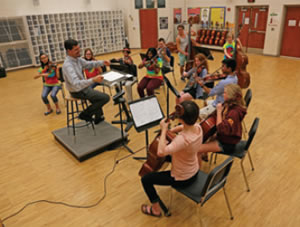
The VAE Rehearal system allows students to transition easily between rehearsal and performance environments.
“Although we're physically rehearsing in our orchestra room, the VAE Rehearsal system makes it feel like we’re really rehearsing on our stage,” says Mark Gitch, Orchestra director at Wayzata High School (WHS) in Plymouth, Minn. Wenger’s Virtual Acoustic Environments (VAE) technology enhances and accelerates music learning by creating realistic acoustic simulations of performance spaces. Wenger engineers also simulated the WHS auditorium’s acoustics with a custom setting.
Gitch believes it’s difficult for musicians to make transitions between rehearsal and performance environments. Like most high schools, the WHS auditorium has many users with limited rehearsal time available.
“Regardless of their skill level, my students notice very similar effects of the VAE Rehearsal system on their rehearsal process,” says Gitch. He appreciated how rapidly students moved beyond enchantment with the technology to listening to themselves, and to each other, differently. “While the technology is fun and inspiring, students quickly found they also worked more intelligently during the rehearsal process,” he notes.
“Students are inspired when playing in a cathedral setting, for example, but they also learn to listen differently,” Gitch comments. “In a resonant environment, they’re listening to that last note a little longer and asking themselves: ‘Is that really the tone I wanted? Is that really the pitch I wanted? Maybe I should do that again…’”
Gitch describes the beauty of the VAE Rehearsal system as threefold. First, its simplicity makes the system very easy to use. Second, the system’s different acoustic environments offer flexibility. Finally, the digital record and playback capability works with any of the nine acoustical settings – for immediate listening in rehearsal, to save for future use or to create an audition recording.
“The VAE Rehearsal system enables a smooth transition between rehearsal and performances,” Gitch concludes.
www.wengercorp.com
This article originally appeared in the School Planning & Management November 2013 issue of Spaces4Learning.