Protecting Our Children at School
It is hard to believe that it has been over a year since the tragedy at
Sandy Hook Elementary School in Newtown, Conn. As predicted, the
Sandy Hook massacre has had a profound impact on school safety
and will continue to do so for years to come. As we all know, there
were a variety of reactions in the wake of this tragedy. As the dust has
begun to settle, I believe that we are beginning to see most districts doing their best to take a common-sense
approach to school safety and security. While
the discussion regarding issues such as gun
control and mental illness will no doubt
continue to be debated across our country, I
would suggest that those of us in the field of
school security continue to look at practical
school safety strategies that can be implemented
in a reasonable period of time.
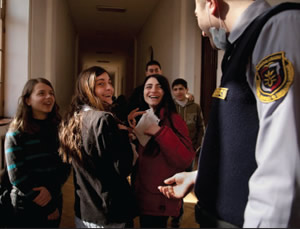
PHOTO COURTESY OF EDUCATIONGOVGE
First, placing an officer in a school is
not the only solution to safety and security.
A safe school is the result of a collaborative
effort between multiple agencies and
individuals. Every school should have a
well-written and well-practiced plan that
involves; school administration, teachers,
staff, parents, students, counselors, school
nurses, law enforcement and fire and rescue
personnel — just to name a few.
Secondly, NASRO does not advocate for
simply placing an armed guard in a school,
nor do we agree with the general idea of arming
teachers. We do, however, recognize the
benefit of a properly trained and well-selected
school-based police officer. This officer
must be the right person for the job, and it is
critical that they are trained in the ways to
properly function in a school environment.
The presence of school resource officers in
schools has become an important part of the
duty to protect children on campus. Parents
and local officials in communities around
the world enjoy an effective relationship with
local police as part of a school safety plan.
Statistically speaking, the effectiveness of
school resource officers is firmly established.
For example, in America, school crime
is down: incidences of school-associated
deaths, violence, nonfatal victimizations and
theft have all diminished since local police
began partnering with school officials. Once
schools are made safe, the campuses tend
to stay safe. Even juvenile arrests go
down, falling nearly 50 percent during
the period of expansion of School
Resource Officer (SRO) programs.
Speaking as a practical matter, the
presence of local police on campus is
essential. The specialized knowledge of
the law, local and national crime trends
and safety threats, people and places in
the community, and the local juvenilejustice
system combine to make police
critical members of schools’ policymaking
teams.
In order to fully realize the benefits
of the presence of local police, the officers must be trained properly. Officers’
law-enforcement knowledge and skills
combine with specialized SRO training
for their duties in the education setting.
This training focuses on the special nature
of school campuses, student needs
and characteristics, and the educational
and custodial interests of school personnel.
SROs, as a result, possess a skill set
unique among both law enforcement and
education personnel that enables SROs to
protect the community and the campus
while supporting the educational mission.
In addition to traditional lawenforcement
tasks, SROs’ daily activities
can include a wide range of supportive
activities and programs.
Trained and committed police officers contribute to the safe-schools team
by ensuring a safe and secure campus,
educating students about law-related
topics and mentoring students as counselors
and role models.
Over the last 23 years, The National
Association of School Resource Officers
has become the world leader in school
based policing.
This article originally appeared in the issue of .
About the Author
Mo Canady is the executive director of NASRO (National Association of School Resource Officers.)