Collaborating with Technology
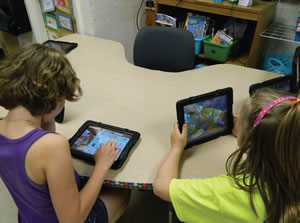
PHOTO COURTESY OF TSP, INC., GARY SABART
Technology is now so pervasive in our schools that students use it with little or no instruction from adults. Kids today are open to technology, and in fact, expect technology-rich environments. Even when schools are already equipped with media centers, students often prefer to congregate around power outlets in the corridor. More and more, they are using virtual libraries instead of printed books and they appreciate the ease of sharing materials quickly. For example, they can take digital photos of a board or worksheet and send them to others who were out sick or who simply overslept.
Two of the most promising new methodologies now being explored in schools are the reverse lecture format and project-based learning, both which shift the role of the teacher to the periphery as a collaborator/mentor. In the reverse lecture methodology, kids view a lecture at home, and when they are at school, teachers act as facilitators, helping students to work together. In other words, they have a peripheral role. In project-based learning, kids learn by doing with guidance to explore concepts at greater depth.
Students can ask questions of others in their group instead of struggling through the questions at home by themselves or with parents. Teachers can work one-onone, or they can group similar students together for productive interaction rather than passive listening and note taking. In rural districts where kids spend hours on the bus, Wi-Fi equipped busses could allow them to watch the lecture on their way to or from school.
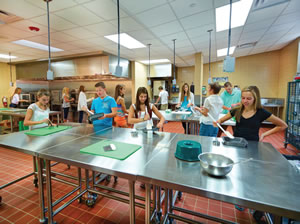
PHOTO COURTESY OF TSP BY RICK PETERS, INSIDEOUT STUDIOS, EDEN PRAIRIE, MN
An Extensive Menu. Project–based learning can create the opportunity for students to learn by doing with guidance to explore concepts at a greater depth. In addition, with some creative thinking, learning projects can be designed to include several components — language, science, art — making the subjects more relevant.
Both reverse lecture format and project-based learning require front-end work—specifically, a time investment in staff development to acclimate faculty to the new method. Technology allows educators to focus less on what’s on the desk or held in the hand and more on the people who are going to implement it. Nevertheless, these changes that support these methodologies will be gradual. Every year the early adopters can push a little further against the comfort level of the late adopters and of the district as a whole.
Technology refactors the use of energy and space
The paradigm is moving away from one room and one teacher. A typical project-based environment might include 50 students and two teachers in a large room or adjoining rooms, in which the curriculum and skills are mixed. Schools can reduce their ecological footprint if large lecture halls are replaced with smaller collaborative spaces, reducing costs for construction, operation and maintenance. If high schools can offer online college courses in the building, their students will be less inclined to leave the campus during their senior year to take these courses elsewhere.
As an example, consider how a project-based curriculum would present a consumer education program. The overall goal is to help a family prepare a healthy meal that is both cost-effective and aesthetically pleasing. Large rooms would provide full lab spaces for preparing appetizers, veggies, meats, and desserts. Students could design menus and learn to observe dietary restrictions. The art teacher would help them to use software such as InDesign, to create the menu. There can be a foreign language component in which students learn about Spanish or Chinese cuisine. As they cook, they could also learn about chemistry. When bringing the finished recipes to the tables, they would use an artistic component for the presentation of each course. The lab space would no longer be held hostage to what a teacher can cram into 35 minutes. Instead, the teacher might have two back-to-back periods to create the integrated, collaborative setting.
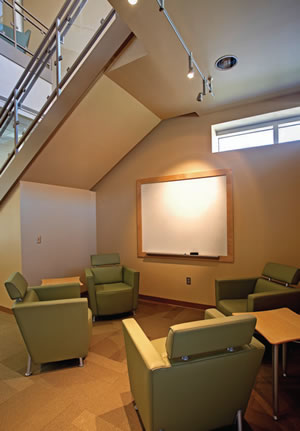
PHOTO COURTESY OF STEVEN BERGERSON, BERGERSON PHOTOGRAPHY, 3349 45TH AVE S, MINNEAPOLIS, MN, WWW.BERGPHOTO.COM
An ideal union
The high school student union of the future will provide opportunities for group work spaces, “dirty” as well as “clean.” Here, dirty refers to messy projects, such as those involving gluing paper or the use of water or chemicals. In the union the kids could sit in huddles of three to five, working on a presentation together. Outlet fixtures for multiple users would be installed following the examples of hotels that use long counters with accessible outlets running down the middle at bar height. Resources and support staff would be accessible within the space or in an adjacent space. Ideally, the union would also contain collaboration spaces and small conference rooms for meetings with outside mentors. Some of those ideals are already in practice at Kingsland High School, Spring Valley, Minnesota.
The Kingsland student union incorporates Smart boards and tall (bar height) seating to accommodate students sitting or standing. One wall is covered in marker boards for students to brainstorm and diagram ideas. Small rooms accommodate collaboration with outside mentors such as doctors and engineers. As the role of furniture, fixtures and equipment increases and more and more guides the use of a classroom, the role of architecture is diminishing.
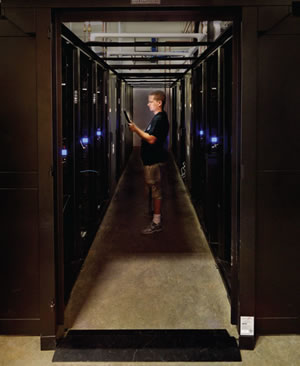
PHOTO COURTESY OF TSP BY RICK PETERS, INSIDEOUT STUDIOS, EDEN PRAIRIE, MN
Real-World Education. By using the reverse-lecture format and project-based learning, educators are able to focus less on what is on the desk and more on the people who are going to be using the knowledge. For these methods to work effectively, districts need to invest in staff development.
Small schools, like Kingsland, are forced to be more innovative in using limited staff and space efficiently. Because they are competing for every student they get, they are more willing to be innovative. On the other hand, larger districts are not as focused on flexibility because they have so many students. They may already have some of these technology spaces, but they aren’t using them in the same creative way. It’s much easier to get a smaller district on board with these changes because they have to be more flexible and accept different scenarios.
While it is true that technology excites kids, and their engagement in their own education goes up in these types of environments, schools have to control the use of computers and related technology; they can’t just set it up and walk away. Managing schedules when some students have a five-period day and some have a seven-period day can be difficult, as can integrating local business mentors and college course work. Therefore, moving to a reverse lecture format requires a multi-year solution. Project-based learning spaces are becoming increasingly popular and are here to stay.
This article originally appeared in the issue of .