The Future Is Now
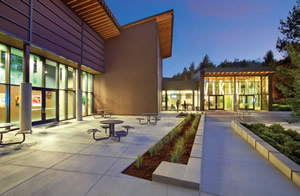
PHOTO COURTESY OF LPA INC./COSTEA PHOTOGRAPHY
For students lucky enough to attend a newly-constructed school, 2014 was a good year. As architects and educational facility planners, we are seeing an increasingly dynamic marriage between project-based learning and 21st-century learning environments that support collaboration through advanced flexibility and technology. In fact, the incorporation of 21st-century or Next Generation elements in our new educational facilities is more than a trend — it is quickly becoming ubiquitous. Imagine how powerful the experience is for teachers and students when the educational environment not only supports, but enhances the educational process; when the space becomes integral to the excitement of learning.
Conversely, imagine the frustration of students and teachers fighting the built environment, unable to effectively collaborate or work in teams because the building is in the way. In our nation’s older school buildings, facilities and curriculum are often out of step. In 1999, the National Center for Education Statistics estimated that the average age of America’s school buildings was 40 years old. In many of these buildings, the delivery of education has evolved dramatically. For the development of many 21st-century skills, project-based learning is an accepted best practice. Students and teachers use tablets, and 1:1 programs are becoming more prevalent. However, in many cases, the buildings remain the same.
With the economic challenges of the past five years, and the continued funding challenges facing many school districts, it is easy to justify waiting on educational facility improvements. We wait until the economy improves. We wait until new revenue streams arise. We wait for a successful bond issue or referendum. But as we wait, the physical environment that our students inhabit becomes more of a hindrance with each passing day.
As a community and as a nation, we seem to accept the need for school renovations related to “warm, safe and dry” issues. Security improvements are, understandably, at the top of nearly every school board’s list of priorities. Renovations aimed at capturing energy savings are more popular than ever. All of these improvements make sense. But if we agree on the premise that educational environments can significantly impact learning outcomes, do we not also have a responsibility to make sure that all educational facilities are capable of supporting a modern and collaborative approach to learning?
The year 2015 should be a time of doing, not waiting. School districts, private schools and other educational organizations must become aware that creating an environment conducive to project-based learning is not necessarily an expensive proposition. One doesn’t need to build a new building to implement change. In fact, some of the most creative and widely acclaimed school construction projects in recent memory have involved the transformation of outdated learning environments through cost-effective means.
For a minimal investment, you can easily renovate underutilized space to create an Information Commons or various project zones. In new schools, planners and designers turn corridors and commons areas into collaboration venues. In existing buildings, achieving the same impact can be as simple as an imaginative use of appropriate furnishings in some available space. Get creative, and create new space!
By focusing on creative solutions, we eliminate the psychological roadblock to change in our physical environments. Too often, we accept our old buildings as an excuse for inaction. But whether we are teachers, facilities directors or architects, we are all problem solvers at heart. Through creativity, resolve and collaboration, we can turn even our oldest educational facilities into agents for change. Let’s start the conversation. We might be surprised how fast we can make an impact.
This article originally appeared in the issue of .
About the Author
Dan Mader, AIA, CEFP, LEED-AP, is chairman of the Council for Educational Facility Planning International (CEFPI) and president and CEO of Fanning Howey Associates.