Trending Today
We’ve all had shelves filled with three-ring binders collecting dust. Our firm had them too. We’ve produced hundreds of facility-planning reports during the past 20 years. Today, our shelves hold servers that house the reports and the websites we’ve created for clients. The trend makes perfect sense: Districts are moving away from paper reporting and toward website reporting.
Back in the day, a paper report served as a single, comprehensive resource for all district stakeholders — from board members, superintendents and facility directors to parents, students, teachers, staff and community members. The inherent limitation of paper reports is obvious: They are only accessible to those who obtain copies. Reports-as-websites are better for all parties. Districts don’t have to spend valuable time and money copying reports or archiving them. Instead, stakeholders can access whatever information they want 24/7/365.
A well-conceived website clearly marks the information relevant for different stakeholders so they can go directly to the information they need, bypassing the information they used to sift through in a paper report. A good website includes an executive summary and an appendix full of detailed data.
Historically, we’ve provided project websites for our clients, and we still do. The difference today is that an updated website can double as the final report, with all the information contained within. We talk with our clients to determine whether they prefer our team create their websites or help their communication teams create them. Some clients want us to create, host and manage their websites, while others want to own the process. We send them data and information to populate their sites.
The placemat as report
PDFs are the new paper. Our firm summarizes a district’s report in a two-sided 11x17 placemat format that lets stakeholders quickly scan a single document to gain a high-level understanding of the project’s process and findings. An online appendix accompanies the report with all details.
The images on this page represent the front and back of a placemat. They highlight background information and processes used to make decisions; benefits and challenges associated with decisions, stakeholder feedback and a timeline of next steps.
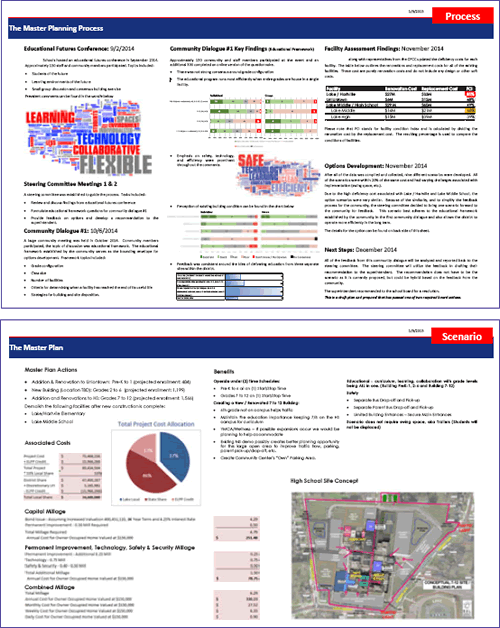
A two-sided 11x17 placemat enables district stakeholders to quickly scan a single hard-copy document to gain a high-level understanding of the facility-planning project’s process and findings.
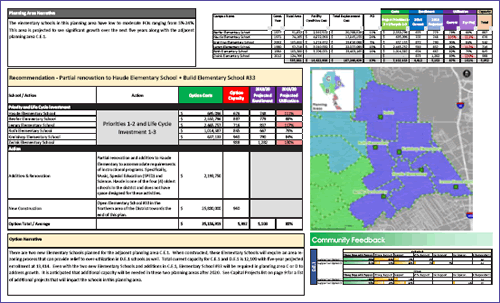
This is a planning area narrative for a different school district. It resides in an online appendix that accompanies a website featuring a facility planning report.
This article originally appeared in the issue of .
About the Author
David Sturtz has more than a decade of experience as a teacher, administrator, educational entrepreneur and strategic planner. He has overseen the instruction of thousands of students, and he has hired and managed hundreds of teachers and supplemental instructor. Today, David serves as a project director for DeJONG-RICHTER a leading school facility planning firm. Both David and the firm are members of the Council of Educational Facility Planners International (CEFPI).