University of Florida Health System Breaks Ground on New Specialty Tower
GAINESVILLE, FL — UF Health broke ground on Friday, January 23, 2015, to construct a new specialty tower that will house two new hospitals — UF Health Heart & Vascular Hospital and UF Health Neuromedicine Hospital.
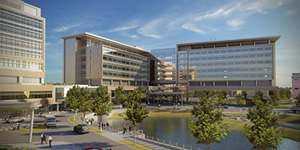 Planned and designed by Flad Architects, the 538,000-square-foot tower will be constructed on UF Health’s south campus and connect to the existing UF Health Shands Cancer Hospital, also designed by Flad. The addition of the hospitals will accommodate UF Health’s ability to provide customized care for the increasing volume of patients with neurologic, neurosurgical, heart and vascular conditions.
Designed to be patient- and family-centered, the tower will house 96 private acute care beds, 20 operating rooms, 120 intensive care unit beds, 78 clinic exam procedure rooms, diagnostic testing and imaging, pre- and postoperative and PACU areas, multidisciplinary outpatient clinics, catheterization lab facilities, cardiac and neurological rehabilitation, hybrid operating rooms and an intraoperative MRI.
“These two new hospitals reflect the goals outlined in our strategic plan, to offer our patients a continuum of compassionate care that will address their cardiovascular and neurologic needs throughout their lives,” says David S. Guzick, M.D., Ph.D., president of UF Health and senior vice president for Health Affairs at the University of Florida. “While we already provide state-of-the-art care to these patients, the two new hospitals will provide a healing environment that revolves around our patients, one location to address everything from outpatient visits and easy access to laboratory tests and imaging to complex surgeries and follow-up care.”
“With the goal of putting the patient first, the combined facilities will provide inpatient and outpatient care in one integrated facility that will offer an unparalleled care setting for the patients and families who seek treatment at UF Health,” said Laura Stillman, principal-in-charge, Flad Architects.
Full-scale, mock-up patient rooms were built in a nearby warehouse to allow staff to simulate work processes and provide live feedback during the design process. The final result is a standard patient room that is zoned into sections dedicated for patient care, family, and caregivers. It provides patients and families with comforting accommodations while giving physicians and healthcare professionals the opportunity to do their best work.
Construction will be completed in the fourth quarter of 2017 and will open for patients in early 2018.
About Flad Architects
Flad Architects (www.flad.com) serves world-class healthcare, academic and research institutions in the U.S. and around the globe.
About UF Health
University of Florida Health (www.ufhealth.org) is the Southeast’s most comprehensive academic health center encompassing the University of Florida Health Science Center and the UF Health Shands and UF Health Jacksonville family of hospitals and services. Our mission is to promote health through outstanding and high-quality patient care; innovative and rigorous education in the health professions and biomedical sciences; and high-impact research across the spectrum of basic, translational and clinical investigation.