Outdoor Environments
PHOTOS © SCOTT BERMAN
“It’s been a long wait, but it’s finally finished,” said fourth-grader Seada Torres in a well-delivered speech at the opening of a state-of-the-art, environmentally friendly playground at her New York City school.
Students, school, city and other officials were on hand last June for the ribbon cutting of a playground project that has turned an asphalt lot divided by a fence into an oasis of play and plants on the campus of The School of Science and Applied Learning, CS 300, in the Bronx.
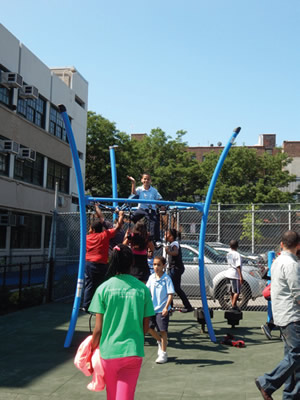
It was an inspiring event — in part because of the fact that many youngsters at the school, like their classmate Seada, provided ideas and worked with designers about what they wanted in their playground, even visiting other schools to see options. And once the speeches were delivered and the ribbon cut, boys and girls instantly and gleefully began the most important activity of the day: play!
The playground is the result of a $1,063,000 project spearheaded by the Trust for Public Land (TPL), which has remade 185 playgrounds for schools and neighborhoods in New York City during the past 20 years, in addition to projects elsewhere in the USA. Funding came from several city agencies and the MetLife Foundation — of that total, $333,000 went toward design and $730,000 for construction, according to TPL.
Like other TPL projects, the approach at CS 300 is synergistic, creating opportunities in terms of education, recreation, the environment, neighborhood beautification and school-parent relationships. Officials described a process in which the trust, city agencies, the school, parents, the community and schoolchildren all worked together to create the pristine playground, which as TPL describes, has “basketball hoops, a turf field, a running track, play equipment, safety mats, a drinking fountain” as well as naturethemed informational signage and art.
It’s a telling sign of a greater outdoor presence at many schools: Playgrounds, gardens and outdoor classrooms are gaining new features and uses, all signaling a long interest in the pursuit of more wellness activities and hands-on educational experiences. In particular, there is a proactive interest in utilizing school grounds to teach, learn and help the environment in tangible ways.
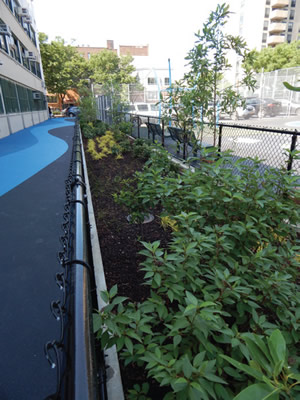
For example, the CS 300 campus and its surrounding Tremont neighborhood of the Bronx are located in the Bronx River Watershed, points out Mary Alice Lee, director of TPL’s New York City Playgrounds Program. The river has been the focus of ecological restoration efforts for some time, and the new CS 300 playground will aid in that effort by capturing as much as 700,000 gallons of storm water runoff annually, a TPL news release says, by using “green infrastructure elements such as bioswales, a rain garden and specialized plantings.”
PHOTOS © SCOTT BERMAN
As for playground equipment generally, the need for safety is a constant, along with age appropriateness and accessibility for youngsters with disabilities. With more outdoor presence comes the need for furnishings, and manufacturers have responded along a wide spectrum that includes tables and benches sized for elementary school youngsters, bright colors, recycled materials and robust products designed to stand up to weather and lots of use.
Playground equipment, whether or not it does those things, inherently expresses the culture of the school and district. For example, there’s an attractive molecule-themed play structure on the grounds of a Green Bay, Wisconsin school: Apropos in that the school is Leonardo da Vinci School for Gifted Learners.
Broadly speaking, there are running themes of the importance and joy of play and physical fitness, vivid colors and imaginative forms, interactive technologies built into play equipment, and inspiration. Among others, BCI Burke, Gametime, Keystone Ridge Designs, Landscape Structures, Little Tikes Commercial, Pilot Rock, Playworld, R.J. Thomas Manufacturing and Victor Stanley have all been active in this area.
There are many approaches. In one initiative, Gametime, for example, and supplier Sinclair Recreation worked with the NFL’s Indianapolis Colts and local volunteers and companies to construct school playgrounds in Indianapolis, most recently at Floro Torrence Elementary, where a facility was put together in one day, according to a company news release. The event generated local publicity, as well.
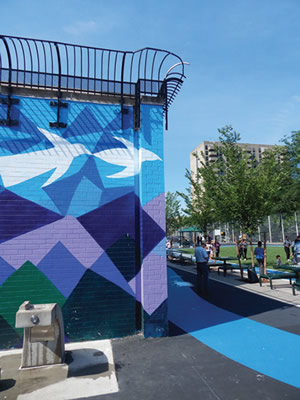
Local media also was on hand at the CS 300 ribbon cutting, with the pristine grounds in view along with a striking backdrop: a mural that in another initiative — including a lead artist and with input from youngsters — was painted on the school building. That 2014 project provided additional collaborative learning opportunities with a tangible outcome: a nondescript school façade has become a bold, vivid work of art.
TPL initiatives continue elsewhere. The School District of Philadelphia plans to spend $5 million through 2020 to remake 20 schoolyards — the move follows a pilot program with TPL, according to local news coverage. In Newark, N.J., a playground at Lafayette Street Elementary is now being transformed by TPL, city and law enforcement officials and local activists, including alumni, a state Green Acres program and two foundations, the PSEG Foundation and the Helen and William Mazer Foundation.
PHOTOS © SCOTT BERMAN
Over the years, various other projects at and with schools have unfolded, highlighting not only very different settings, but also the longevity of the program, which started in 1972. For example, Santa Barbara County in California, Midland School officials worked with TPL and county Land Trust officials to secure with a conservation easement a large nature tract —long the site of school trails and various outdoor lessons. Other projects have unfolded in Florida, northern California and elsewhere.
In the Bronx, officials expect the new playground to be a busy site for sport and play for the entire neighborhood. After all, “the more positive uses you have in a park, the less negative uses,” adds Lee. And by its very presence, the playground sends a signal. As Singleton adds, “It’s a really good lesson to teach our kids that your dream can come true.”
Some suggestions about activating a playground initiative with outside support:
- Build a local network of parents, neighbors, and community groups. Reach out to experts as well, such as nonprofit organizations that can help guide local volunteers.
- Open your playground to community use during off-school hours and weekends. With community input, design it and set policies and hours accordingly.
- Share your ideas, and seek new ideas, from local officeholders and businesses, both of which may have leads about potential sources of public and private funding as well as volunteers.
- Talk with your internal experts, such as custodians. They will likely have insights about playground materials that will stand up to the outdoors and daily use. Along that line, select playground trees, shrubs and plants that are not going to drop fruit and create maintenance problems.
- Be bold. In other words, “think outside the box,” Singleton says, “to keep the energy going and to come up with new possibilities.”
- Tell your story. Share your good initiative with local media. It will generate awareness and interest.
See the Trust for Public Land’s website: www.tpl.org.
This article originally appeared in the issue of .