Managing and Understanding Mining Bees
 As spring is upon us, trees and
flowers are in wide bloom. Along with
mother-nature taking its course and
the vegetation coming back to life from the
winter’s sleep, many other creatures also begin
to stir to get ready for spring and summer.
Mining bees, also known as andrenid bees,
are prevalent all over the country at this time
of the year. The harmless bees can inhabit large ground spaces
and can be found in very large numbers. It is not uncommon to
see thousands of mining bees in or around school grounds. As
this type of bee is very important to the environment and to the
process of pollination, it is important to educate the school staff
and children that often may be intimidated by mining bees.
As spring is upon us, trees and
flowers are in wide bloom. Along with
mother-nature taking its course and
the vegetation coming back to life from the
winter’s sleep, many other creatures also begin
to stir to get ready for spring and summer.
Mining bees, also known as andrenid bees,
are prevalent all over the country at this time
of the year. The harmless bees can inhabit large ground spaces
and can be found in very large numbers. It is not uncommon to
see thousands of mining bees in or around school grounds. As
this type of bee is very important to the environment and to the
process of pollination, it is important to educate the school staff
and children that often may be intimidated by mining bees.
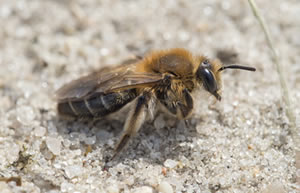
A mining bee is about a quarter inch long. They have a black
abdomen with white and yellow body hair. They occupy all sorts
of land masses that include ball fields and adjacent areas around
schools. The mining bee is a bee that burrows into the ground
to construct their nests. These nests are built into mound like
structures that may resemble ant nests. The volume of these bees
in an established area can be overwhelming. The first instinct of
the person that sees these bees around the ground is that they will
be attacked or the bees will sting them. The female mining bee
digs the burrow to house their offspring. The mining bee is very
active for only about six to eight weeks. When active, the bees often
swarm low to the ground. Due to the volume of the bees, people get
very excited and think they will be stung, especially students. It is
very important to educate the
students and staff at schools
where these bees may occupy
ground space. Providing education
and understanding of
their function is important.
As these bees are important
to the ecosystem, it is
important to provide tolerance
for this precious commodity.
This acknowledgement should
be a major influence on the
educational piece for schools. Students and staff should be
made aware that these native
bees are very important pollinators. They should also be informed
that they are not a serious pest issue. They are only active for
several weeks and then they disappear. Once they complete their
life cycle, they will not appear again until the following year. It
is not recommended to exterminate these bees as they are very
gentle and docile insects which are very unlikely to sting. During
the time of activity, there are ways to educate students and staff, as
well as other visitors to the school.
 The use of signage and informational tools are a great way to
make the public aware of these bees. It can be very difficult to
gather or hoard these bees. It may be very difficult to manage them
during their active times of the year as well. If there is a desire for
assistance for your school division, a professional insect or bee
removal company should be consulted for this purpose. Pesticides
should be a last resort as they are detrimental. This can wipe out
an already decreased population of this type of species of bee.
Pesticides sprayed around school areas are often not practical and
may be toxic to the environment and to the children playing in
these areas. Awareness and toleration may be the best option.
The use of signage and informational tools are a great way to
make the public aware of these bees. It can be very difficult to
gather or hoard these bees. It may be very difficult to manage them
during their active times of the year as well. If there is a desire for
assistance for your school division, a professional insect or bee
removal company should be consulted for this purpose. Pesticides
should be a last resort as they are detrimental. This can wipe out
an already decreased population of this type of species of bee.
Pesticides sprayed around school areas are often not practical and
may be toxic to the environment and to the children playing in
these areas. Awareness and toleration may be the best option.
Children can be easily influenced and swarming bees can
be alarming at first site. It is important to educate and reassure
students and staff about this type of bee. The working habits of
the mining bee are quite unique and they truly can be described
as worker bees. If your school grounds are inhabited with this
pollinating bee, share the space with them. The environment appreciates
it. As the honey bee population continues to decrease, the
work of the mining bee continues to be very important. Education
is the key and keeping the students and staff informed is essential
in being good stewards of the environment and the ecosystem.
This article originally appeared in the issue of .
About the Author
John A. Bailey, Ph.D. is the director of School Plants for Chesapeake Public Schools and a National School Plant Managers Association board member, representing Virginia, and a Virginia School Plant Managers Association board member, representing Region II, in Virginia.