Active Seating Boosts Student Focus
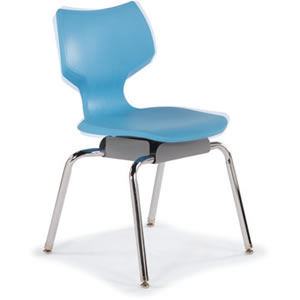
Smith System’s Flavors Noodle chair helped to reduce fidgeting
and enhance student focus at Central Avenue School.
A sharp rise in the global rate of pediatric ADHD cases has
motivated schools to find better solutions
for student seating. That includes Central
Avenue School (CAS), a pre-K through
fifth-grade school of 500 students within New
Jersey’s Madison Public School District.
Megan Kelly Petersen, a CAS occupational
therapist, had observed a common denominator
at the school: students who struggled
to sit still, stay focused and hone their fine
motor skills, like writing. Often, students
were sitting with poor posture and continually
fidgeting. She could see how the school’s
predominant one-size-fits-all seating — a
hard, traditional shell on four legs —
wasn’t working for many students.
“Traditional chairs tend to facilitate a
posterior pelvic tilt and, therefore, a slouched
posture. This impacts students’ breathing,
vision and fine motor skills.”
Peterson found a better option with
Smith System’s Flavors Noodle chair. The
“active seating” chair features a patented
suspension below the seat pan that allows it
to tilt slightly in all directions, moving with
the student. It provides comfort, back support
and promotes core muscles use. In fact,
studies show that academic performance
improves when students can move naturally
(i.e., fidgeting and shifting) while learning.
CAS added 30 Noodle chairs last year.
Though the sample was small, nearly 90
percent of the teachers agreed the chairs
increased attention span. Among students,
100 percent said the chairs helped them
focus. The chair’s success will likely lead to
a larger purchase this year.
Many students need modifications to
fully access their education, says Petersen.
“When purchasing furniture, schools must
consider attention level, movement seeking
amount, muscle tone/muscle strength,
posture, fine motor skills, length of sitting
time and work expectations.”
www.SmithSystem.com
This article originally appeared in the issue of .