Better Classroom Security for Safer Schools
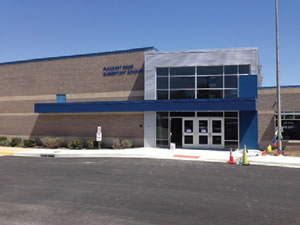
CLassroom Security

Olathe Public School District made their schools safer and more secure by replacing multiple brands of locks on classroom doors with Schlage locks and the Everest 29 key system.

The Olathe Public School District in Kansas is improving classroom security and simplifying key control by replacing multiple brands of locks on classrooms doors with Schlage locks and the patent-protected Everest 29™ key system.

With 40+ schools, the school district was using key systems from three different manufacturers, making key control difficult.

Challenges included:

  • Limited support and expansion: manufacturers no longer supported some systems, while others had reached their capacity.
  • Overexposure: Some of the key systems had been in place so long that it was difficult or impossible to know who had keys.
  • Maintenance: Upkeep was also troublesome with so many key systems to maintain.

The district wanted to implement door hardware products and a consistent key system across the district that allowed for increased control and more effective maintenance.

The school district chose Schlage mortise and cylindrical lock products and a patent-protected Everest 29 key system because of its many benefits, including:

  • Patent protection: The key system provides patent protection against unauthorized duplication through 2029, so the district will be able to maintain effective key control with confidence.
  • Ease of rekeying: All locks are Schlage with full-size interchangeable cores, which simplify rekeying.
  • Classroom security functionality: The Schlage L-Series mortise locks and ND-Series cylindrical locks used include a classroom function that allows teachers to lock the door from within the classroom during an incident.

Most of the locks being upgraded are on classroom doors, the district also is replacing locks on other openings.

www.allegion.com

This article originally appeared in the issue of .

Featured

  • Rethinking K-12 Schools as a Continuous Learning Experience

    Most students move through three or more separate facilities during their K-12 journey, yet the built environments they encounter at each stage have traditionally been designed in isolation, with little continuity in spatial language, learning philosophy, or physical resources. Each new school is a reset with different layouts, learning models, expectations, and ways of moving through a building. The next generation of school design is making the case that the first day of kindergarten and the last day of high school can and should feel connected through common support systems and infrastructure in the physical environment.

  • Spaces4Learning Announces 2026 Product Award Winners

    Spaces4Learning has just announced the winners of the 2026 Product Awards! The award program spotlights outstanding product development achievements of manufacturers and suppliers whose products or services are considered to be particularly noteworthy in their ability to enhance K–12 and higher-education learning environments.

  • Wold Completes Geothermal Projects at Two Minnesota Schools

    Wold Architects & Engineers recently announced that it has completed two geothermal expansion projects for Mounds View Public Schools in Shoreview, Minn., according to a news release. The work at Highview Middle School and Irondale High School serves the district’s long-term goal of reducing energy costs and dependency on non-renewable fuel sources, as well as improving building performance.

  • Cal Poly Humboldt Starts Construction on Healthcare Education Hub

    California State Polytechnic University, Humboldt in Arcata, Calif., recently announced that work has begun on a renovation project that will turn the Stewart Building into a new Healthcare Education Hub, according to a news release. The university is partnering with Sundt Construction Inc. for construction services.