Synced Clocks Keep Everyone on Same Page
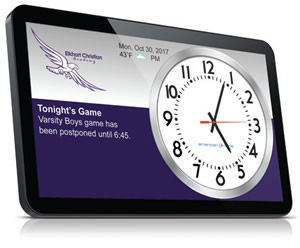
American Time’s EverAlert synchronized clocks keep every student and staff member on the same schedule and make sure classes and events always start on time at Elkhart Christian Academy.
Elkhart Christian Academy was struggling with wall clocks that didn’t stay in sync. This caused class times to start early or end late, and maintenance staff was frequently called to adjust clocks. For example, during daylight saving time (DST) changes, someone worked over the weekend to adjust the clocks, which then took 24 hours to sync.
The school was considering American Time’s synchronized clock technology when it also learned about EverAlert, American Time’s three-in-one communications platform. Elkhart realized this comprehensive solution would solve even more of its operational challenges.
The EverAlert platform and wall-mounted display units function as three systems in one: An emergency notification system that shares clear and timely information during threats; a message system that displays news and tailors it by audience; and a synchronized clock system that ensures everyone is on the same time.
Elkhart installed EverAlert in each classroom and several common areas. As a result, students and staff are kept on time and maintenance spends less time on clocks because they are in sync and automatically update for DST.
When fire, tornado, or lockdown drills occur, EverAlert’s visual display helps clearly identify the alarm type so teachers and students react more quickly.
Daily announcements specific to the elementary, middle, or high school are displayed on the appropriate EverAlert unit in each classroom. Teachers can also post their own classroom-specific messages.
Ryan Pease, tech support at the Academy, notes, “The teachers really like receiving daily messages on EverAlert without having to check email. It gives teachers advanced notification and they like that…We’ve really come to rely on EverAlert for many things.”
www.american-time.com
This article originally appeared in the issue of .