West Chester University of Pennsylvania: Commonwealth Hall
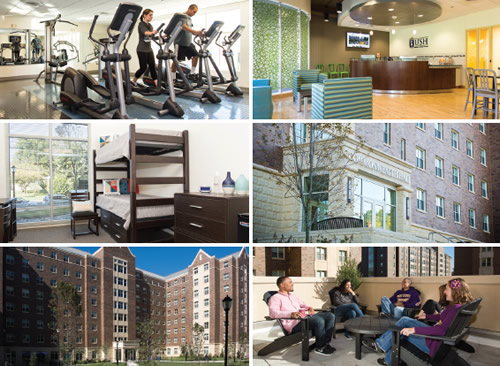
PHOTOS © GREYSTREET PHOTOGRAPHY, SHELLIE FERGUSON
Commonwealth Hall at West Chester University of Pennsylvania (WCU) opened in 2015 as the second phase of the school’s Housing Replacement Initiative. West Chester sought to improve the quality of their student housing options while increasing the available beds to allow an increase in enrollment. At the same time, it was important that the new development feel as though it belonged within the existing campus context.
Designed by Voith & Mactavish Architects LLP, in association with WTW Architects, its aesthetic is a blend of Classical and Gothic Revival architecture at a scale that complements the existing historic campus buildings as well the adjacent residential neighborhood. The exterior, comprised mostly of brick but with buff stone accents, was carefully designed to reflect the scale, color tone, and fenestration patterns of the campus’s historic buildings. Nevertheless, the systems and materials are entirely modern: geothermal heating and cooling, a latent heat recovery system, and high-albedo roofing are just some of the building’s sustainable elements that also help minimize operating costs.
The interior blends form and function to deliver a true living/learning community that accommodates a variety of programming: a yoga and fitness studio, separate study and social lounges on each floor, free laundry facilities, a central multipurpose lounge, full kitchen and vending area, and the WCU Health & Wellness Center. It also houses the University Student Housing (USH) leasing office on the ground floor. The 651-bed community, open to all academic levels, is managed by USH, an entity created by the school’s nonprofit WCU Foundation for the express purpose of managing their new high-end on-campus housing. Rooms are divided between private and semi-private suites with semi-private bathrooms, all of which require card swipe entry, and feature generous windows overlooking a new quad created between dormitories built during the previous phase of development.
This article originally appeared in the College Planning & Management January 2018 issue of Spaces4Learning.