Construction Begins on Connecticut High School

Construction is underway for the new Ella T. Grasso Technical High School in Groton, Conn. The 226,000-square-foot facility, designed by Moser Pilon Nelson Architects, is being built on a parcel contiguous to the existing technical high school. When the school opens for the 2019-20 school year, the existing facility will be demolished to make room for future athletic fields and facilities.

“We are very excited to have construction underway after more than a decade of planning efforts,” says Richard B. Brown, AIA, principal-in-charge of the project. “The new building will enable the student enrollment to grow to over 800 students and to do so in a facility with instruction in a dozen skilled trades.”

The $98-million project is scheduled to be completed in June of 2019. Moser Pilon Nelson is based in Wethersfield, Connecticut.
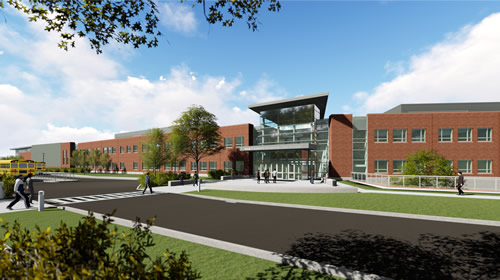
Ella T Grasso High School

Featured

  • Academy of Classical Education Breaks Ground in Louisiana

    Charter Schools USA (CSUSA) recently announced the groundbreaking of a new public charter school in Covington, La., according to a news release. The Academy of Classical Education at Covington will enroll students in grades K–8 and is scheduled for completion in August 2026, just in time for the new school year.

  • Rowan University, HPE Partner on New Learning Initiative

    Rowan University in Glassboro, N.J., recently announced that it has expanded its partnership with enterprise technology provider HPE to improve research capabilities and hands-on learning opportunities, according to a news release.

  • Children walking along bright school corridor with motion blur

    How Next-Gen Design Is Reshaping the Student Experience

    The environments where students learn play a crucial role in shaping their growth in and out of the classroom. By centering design on well-being, flexibility, and purpose, districts can ensure their facilities remain vibrant community assets for many years to come.

  • Pitzer College

    Designing for Change in Higher Ed Learning Environments

    Higher education will continue to evolve, and learning environments must evolve with it. By prioritizing adaptable infrastructure, thoughtful reuse, strong energy performance, and wellness-centered design, campuses can create spaces that support learning today while remaining flexible for the future.