Construction Begins on New Jersey Elementary School

Construction began recently on the new Seaman Avenue Elementary School in Perth Amboy, N.J. The new school will be home to over 800 students in grades K-5 and will boast features such as an ESL resource room, small group study rooms, vocal and music rooms, and a computer lab.

The project, which broke ground in October 2018, will be designed by EPIC Management, Inc., along with DIGroupArchitecture, of New Brunswick, N.J. The new facility will be completed and ready to house students for the 2019-2020 academic year.
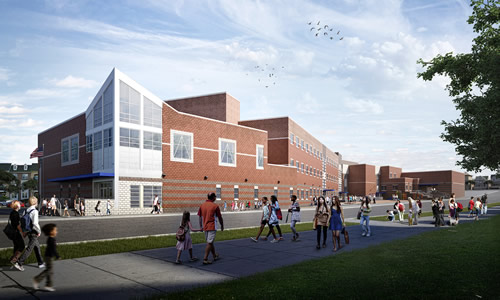
Seaman Ave Elementary School

Featured

  • Missouri Child Development Center Completes $2.3M Expansion

    The Urban Sprouts Child Development Center in St. Louis, Mo., recently announced the completion of a $2.3-million expansion and adaptive reuse project, according to a news release. The new space includes a retail café, outdoor learning space, and a support office building.

  • Montclair State University Debuts New VR Facility

    Montclair State University in Montclair, N.J., recently announced the completion of a new virtual reality learning facility developed in partnership with Dreamscape Learn, according to a news release. The 2,450-square-foot lab space is inside the College of Communication and Media building and will serve students pursuing careers in digital media, virtual reality, and content creation.

  • Wold Architects & Engineers Announces Acquisition of JJCA

    Wold Architects & Engineers, based in Minneapolis, Minn., recently announced that it has acquired JJCA, an architecture firm based in Nashville, Tenn., according to a press release. JJCA specializes in healthcare and education design; the partnership allows both firms to expand their presence across the country while building on existing strengths.

  • How Proactive Maintenance Can Transform Athletic Facilities into Strategic Assets for College Sports

    College athletics is entering one of the most transformative periods in its history. With NIL reshaping financial models and competitive expectations, athletic departments across the country are being asked to do more than ever with increasingly constrained resources.