Furniture Takes Learning to the Next Level
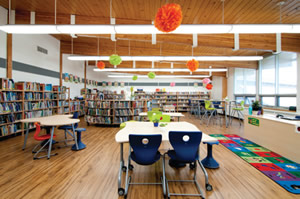
Using VS America furnishings, Kenora Catholic District School Board adopted open and collaborative learning spaces, phasing out the traditional lecture-style classroom.
IN 2013, the Kenora Catholic District School Board (KCDSB) in Ontario, Ca., was a traditional school district with limited exposure to the “learning commons” concept. The school district itself, with four elementary schools and one high school, has roots that reach back to the 1880s.
The groundswell for change in KCDSB’s classrooms began when students and teachers took action to transform their outdated, industrial-era classrooms into open, transparent learning environments.
“We actually had an entire class of grade five and six students approach us with a proposal to help them rethink their classroom space,” says Jamey Robertson, Innovation and Creativity coordinator for KCDSB. The children had done their homework and brought valid concerns to the table, asking the adults to support their case. Students, teachers, and librarians were all ready to embrace collaborative learning spaces.
“Our staff saw VS America as the core component,” Robertson says. “They were exceptionally supportive in helping us envision what’s possible with their products and the kinds of learning conditions we could create. VS offers other things we really value, such as build quality, warranty, and local support. But the first factor was the flexibility of the products themselves —the fact that they’re so adaptable, so customizable, and offer a million different options for what you can create.”
The furniture gives the district the ability to shape and reshape their spaces without the insurmountable costs of construction or remodeling. “VS products are interchangeable and consistent in the way they work together,” Robertson explains. “The feedback from students has been 100-percent positive. They love the vibrant bright colors and describe the VS pieces as fun and uplifting.”
Teachers are now free to experiment with their spaces, and the traditional lecture-style classroom is a thing of the past. Instead, students are moving in living, changing classrooms.
www.vsamerica.com
This article originally appeared in the School Planning & Management October 2018 issue of Spaces4Learning.