Pittsburgh Playhouse Opens at Point Park University

The new Pittsburgh Playhouse continues Point Park University’s long tradition of historic preservation and creative reuse, incorporating two historic structures: the University Center originally designed by Frederick J. Osterling for the Colonial Trust Company, and the Stock Exchange Building, originally designed by prominent architect Charles M. Bartberger. Careful to consider the aesthetic of its location, DLR Group|WRL designers created an exterior façade that complements the Playhouse’s historic Pittsburgh, PA, setting architecturally.
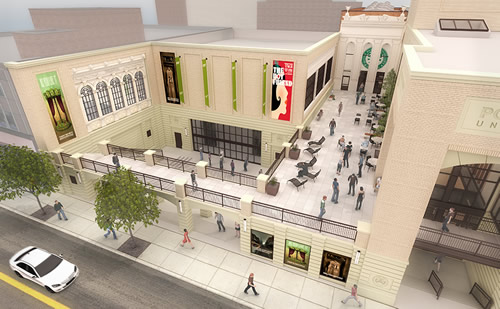
Pittsburgh Playhouse

Situated on 1.5 acres at the university’s downtown Pittsburgh campus, the 90,411-square-foot complex is a substantial addition. The project features three new theaters: a 550-seat proscenium/thrust main stage and multi-form 212-seat “transformational thea­ter,” both of which feature variable enclosures that allow each venue to play to its urban neighborhood, and a 102-seat black box venue. It also houses a sound stage, scenery shop, prop shop, paint shop, costume shop, television studio, scenic design and general classrooms, rehearsal halls, acting studios, classrooms, and faculty offices as well as public amenities such as lobbies, concessions, ticket/business office, and performer support. Other labs and shops and studios are exposed to the internal circulation system and to the street itself, communicating the vitality of making, fabrication, experimentation, and creativity.

Featured

  • Designing the Bridge Between Inclusivity and Independence in K–12 Schools

    Fostering independence is fundamental to learning and development for K–12 students. It offers many proven benefits, such as enhanced confidence, problem-solving, decision-making, and social skills. However, this foundational objective loses its impact if it’s not accessible and adaptable to all students. Inclusivity plays a critical role in cultivating independence and healthy autonomy for students, fostering positive student learning outcomes by uniting pedagogy with the physical learning environment.

  • Rethinking K-12 Schools as a Continuous Learning Experience

    Most students move through three or more separate facilities during their K-12 journey, yet the built environments they encounter at each stage have traditionally been designed in isolation, with little continuity in spatial language, learning philosophy, or physical resources. Each new school is a reset with different layouts, learning models, expectations, and ways of moving through a building. The next generation of school design is making the case that the first day of kindergarten and the last day of high school can and should feel connected through common support systems and infrastructure in the physical environment.

  • Minnesota District Converts Middle School into Community Hub

    White Bear Lake Area Schools in White Bear Lake, Minn., recently announced the end of a major renovation project that converted a former middle school into a new centralized district and community hub, according to a news release.

  • ed tech conference calendar

    Upcoming Awards, Events & Webinars