UMass Dartmouth Breaks Ground on $134M Student Housing and Dining Complex

The University of Massachusetts Dartmouth broke ground in November on a $134-million housing and dining complex designed to transform the student living and learning experience on campus. The facilities will open when students arrive for classes in fall 2020. The complex will include:

  • A $108-million, 1,210-bed, 267,500-square-foot housing complex in two buildings. Besides the actual living areas, the facilities will include general academic classrooms, multimedia and study lounges, demonstration kitchens, and recreation spaces. The buildings will also offer technology-equipped maker spaces where students will be able to work on group projects, soundproof music practice spaces, and two computer learning commons. Two faculty-in-residence apartments will foster mentoring and advising. The new housing will replace four residence halls that opened in 1976.

  • A $26-million, 38,000-square-foot student dining commons with a capacity of 800. The facility will be designed with a marketplace concept that will expand food options in response to students’ needs and expectations. The design will include a large flat-top grill where students will be able to see their meals being prepared. The university’s current main dining hall was built in 1977 for a residential student population of 1,600 but now serves more than 3,000 students daily.
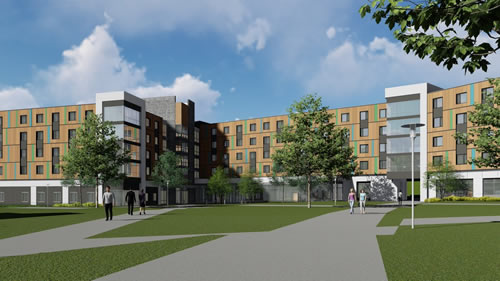
UMass Dartmouth Student Housing and Dining Complex

Featured

  • Niles West High School Natatorium Renovation

    Natatoriums are highly specialized spaces, and luminaires in this setting face several unique challenges. Perhaps the most significant is corrosion, which is exacerbated by high indoor humidity, condensation, and pool chemicals, often resulting in material degradation in luminaires not certified to perform in corrosive environments.

  • DLR Group Appoints New K–12 Education Practice Leader

    Integrated design firm DLR Group recently announced that it has named its new global K–12 Education leader, Senior Principal Carmen Wyckoff, AIA, LEED AP, according to a news release. Her teams have members in all 36 of the firm’s offices in the U.S., Puerto Rico, the U.S. Virgin Islands, Europe, and Asia.

  • UNL Kiewit Hall

    Designing for Engineering Excellence: Integrating Sustainability and Wellness at UNLs Kiewit Hall

    Kiewit Hall at the University of Nebraska-Lincoln exemplifies how academic institutions can integrate sustainability and wellness into modern learning environments. With an integrated and collaborative team approach, Kiewit Hall addresses enhanced learning and creativity, physical health, and mental wellness, and fosters a sense of community through innovative design, operations, and policy solutions.

  • Spaces4Learning Trends & Predictions for Educational Facilities in 2026: Part II

    As education leaders look toward 2026, the design of K–12 and higher education facilities is being reshaped by powerful, converging forces. Survey respondents point to the rapid growth of Career and Technical Education, deeper alignment with workforce and industry needs, and the accelerating influence of AI and emerging technologies.

Digital Edition