Flexibility With AV
Modern audiovisual (AV) technologies are changing how colleges and universities educate students, deliver information and entertainment, manage indoor environments, and design community spaces. Thanks to innovations in cameras, microphones, digital displays, and control systems, leading campuses and classrooms are creating greater flexibility for educators and a more engaging, accessible learning environment for students.
 While every college has different strengths and specialties, most share the goal of serving as many students as possible. As a result, distance learning is one of the biggest trends in higher ed. In order to create a true classroom-like experience for remote students, schools such as Purdue University and the University of Idaho are taking care to choose the optimal AV equipment for delivering crystal-clear coverage of everything that happens in a classroom to students in other locations.
A Sound Solution
After remote students at Purdue reported that audio was often unreliable and unintelligible in some online courses, the school determined its classroom microphones were not up to the task. By replacing them with new beamforming microphone arrays, the school quickly solved the problem and now delivers crystal-clear audio to distance learners. Beamforming microphone arrays are a relatively new technology that uses multiple microphones in a single unit, combined with artificial intelligence, to automatically focus on the current speaker’s position while cancelling echoes and reducing distortion.
At the University of Idaho, new specialized videoconferencing cameras have changed how online courses are presented. Using compact plug-and-play cameras that capture a wide 180-degree view, educators can now use virtually any room on campus, no matter how big or small, to deliver courses or office hours remotely. The cameras’ ease of use and 4K quality were vital so faculty never have to worry about setup delays or low-quality video.
In another example of technology’s benefits, the University of Georgia’s Creative Media Institute has invested in a large, trapezoid-shaped curved LED wall to provide students hands-on experience with real-world media technologies. Various courses involve projects in which students create content for the display, learning about different media, custom aspect ratios and pixel counts, and how color management affects display results. The LED wall is also an attractive piece for campus tours and offers a canvas to local artists during special events.
Modern AV technologies can also enable novel and engaging spaces for entertainment, leisure, and community building. The Gorecki Center, an event and conference building at Minnesota’s College of St. Benedict, recently upgraded to an AV control system that allows faster setup and adjustment of projectors, speaker volumes, and video source selection while also delivering higher-quality video and audio. The control system’s intuitive interface enables presenters in several rooms to quickly use lectern-mounted touchscreens to manage the room’s capabilities, with no training required. The control system also provides two-way feedback so building operators can see the status of every connected component at the touch of a button.
For the World to See
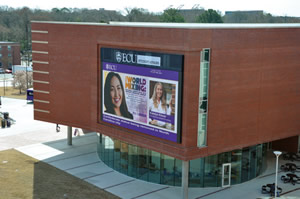
At East Carolina University in North Carolina, the opening of a new Student Union Building afforded the opportunity to turn an adjacent quad into a huge outdoor viewing space with a 42-foot-by-22-foot LED display topped with professional loudspeakers. Campus officials see it as a way to host community events, provide a relaxing environment for students, and deliver a “wow factor” for campus tours. It can even be used for presentations, thanks to a pedestal with connections for a laptop and a microphone.
All of these recent technology integration projects show that today’s AV solutions are improving almost every aspect of higher education—helping schools reach more students, providing specialized displays for content development courses, simplifying building management, and offering community benefits beyond classroom activities. It’s up to each institution to decide which solutions best benefit its students and faculty, but clearly, the higher education community is going to become more reliant on cutting-edge AV technology.
This article originally appeared in the College Planning & Management April/May 2019 issue of Spaces4Learning.
About the Author
Brad Grimes is senior director of Communications for AVIXA, the Audiovisual and Integrated Experience Association. AVIXA represents the $178 billion global commercial AV industry and produces InfoComm trade shows around the world. For more information, visit www.avixa.org/higheredAV.