Positive Learning Spaces in Hamilton City School District
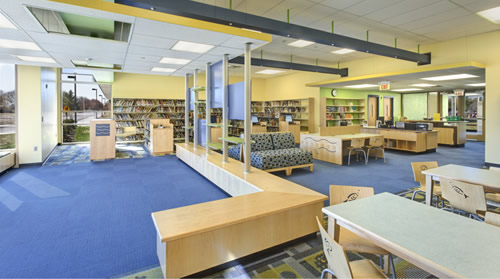
PHOTO © WILLIAM MANNING PHOTOGRAPHY
SHP Leading Design was commissioned by the Hamilton (Ohio) City School District to design eight new elementary schools. The objective was to make the schools more equitable across the district, while allowing each school to maintain its own design aesthetic. SHP worked with Interface, using their carpet tile to provide high-performance flooring that is LEED compliant. The variety of design choices served to develop distinct color schemes for the individual schools and educational spaces.
Project Snapshot
PROJECT: Creating Positive Learning Spaces in Hamilton City School District
DISTRICT: Hamilton City School District
LOCATION: Hamilton, Ohio
COMPANY NAME: Interface
WEBSITE: www.interface.com
THE CHALLENGE
When the Hamilton City School District in Ohio commissioned Cincinnati-based SHP Leading Design to design eight new elementary schools, the objective was to make the schools more equitable across the district. While each school was to have a distinct, high-level design aesthetic, ease of maintenance, and sustainability rounded out the top criteria for the newly designed spaces.
THE SOLUTION
“The main thing we were looking for was a product that would be easy to maintain, and carpet tile allows easy replacement for any damage or soiling. So, that is what drove the idea behind the carpet tile,” explains SHP senior interior designer Carrie Malatesta. Interface carpet tile answered the call on all counts, and became the impetus for the entire design scheme with carpet tile being used in many spaces.
To create a unique look and feel for each school, SHP devised two sets of themes. Four schools reflected a palette based on the four seasons (winter, spring, summer, and fall), and the other four schools were inspired by the elements (fire, water, earth, and wind). “We actually started with the Interface carpet tile as the foundation of the color scheme for the themes,” Malatesta says of how the interior design scheme evolved.
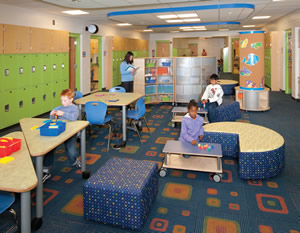 Sustainability was an important part of the criteria in choosing a flooring solution for this large scale (90,500-square-foot) project. Conscious that LEED Silver Certification was a requirement for all of these facilities, Interface carpet tile was a logical choice. “These schools are partially funded by the Ohio Schools Facilities Commission, and all of those schools need to have LEED Silver certification. So, we were definitely looking for materials and products (like Interface carpet tiles) that would contribute toward LEED certification,” says Malatesta. Beyond LEED, Interface carpet tile also offers the environmental benefits of a long, useful life. The high-performance flooring holds up well against the wear and tear of young students on a daily basis, and the option of selective replacement extends the life of the overall floor.
IMPACT ON LEARNING
The feedback from students, staff, and parents has been overwhelmingly positive. Students, teachers and support staff are thriving in exciting new environments that are enhancing student performance and standing up to the durability rigors required of flooring for the elementary schools. Not only did the Interface carpet tile enhance the learning environment for students with inspirational design, it also delivered on outstanding performance over time. A win-win for everyone.
Editor’s Review
According to the International Association of Color Consultants - North America (IACC-NA), a school’s physical environment has a powerful psycho-physiological impact on its students. “Appropriate color design is important in protecting eyesight, in creating surroundings that are conducive to studying, and in promoting physical and mental health.” The IACC also notes that many cases of irritability, premature fatigue, lack of interest, and behavioral problems can be attributed directly to incorrect environmental conditions involving poorly planned color and lighting. The decision makers also addressed the acoustics issues with this choice of floor covering thereby enhancing the students’ ability to learn and the teachers ability to teach.
This article originally appeared in the School Planning & Management April/May 2019 issue of Spaces4Learning.