4 Reasons to Build Choice into Classroom Design — and How to Make It Work for Students
A look at the key elements of a modern and highly engaging learning space
- By Deanna Marie Lock
- 04/01/20
Compare
these two scenarios:
You
walk into a classroom and everything looks the same. All of the
furniture — the desks, tables and chairs — is of a uniform style.
Maybe there are student desks arranged in neat rows, or maybe there
are tables clustered together in groups of four. Regardless of the
layout, it doesn’t matter where you plop down: Every seat is
exactly alike.
Or,
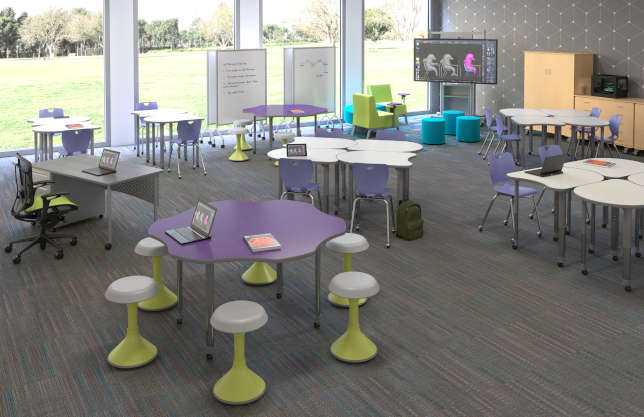
you walk into the room and see a variety of seating types. There are
tables arranged in groups of three or four, but also soft seating
options. There are traditional plastic chairs, but also stools that
swivel or rock.
If
you’re a student, which scenario would get you more fired up to
learn? Which classroom environment is more likely to unleash
students’ creativity and individualism? Which one sends a subtle
message that independent thought and activity are discouraged?
Teaching
and learning are undergoing significant transformation, but, by and
large, the design of classrooms has not transformed at the same rate.
At School
Specialty,
we’ve identified six key elements of a modern and highly engaging
learning space that both supports and encourages 21st
century learning: choice, comfort, versatility, connection,
stimulation and technology.
This
article looks at choice in particular, why it’s important — and
how you can incorporate choice into the design of a learning space.
Why
Provide Choice?
Giving
students choices in where they sit and how they learn is important
for many reasons. For instance:
-
It
makes classrooms more inclusive.
Something as simple as having multiple seating styles to choose from
can accommodate different learning needs and preferences — and it
helps students feel more welcome. For example, students who have
anxiety or sensory processing disorders can be overly sensitive to
certain types of fabrics or materials, and offering a variety of
options for where to sit and work lets them choose where they’ll
be most comfortable.
-
It
advances social and emotional learning.
Giving students options in where to sit and what tools and materials
to work with promotes responsible decision-making and builds
confidence. When students have the freedom to make learning
decisions for themselves, they feel more in charge of their own
development.
-
It
gives students ownership of their learning.
Choice and student agency put students at the center of the learning
process, sending a clear signal that they’re empowered to take
ownership of their education. Instead of waiting for the teacher to
supply them with answers, students are encouraged to think,
investigate and learn for themselves.
To
meet a wide range of student needs and abilities, a growing number of
teachers are incorporating Universal Design for Learning (UDL)
principles into their classrooms. UDL is a framework for developing
flexible learning environments that can accommodate differences in
how students learn. It calls for using instructional methods and
materials that provide multiple
means of representation, to
give students various ways of acquiring knowledge; multiple
means of expression, to
give them different options for demonstrating what they know; and
multiple
means of engagement, to
tap into students’ unique interests and motivate them to learn.
The
idea behind UDL is that by approaching instruction in many different
ways, teachers will hit upon a method that resonates with each
individual learner. Building choice into the design of a learning
space is simply taking the concept of UDL and applying it to the
design of the space as well, by giving students multiple options in
where to sit and work so they’re able to learn most effectively.
How
to Build Choice into Classroom Design
How
can you incorporate choice into the design of a learning environment?
Instead of opting for uniform seating throughout a classroom,
consider using both individual and group seating, as well as a mix of
hard and soft seating options. Instead of prescribing a uniform set
of tools and materials to teach and construct with, mix it up with a
variety of choices for students.
Classrooms
that include multiple options for both materials and seating — such
as standing
desks,
soft
seating,
fidget
stools
that allow students to rock or swivel while they’re working and
traditional desks and chairs — help students make their own choices
to support how they’ll learn best.
Students
also should be able to choose whether they want to work alone or in
groups for certain assignments. Designing classrooms with different
zones for individual and small-group seating, or using flexible
furniture that can be moved around the room and quickly rearranged,
allows students to switch seamlessly from individual to small-group
work as needed.
As
students switch from one learning task to another, they should be
able to move around the room and sit where it makes the most sense to
do so. They might sit in a group with two or three of their peers to
collaborate on a project, then move to a soft, comfortable chair to
read independently and so on.
Of
course, there are some logistical challenges that teachers will have
to overcome in order to make this work in their classrooms. Letting
students pick a seating option that works best for them doesn’t
mean the teacher gives up control. Teachers must still be able to
move anyone at any time, because students will sometimes make unwise
choices with their seats.
Teachers
should clearly outline their expectations at the beginning of the
year and then reteach these throughout the school year. You can find
more advice for maxing flexible seating work in this
blog post
on the topic.
Furnishing
learning spaces with a variety of seating options can accommodate
different student needs and preferences. Empowering students to
choose their own seating gives them a say in how they learn, which
makes them more invested in their education.