Boosting Student Wellness and Safety Through Indoor-Outdoor School Spaces
- By Elizabeth Stoel
- 03/18/25
Young people spend most of their lives at school. The character and quality of life on campus—classes, activities and personal encounters—not only shape academic outcomes, but also influence mental health and physical wellbeing. With this reality in mind, the key question for school leaders, facilities teams, and their architects is often how the physical campus can best support a positive student experience. In fact, prioritizing student wellness requires looking both outside and inside the building’s walls and creating opportunities for indoor-outdoor learning and engagement.
Engaging students through facilities designed for indoor and outdoor learning and activities reflects a growing awareness of how children learn and thrive, with educators recognizing the importance of getting outside and disconnecting from technology. And, as today’s youth grapple with the urgent mental health crisis of increased anxiety and loneliness fueled by both the pandemic and technology, along with a related crisis in youth physical health, the wellness benefits of getting outside have never been so palpable.
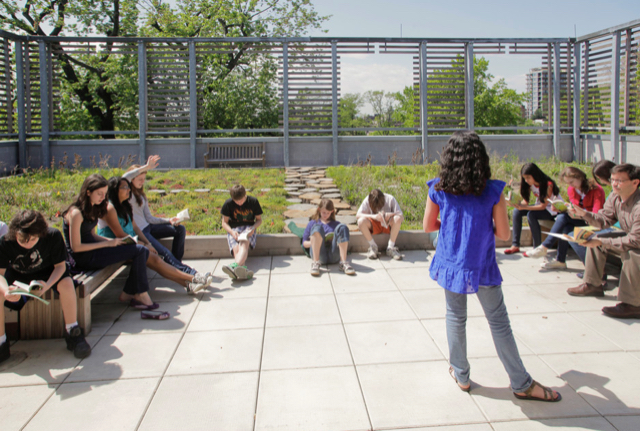 Outdoor learning space
Image courtesy of Cooper Robertson
Indoor-Outdoor Spaces for Physical and Mental Health
One of the most significant educational design trends in the post-pandemic era prioritizes innovative spaces and opportunities that enable indoor-outdoor learning and engagement. Whether a school is located in a warm-weather climate or an environment with greater seasonal variation, incorporating indoor-outdoor settings provides essential physical, mental, and academic benefits year-round—all critical aspects of students’ overall health and success. Maximum benefits are achieved by incorporating flexible opportunities for indoor-outdoor learning, gathering, and contemplation at a variety of scales.
Designing “spill-out” outdoor rooms, for instance, is an effective way to connect outdoor learning and recreational environments directly to indoor classrooms. These spaces allow students and educators to move seamlessly between inside and out, simplifying circulation through the school building, saving valuable time during class, and ultimately making it more likely that students will spend time outside during any given school day. Outdoor space that is contiguous with indoor space can offer opportunities for break-out groups, collaborative, messy, hands-on projects, and the ability to rotate fluidly from active S.T.E.A.M.-oriented study to focused work at desks.
The specific approach to designing these spaces will vary depending on the local context and climate conditions. For a new S.T.E.A.M. facility at the Lyford Cay International Baccalaureate School in the Bahamas, the Cooper Robertson team designed a building with single-loaded classroom wings, exterior circulation, and 12-foot-wide veranda on each side. In addition to dramatically increasing the classrooms’ effective square footage, these covered outdoor spaces also facilitate cross-ventilation for the interior zones, reducing mechanical system load and the need for air conditioning.
Schools in colder climates can also benefit from this design strategy, with a more seasonal approach. A good example can be found in the New York Botanical Garden’s Edible Academy learning center in the Bronx. Here, the central classroom building connects directly to an adjacent open-air pavilion via well-insulated, garage-style roll-up doors that support seamless indoor-outdoor connections when weather permits, and that effectively enclose the indoor spaces during inclement weather or winter months. Because the large roll-up doors use glass panels, even when closed the students benefit from enhanced daylight access.
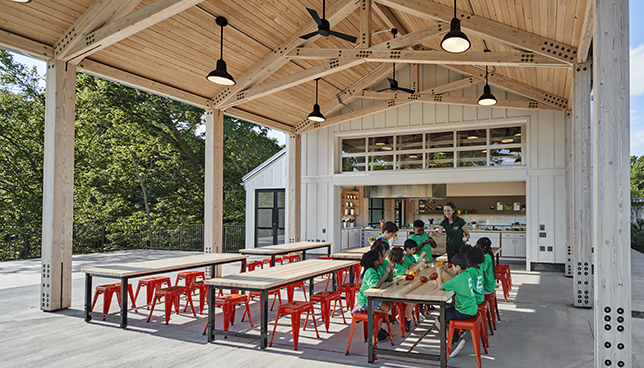 Edible Academy
Image courtesy of Cooper Robertson
Adding to the positive benefits of the indoor-outdoor space is that this LEED Gold-certified learning center incorporates a sustainable structure with cutting-edge technology, a green roof, porous pavements, and geothermal heating, reducing its environmental impact and promoting a healthy, natural environment.
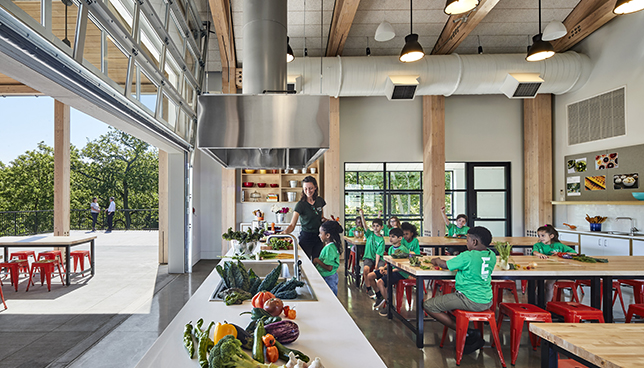 Edible Academy
Image courtesy of Cooper Robertson
Another valuable opportunity for creating outdoor learning space sits above many classrooms – on the roof. Designing rooftop learning gardens is a useful way to involve students in a range of hands-on learning and recreational activities. Cooper Robertson’s middle school building for the Ethical Culture Fieldston School in New York City incorporates a green roof with dedicated space for teaching activities such as planting, alongside other areas intended for quiet student contemplation.
Not only was this roof planted with the input of a New York City-based plant ecologist to prioritize native plants, but the green roof also was created as habitat for insects and birds, and an area of exploration for students. It also features sustainable storm-water management designs. In this way, rooftop learning gardens can also help schools reach important sustainability goals — while serving as a teaching aid on climate topics. Incorporating planted areas on a rooftop can retain stormwater and minimize runoff, reduce solar heat gain into the building, ameliorate the urban heat island effect, and create a native plant habitat for pollinator insects and birds. All of these are valuable hands-on learning opportunities for students.
While traditionally, outdoor time during and after school has been focused on athletics, spaces like gardens can benefit all students, including those with limited mobility, neurodivergent learners, and simply those who aren’t athletes and have fewer opportunities for scheduled outdoor time during the school day. These spaces must be designed to be universally accessible and able to accommodate the widest possible range of learners.
At our new middle school building at Ethical Culture Fieldston School, the green roof is designed as a teaching space and research project. It was planted by users under the leadership of a Columbia University plant ecologist using New York City native plants to create habitat for insects and birds, exploring for students the biological as well as storm-water management benefits of the roof.
Whether modest or more ambitious in scale, these gardens can be created for institutions of all sizes – even smaller buildings can be feasibly retrofitted. And especially for schools in urban or similarly space-constrained settings, placing outdoor space on the roof allows for uses that otherwise might be impossible to program on the school campus, as with Cooper Robertson’s Harlem Village Academies High School in Manhattan, where a roof garden provides the only onsite outdoor space. (It’s also worth pointing out that for school leaders who simply don’t have any possibility of creating indoor-outdoor learning environments within their facilities, there are other ways to give students these opportunities, for instance through increasingly common partnerships with offsite organizations that use animals to provide learning and therapeutic opportunities on their own campuses).
Indoor-Outdoor Activity and School Security
Indoor-outdoor activity can also be an effective element of a holistic approach to school security. Designs that maximize a school’s engagement with the surrounding neighborhood through unobstructed active outdoor spaces can create visible buffers between the school campus and abutting streets. It may seem counterintuitive, but being more visible to the surrounding community can make school populations safer and increase students’ sense of security.
Designs that allow these areas to be open to the community after hours and on weekends create a reinforced sense of the school as community resource for everyone. In addition, schools that are more physically connected to their surrounding communities and are less fortress-like in design benefit from an eyes-on-the-street approach, promoting relationships among neighbors, students, staff, and faculty.