Architectural Power for the Modern Campus Landscape
For generations, an outdoor classroom only required a textbook and a patch of grass. Today, not only has the laptop replaced the printed pages, the rise of agile learning has turned campuses into study halls with students listening to lectures and researching topics from quads, gardens, and plazas. Recent research shows that 56% of students now prefer hybrid learning, seeking out an environment between the classroom and dorm where they can work productively. However, this digital freedom has a physical limit: the need for accessible outlets to charge devices.
For architects and facility managers, the challenge is to provide connectivity without cluttering the landscape with visual eyesores or creating safety hazards with extension cords. However, by organizing power needs into three distinct zones — invisible, activation and utility — they can provide power that keeps the campus beautiful while giving students the constant connection they need.
 Images courtesy of Legrand
The Invisible Zone: Maintaining Sightlines with Diving Bell Technology
In the past, bringing safe, permanent power into the ground in high-traffic plazas and campus landmarks was a major challenge. These areas typically relied on visible pedestals or temporary power like a generator.
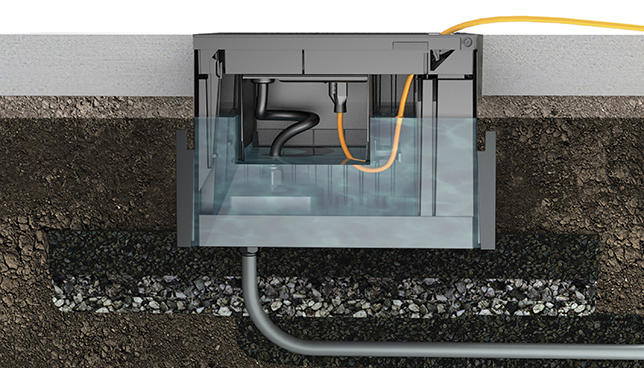
The solution is a ground box that sits flush with the pavement and uses diving bell technology. Instead of trying to fight nature with a mechanical seal that eventually fails, the diving bell uses a simple rule of physics: air is lighter than water. The unit is designed with an open bottom that creates a trapped pocket of air. This air pocket acts as a shield, keeping water from reaching the electrical plugs.
While the concept has been used for centuries by underwater explorers, its application here ensures that equipment remains safe even during periods of total submersion. These boxes are tested to work under six feet of water for more than 24 hours. They are also rugged enough to handle 5,000-pound loads from maintenance trucks, meaning a plaza can power a large festival on Saturday and be returned to a clear, open space by Sunday morning.
Beyond the technical reliability, keeping infrastructure invisible supports the core principles of biophilic design. When visual clutter is removed, students maintain a visual connection with nature: a design standard proven to reduce stress by 15% and significantly improve focus. Invisible power also preserves the symmetry and order of historical landmarks — a top priority for campus preservationists tasked with protecting the heritage of older institutions.
The ground box technology was tested at Alvin Independent School District’s Memorial Stadium in Texas. The district moved its power underground to remove dangerous light poles from the field. They needed a way to power equipment like inflatable tunnels and pitching machines without installing something that athletes would trip over.
By using ground boxes covered with matching turf, the district created a power source that was completely hidden and safe for players. Even after Hurricane Harvey flooded the stadium with more than four feet of water, the boxes stayed dry inside. Being able to plug in and have power right after a historic flood helped the community get back on its feet without expensive repairs or specialized electrical drying.
 Images courtesy of Legrand
The Activation Zone: Expanding the Power Footprint
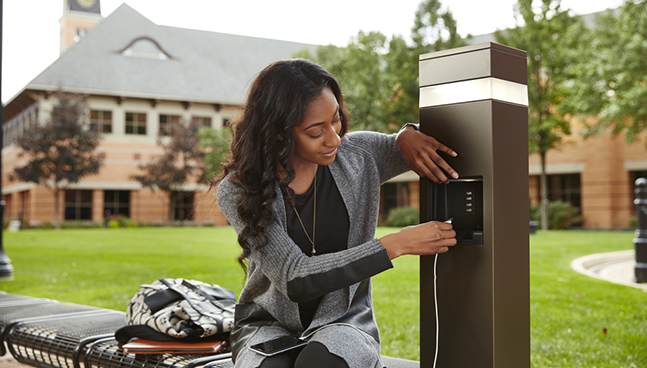
While the invisible zone focuses on hiding the tech, the activation zone uses power to invite students in. Today’s campus serves as a primary social and academic hub; students naturally gravitate toward sensory-rich outdoor environments, but they will quickly leave those spaces if they cannot stay connected. Many green spaces and courtyards go unused because there is nowhere to plug in. By placing outdoor charging stations in these areas, campus planners can turn quiet spots into popular study hubs.
These stations act as beacons that show students where they can find help. They offer a mix of standard outlets and high-speed USB-C ports, which allows students to leave their charging bricks at home. Beyond simple utility, these stations support a growing student wellness angle. Outdoor charging allows students to work in the fresh air, which sources say is linked to a 55% lower risk of mental health disorders.
A key part of these stations is the built-in lighting, which supports the 24/7 campus trend. Soft accent lights help people locate the station from a distance, while brighter area lights create a safe, welcoming space for students to study or talk at night.
 Images courtesy of Legrand
The Utility Zone: Weatherproof Performance for Heavy-Duty Power
The utility zone covers the behind-the-scenes areas like stadiums, bases of tree lined paths and streetside to support food trucks. In these locations, the equipment has to be rugged to handle extreme weather, high-amperage power and pedestrian traffic.
Beyond requiring physical durability, the utility zone is defined by the shift toward decarbonization and smart energy. Facility managers are under pressure to reach carbon neutrality, and the infrastructure they choose plays a major role in that mission. Permanent power pedestals are a more sustainable solution than gas-powered portable generators, directly supporting an institution’s Environmental, Social and Governance goals by reducing on-site carbon emissions and noise pollution during campus events.
To meet these demands, power pedestals have been designed with 0.070-inch thick G90 galvanized steel and finished with a special outdoor coating to prevent rust. This heavy-duty build, as required by UL 1773 standards, keeps the equipment from bending or breaking, even in busy areas. By installing permanent, rainproof equipment, facility managers save time and money by eliminating the need for noisy temporary generators or hazardous extension cords for every campus event.
 Images courtesy of Legrand
The Compliance Standard: Safety and Accessibility
Good power planning relies on strict safety codes. For outdoor environments, equipment must meet NEMA 3R requirements to be designated as rainproof, ensuring that outlets stay dry and safe even in adverse weather. High-quality ground boxes must be UL Listed to ensure it meets safety standards and protects users from fire or electrical shock.
A critical component of this safety is while-in-use protection. The National Electrical Code (NEC) Article 406.9(B)(1) requires all 15- and 20-amp receptacles in wet locations to have weatherproof covers that remain sealed even when a cord is plugged in. For higher-rated receptacles, such as 30A, 50A and 60A, Article 406.9(B)(2) provides compliance pathways to ensure that the connection remains weatherproof based on how the equipment is used.
Standard covers often only protect the outlet when it is not in use. However, for food trucks or outdoor lab equipment that stays plugged in for hours, a while-in-use cover is essential. It prevents rain, snow or irrigation spray from reaching the energized connection while the cord is inserted.
Beyond electrical safety, a modern plan also focuses on:
- Accessibility: Modern power hubs are designed so they are easy for everyone to reach, regardless of their physical ability.
- Power and security: Integrated lighting in power stations help make the campus safer. They brighten up dark paths and bus stops, helping students feel more comfortable and secure as they move around the campus after dark.
As students continue to study more in outdoor spaces, the need for well-placed power will only grow. By using a zoned approach, architects and facility managers can create a campus that is both beautiful and useful. Whether it is a hidden ground box or a bright charging station, strategic outdoor power ensures that the campus is not just a place to walk through, but a place where students can stay and learn.