Opportunity by Design
How School Architecture Can Close Readiness Gaps, Expand Equity, and Redefine Learning in Rural America
- By Dr. Justin Zajic
- 08/11/26
Rural schools are asked to solve national problems with local resources. They are expected to close readiness gaps they did not create, respond to poverty they cannot control, and provide opportunities students may not receive anywhere else. Yet these expectations are often placed inside buildings designed for a different era of education.
The physical school environment is usually treated as an operational concern: square footage, maintenance, compliance, safety, and cost. Those matters are real. But they are incomplete.
A school building is also an instructional system.
School buildings determine how students move. It determines where adults collaborate. It determines whether small-group intervention is practical or constantly improvised. It determines whether transitions consume learning time. It determines whether noise interrupts instruction. It determines whether students see themselves reflected in the environment. It determines whether the school feels like a place built for them or merely a place they are assigned to attend.
For students from low-socioeconomic households, and for students who enter kindergarten without the advantage of consistent preschool access, the building may be one of the most stable learning conditions in their lives. That makes design an equity issue.
School architecture does not replace excellent teaching. It either enables it or constrains it.
The Rural Readiness Challenge
Students do not arrive at school with equal access to early learning experiences. In rural communities where preschool is limited, inconsistent, geographically difficult to access, or not publicly funded, many children begin kindergarten without the vocabulary, routines, stamina, executive-function practice, and early-literacy exposure that peers may have received before ever entering a K-12 building.
The challenge is compounded for students from low-income households. Poverty does not determine a child’s potential, but it can limit access to enrichment, health care, transportation, stable routines, academic language exposure, and early childhood programming. Schools are then asked to close these gaps through instruction alone.
That expectation is too narrow.
If readiness gaps are structural, the response must also be structural. Curriculum matters. Instruction matters. Assessment matters. Professional development matters. But the environment that surrounds all of them matters as well.
A school designed around access, flexibility, belonging, movement, regulation, and intervention can create learning conditions that students may not consistently receive elsewhere. It can reduce friction. It can recover time. It can make support easier to deliver. It can make belonging visible. It can turn the schoolhouse itself into part of the learning infrastructure.
When a district designs space around how children actually learn, the building becomes more than a facility. It becomes an equity strategy.
The Opportunity-by-Design Framework
The Opportunity-by-Design Framework (ODF) is built on a simple premise: the physical environment determines what instructional practices are possible and, therefore, what outcomes are achievable.
The framework does not claim that design alone causes student achievement. Rather, it argues that design creates or limits the conditions through which instruction, intervention, belonging, enrichment, and support reach students.
Opportunity-by-Design Framework (ODF) Stages
| ODF Stage |
Primary Function |
| 1) Design Inputs |
Light, acoustics, flow, flexible furniture, cultural identity, specialized spaces |
| 2) Instructional Capacity |
Faster transitions, MTSS at scale, small-group intervention, differentiated teaching |
| 3) Student Experience |
Engagement, autonomy, belonging, regulation, reduced cognitive friction |
| 4) Measureable Outcomes |
Increased instructional time, improved behavior patterns, staff culture, stronger access to enrichment |
| 5) Equity Impact |
The greatest benefit accrues to students who had the least access before they enter school |
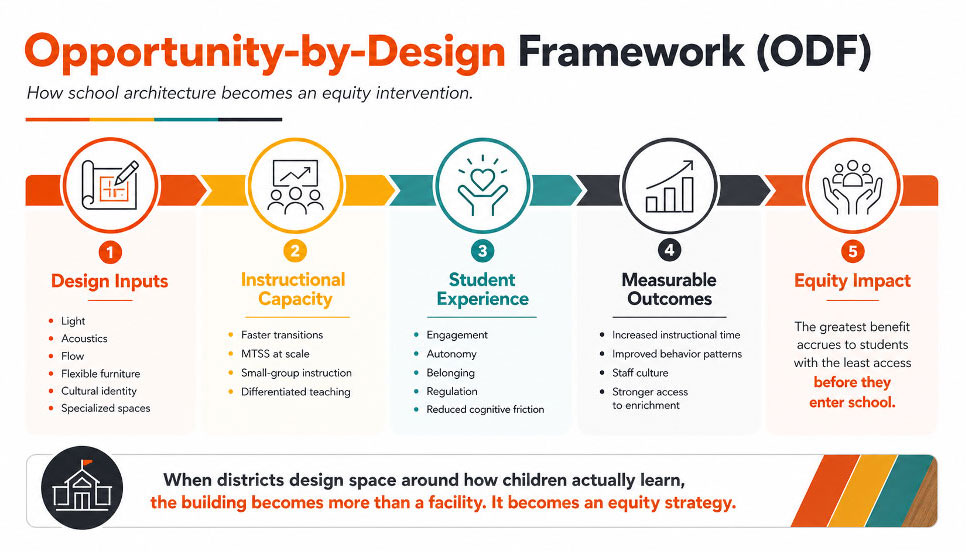
Opportunity-by-Design Framework (ODF): design inputs connected to equity impact
The framework challenges districts to think differently about buildings. The question is not only whether a facility is safe, compliant, or attractive. The question is whether the building increases the instructional capacity of the adults inside it and expands access for the students who need that access most.
A Rural Case Study: Rebuilding the School Around Learning
The Opportunity-by-Design Framework is illustrated through a rural Midwestern district serving roughly 900 students across 932 square miles. The district serves a diverse student body, with more than half of students qualifying for Free or Reduced Meals and many students living in communities where access to preschool is limited or inconsistent. The district’s geography and demographics are not incidental context. They define the equity challenge the school must respond to every day.
The district replaced a 60-year-old elementary building and armory with a 108,000-square-foot elementary facility designed by CMBA Architects. The new campus aims to advance educational concepts rather than simply replacing old square footage with new square footage. The guiding belief was clear: The building itself should add to the education of every child.
Layout, furniture, natural light, acoustic design, student movement, murals, cultural representation, intervention access, and specialized learning spaces were treated as part of the instructional system.
This was not a cosmetic upgrade.
It was a systems redesign.
Design Inputs That Changed Instructional Capacity
Instructional Time Recovered Through Flow. In the previous building, kindergarten students were located on the lower level of a four-story structure. Recess, specials, services, and daily movement required repeated stair transitions. The daily time loss was not dramatic in a single moment, but it was substantial over time.
After moving into the new facility, kindergarten teachers reported gaining two or more weeks of instructional time because students no longer lost minutes navigating multiple flights of stairs throughout the day.
This is one of the clearest examples of design as an instructional variable. No curriculum changed in that specific example. No new assessment platform created those minutes. The physical barrier was removed, and instructional time increased.
In early literacy, time matters. For young learners who need repetition, oral language development, small-group support, and predictable routines, recovered minutes are not incidental. They are opportunity.
Flexible Furniture and Student Agency. Classrooms and shared spaces were equipped with mobile furniture, dynamic seating, and options that allow students to sit, stand, move, collaborate, and reconfigure the room with minimal disruption. The purpose was not novelty. The purpose was access.
Students learn differently across tasks and developmental stages. When the room can change quickly, instruction can change quickly. A teacher can move from direct instruction to small-group work, collaborative learning, independent practice, and intervention without the room itself becoming the obstacle.
Flexible seating and movement-supported environments are consistent with research connecting physical activity and classroom movement to attention and engagement. For students who struggle with regulation, stamina, or focus, the ability to move appropriately within the learning environment is not a luxury. It is part of access.
Pods, Acoustics, and Transition Efficiency. The building organizes classrooms into intentional learning pods, with specials and student services placed centrally. This creates smaller learning communities while reducing unnecessary traffic through instructional spaces.
Hallway noise does not carry into classrooms in the same way it did in the previous facility. For early learners, this matters. Young students, especially those still developing language and literacy foundations, are more vulnerable to environmental distraction and acoustic interference.
A quieter, more predictable environment reduces cognitive friction. It protects learning time. It makes routines easier to sustain. It helps adults respond faster and students regulate more successfully.
MTSS as a Building-Level Design Problem. The district’s flagship MTSS structures, including Walk to Read and March to Math, rely on flexible grouping, efficient movement, and intervention spaces that do not stigmatize students or interrupt the flow of the day.
In the old paradigm, schools often design an intervention system and then try to force it into available space. Opportunity by Design reverses that logic: design the building so intervention is operationally possible.
When space supports movement, grouping, and targeted instruction, MTSS moves from theory to daily practice.
Belonging Is Built, Not Posted on a Wall
The facility includes place-based murals that incorporate South Dakota history, geography, wildlife, agriculture, and Dakota language. In a district serving a significant Native American student population, this decision matters.
Cultural representation in the physical environment signals that students are not merely accommodated. They are recognized.
When students see local language, landscapes, and identity embedded into the school, the building communicates belonging before a single lesson begins.
Murals and visual learning elements also expand background knowledge. They turn hallways into instructional spaces. A student walking past a mural of the Missouri River, the Black Hills, bison, prairie animals, crops, or Dakota vocabulary is repeatedly exposed to content, language, and place.
In that sense, the school becomes an environmental text. Students read the building long before they read the day’s lesson.
Enrichment Access for Students Who May Not Receive It Elsewhere
The building includes a K-5 STEAM lab designed to expose students to coding, robotics, programming, engineering, problem solving, and applied learning. For students from low-income and geographically isolated communities, access to these experiences cannot be assumed outside of school.
Equity is not only about remediation. It is also about enrichment.
Students who need academic support also deserve access to advanced tools, creative problem solving, and future-facing learning opportunities.
This is where design intersects with the district’s broader extended-learning strategy. Through LEAP, a grant-funded after-school and summer program, the district works to address academic supplementation and summer regression, consistent with the “Faucet Theory” articulated in Zajic’s research on summer regression and rural students. During the school day and beyond it, space becomes part of the learning infrastructure.
Measurable and Observable Outcomes
A careful article must distinguish causation from contribution. The district’s data and observations do not prove that a new building alone caused every positive shift. Leadership, staffing, implementation, curriculum, student needs, intervention quality, and data quality all matter.
However, the pattern is meaningful.
First, the kindergarten instructional-time gain is concrete. Teachers reported recovering two or more weeks of instructional time because the physical barrier of stair transitions was removed.
Second, staff culture shifted. The new facility increased visibility, collaboration, and pride. Staff see one another more often, the building feels open and inviting, and candidates interviewing for positions experience a clear message that the community values students and educators.
Third, behavior documentation showed improvement by the end of 2025-2026 after the first year in the new facility, with earlier baseline data interpreted cautiously because tracking systems and consistency improved over time.
Fourth, early academic data reveals an equity-aligned pattern. The story is not one of instant universal achievement growth. It is more nuanced and more important than that.
The strongest post-building signals appear among the students the Opportunity-by-Design Framework would predict to benefit most from improved access, flow, belonging, intervention space, instructional consistency, and environmental predictability.
Early Literacy Signals in K-2 DIBELS
The district’s K-2 DIBELS data adds an important early-literacy lens to the Opportunity-by-Design Framework. Unlike the Smarter Balanced Assessment, which measures achievement at the end of the school year, DIBELS provides multiple checkpoints within the year. For this reason, the most useful comparison for this article is end-of-year performance over time, especially for students eligible for Free and Reduced Meals.
When viewed through that lens, the early-literacy data shows an encouraging equity pattern.
FRAM-eligible K-2 students improved from 61.8 percent end-of-year At/Above Benchmark before the new facility to 67.9 percent during the first two years in the new building. Students not matched as FRAM-eligible remained relatively stable, increasing from 70.7 percent to 71.2 percent.
In other words, the largest movement occurred among students from low-socioeconomic households.
The achievement gap also narrowed. Before the new facility opened, the end-of-year benchmark gap between FRAM-eligible students and non-FRAM-matched students was 8.9 percentage points. During the first two years in the new building, that gap narrowed to 3.3 percentage points.
That 5.6-point narrowing does not prove that architecture caused the improvement, but it is consistent with the framework’s central claim: when schools improve access, flow, predictability, intervention space, and belonging, the benefits may appear most clearly among students who have historically experienced the greatest barriers.
The data also shows movement at the lower end of the performance distribution. The percentage of FRAM-eligible students ending the year Well Below Benchmark declined from 23.7 percent before the new facility to 18.6 percent during the new-building era. This matters because equity is not only about increasing the number of students who reach benchmark. It is also about reducing the number of students who remain furthest from it.
The within-year pattern provides additional nuance. FRAM-eligible students did not show larger fall-to-spring growth in the new-building years because they began the year stronger than in the pre-building period. The better interpretation is that FRAM-eligible students started stronger and ended stronger. In the new-building era, FRAM-eligible students moved from 43.2% At/Above Benchmark at the beginning of the year to 69.2% At/Above Benchmark by the end of the year.
That pattern suggests that the building may be contributing to more stable early-learning conditions, even while instruction, intervention, staffing, curriculum, and student needs remain essential parts of the story.
K–2 DIBELS Outcomes: Pre-Building vs. New-Building
| K-2 DIBELS Low-SES Measure |
Pre-Building |
New-Building |
Change |
| FRAM-Eligible EOY At/Above Benchmark |
61.8% |
67.9% |
+6.1 pts |
| Non-FRAM-Matched EOY At/Above Benchmark |
70.7% |
71.2% |
+0.5 pts |
| FRAM/Non-FRAM Benchmark Gap |
8.9 pts |
3.3 pts |
Narrowed 5.6 pts |
| FRAM-Eligible EOY Well Below Benchmark |
23.7% |
18.6% |
Improved 5.1 pts |
| FRAM New-Building BOY to EOY |
43.2% to 69.2% |
— |
+26.0 pts |
Taken together, the DIBELS data does not show that design alone caused early-literacy gains. It does show that the first two years in the new facility produced a more equity-aligned K-2 reading pattern: stronger end-of-year outcomes for low-SES students, a narrower benchmark gap, fewer students ending the year Well Below Benchmark, and stronger starting and ending points for FRAM-eligible students.
Those are exactly the kinds of early signals the Opportunity-by-Design Framework would expect if the physical environment is functioning as a structural support for instruction, intervention, regulation, and access.
Grades 3-5 SBA Signals: The Aggregate Is Not the Story
The K-2 reading data provides the earliest evidence point. The Smarter Balanced Assessment data extends the analysis into Grades 3-5, where end-of-year achievement can be examined across ELA and math over multiple years.
Like DIBELS, the SBA results reinforce the need for both ambition and caution.
A careful analysis of the district’s Smarter Balanced Assessment data shows that the first two years in the new elementary facility did not produce a broad, immediate districtwide proficiency surge across every grade and subject. Overall ELA performance remained essentially flat. Overall math performance became modestly positive only after removing one extreme Grade 5 math outlier from Spring 2026.
But the deeper pattern is more meaningful than the aggregate.
Students eligible for Free and Reduced Meals improved in both tested subjects. Their ELA proficiency increased by 13.5 percentage points, and their math proficiency increased by 17.3 percentage points after the opening of the new facility. The FRAM/non-FRAM achievement gap narrowed by 7.5 percentage points in ELA and 7.5 percentage points in math.
Race and ethnicity data showed a similar equity-aligned pattern. American Indian/Alaskan Native students improved in ELA by 5.7 percentage points, and the ELA proficiency gap between American Indian/Alaskan Native students and White students narrowed by 8.1 percentage points. Math results were more modest, but after removing the Grade 5 outlier, American Indian/Alaskan Native math proficiency also moved in a positive direction.
Grades 3–5 SBA Proficiency and Achievement Gap Changes
| Grades 3-5 SBA Measure |
ELA Change |
Math Change |
| Overall Grades 3-5 Proficiency |
-0.1 pts |
+1.6 pts* |
| FRAM-Eligible Students |
+13.5 pts |
+17.3 pts* |
| FRAM Achievement Gap |
Narrowed 7.5 pts |
Narrowed 7.5 pts* |
| American Indian/Alaskan Native Students |
+5.7 pts |
+2.4 pts* |
| AI/AN-White Achievement Gap |
Narrowed 8.1 pts |
Narrowed 0.5 pts* |
*Spring 2026 Grade 5 Math removed as an extreme outlier.
These results do not prove that architecture alone caused achievement gains. They do, however, support a more defensible and more important claim: when a building is intentionally designed to improve instructional time, reduce cognitive friction, support intervention, strengthen belonging, and expand access to enrichment, the early benefits may appear most clearly among students who previously experienced the greatest barriers to access.
In other words, the data does not suggest that design replaces instruction.
It suggests that design may strengthen the conditions in which instruction works.
What the Data Does — and Does Not — Claim
The local data should be interpreted carefully.
It does not prove that a building, by itself, caused achievement to rise.
It does not show that every grade, every subject, and every student group improved.
It does not erase the importance of curriculum, teachers, intervention systems, leadership, attendance, family engagement, or student mobility.
It also should not be dismissed.
Across K-5 assessment data, the new-building era produced a consistent equity-aligned signal. In K-2 DIBELS, FRAM-eligible students improved at end of year, the low-SES benchmark gap narrowed, and fewer low-SES students ended the year Well Below Benchmark. In Grades 3-5 SBA, FRAM-eligible students improved in both ELA and math, and the FRAM achievement gap narrowed in both subjects. American Indian/Alaskan Native students showed positive movement in ELA, and the AI/AN-White ELA gap narrowed.
That is not proof of causation.
It is evidence of alignment.
The data aligns with the framework’s claim that students who face the greatest access barriers may benefit most when the school environment becomes more coherent, predictable, flexible, supportive, and instructionally efficient.
The aggregate is not the story.
The equity pattern is.
The Field-Challenging Claim
Education systems continue to invest heavily in programs, curriculum, assessment platforms, and professional development while often treating the physical environment as a secondary concern. That is a strategic error.
High-quality instructional strategies placed inside low-capacity environments produce limited returns.
If the building slows transitions, isolates adults, limits small-group instruction, amplifies noise, hides culture, restricts movement, and separates enrichment from daily learning, the system has already reduced its own instructional effectiveness.
The future of education will not be one-size-fits-all. It will require mass customization, flexible pathways, targeted interventions, deeper student engagement, and stronger connections between school and community. Those systems require buildings designed for adaptability, not compliance alone.
Rural districts should not wait for urban systems to define the next model of school design. Rural schools understand community, flexibility, scarcity, and necessity. They are well positioned to lead.
Implementation Blueprint for District Leaders
Not every district can build a new school. Every district can make strategic design decisions. The following priorities apply across new construction, renovation, furniture replacement cycles, and small-scale facility improvements.
- Start with early grades. Kindergarten and early elementary students are most affected by readiness gaps and most sensitive to transitions, noise, movement, regulation, and environmental predictability.
- Treat furniture as instruction, not decoration. Mobile, flexible, student-centered furniture expands instructional options and supports movement, collaboration, independence, and engagement.
- Improve acoustics, lighting, and flow. Noise, poor lighting, and inefficient movement reduce learning capacity. These are instructional barriers, not merely facility issues.
- Create dedicated spaces for intervention and enrichment. Small-group support and STEAM exposure should be easy to access, not hidden in leftover spaces.
- Embed culture, identity, and community into the environment. Students should see their place, language, history, and future reflected in the schoolhouse.
- Use data carefully, but use it. Facility investments should be evaluated through multiple measures: instructional time, behavior patterns, staff collaboration, student belonging, early-literacy data, end-of-year achievement, subgroup gaps, and access to enrichment.
- Look beyond the aggregate. If the theory of action is equity, then the evaluation must disaggregate results. The most important question is not whether every average immediately rises. The most important question is whether the students who faced the greatest barriers are gaining stronger access to opportunity.
Conclusion: Designing for the Students We Actually Serve
If schools are responsible for educating every child, then schools must be designed for every child.
Not the average student.
Not the ideal student.
Not the student for whom traditional classrooms were originally designed.
The students who walk through school doors today need flexible systems, responsive spaces, cultural belonging, strong adult collaboration, predictable routines, intervention access, and learning opportunities they may not receive anywhere else.
Design will not solve every challenge in education. But it is one of the few levers that reaches every student, every adult, every day, immediately.
When architecture is aligned with instructional practice and equity priorities, the building itself becomes part of the educational promise.
The early outcome data matters because it complicates the story in the right way. The new facility did not magically erase every achievement challenge. No building can. But the first two years of K-5 results suggest that the strongest positive movement occurred among students historically most affected by access gaps: students from low-socioeconomic households and American Indian/Alaskan Native students in ELA.
That is the equity promise of design.
Not instant transformation.
Not a substitute for teaching.
But a structural improvement in the daily conditions through which teaching, intervention, belonging, regulation, enrichment, and opportunity reach children.
The future of education will not be built solely through better programs.
It will be built through better systems.
And systems begin with design.