 Arlington High School
 Arlington High School
 Arlington High School
 Arlington High School
 Arlington High School
 Arlington High School
 Arlington High School
 Arlington High School
 Arlington High School
Project Information
Facility Use: K-12 Institution
Project Type: New Construction
Category: Whole Building / Campus Design
Location: Massachusetts
District/Inst.: Arlington Public Schools
Chief Administrator: Elizabeth Homan, Superintendent
Completion Date: 02/01/2025
Gross Area: 408,000 sq. ft
Area Per Student: 233 sq. ft
Site Size: 22 acres
Current Enrollment: 1,757
Capacity: 1,755
Cost per Student: $133,497
Cost per Sq. Ft.: $573.50
Total Cost: $234,287,347
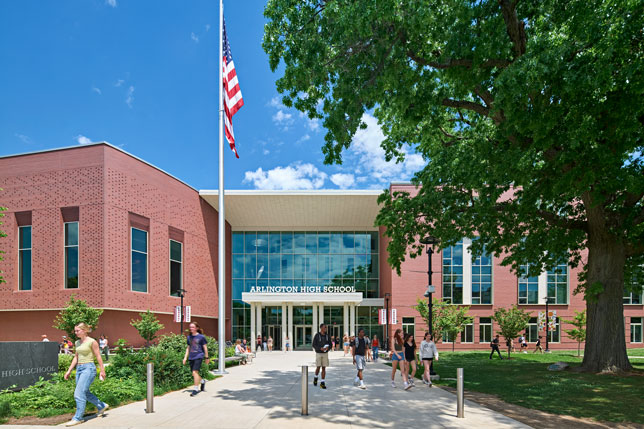
Arlington High School is a LEED Platinum certified, forward-looking educational facility designed to support interdisciplinary learning, community programs, and the town’s commitment to environmental stewardship. Carefully planned and constructed over four phases just feet away from the occupied school, the new Arlington High School replaces a sprawling, outdated facility with welcoming, flexible spaces for hands-on learning and teaching.
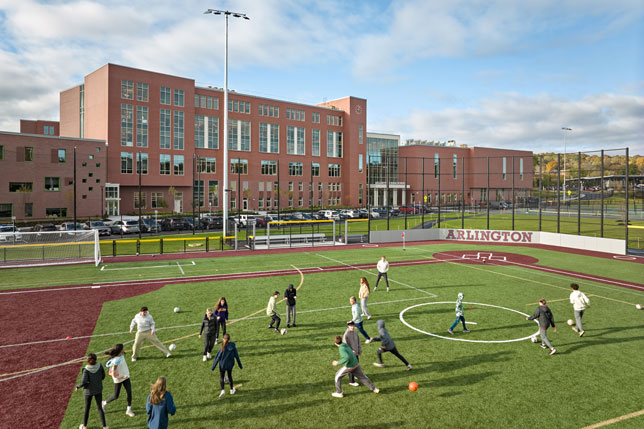
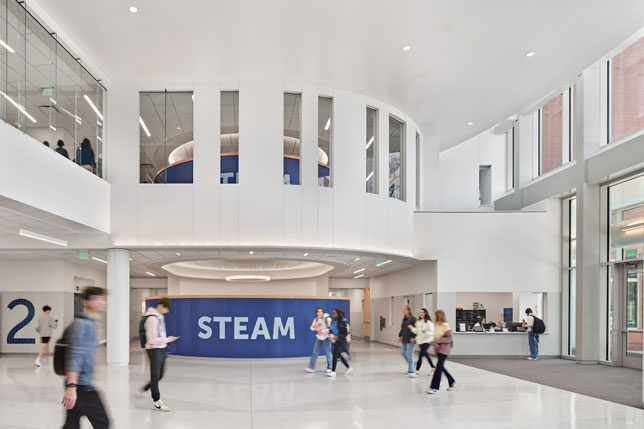
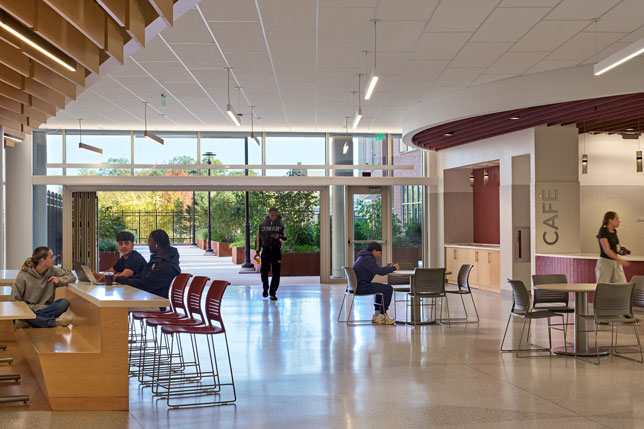
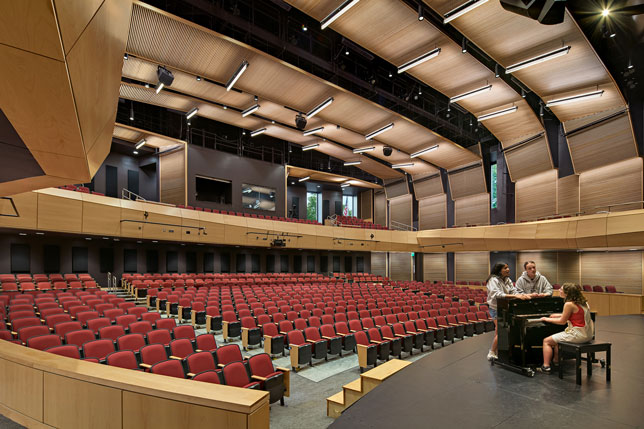
Organized around a central spine with four programmatic wings, the new school is welcoming with clear circulation and strategic program adjacencies. As the heart of the school, the spine functions as both a student activity hub and the main circulation, physically and programmatically connecting the upper Massachusetts Avenue entrance and tree-lined green to the athletic fields, parking, and commuter bikeway at the lower entrance. As one moves through the building, the spine serves as the lobby for public venues including the 800-seat auditorium, black box theater, and gymnasiums, then becomes a broad forum stair cascading down to the cafeteria and lower entrance. Four wings—STEAM, humanities, performing arts, and athletics—plug into the spine and contain flexible classrooms, science labs, teacher planning areas, independent and project-based learning nooks, and a variety of spaces for career technical education, performing arts, and visual arts.
Background, Planning Process, and Project Goals
Located just six miles northwest of Boston, Arlington is known for its exceptional public schools and strong civic identity. Through their climate and resiliency planning efforts, Arlington pledged to become carbon neutral by 2050 and adopted the Massachusetts specialized stretch energy code.
Following a district-wide study of Arlington Public Schools to evaluate existing conditions and plan for increasing enrollment, the district secured significant state funding for a new high school from the Massachusetts School Building Authority (MSBA), making this once-in-a-generation project a reality for Arlington.
The vision for the new Arlington High School grew out of an inclusive public process that engaged a variety of stakeholders, articulating the need for a school that strengthened connections between students, with the greater Arlington community, and to the natural environment.
Through a series of visioning sessions, community surveys, public forums, numerous teacher and departmental planning meetings, and sustainability charrettes, the project team worked collaboratively with Arlington stakeholders to develop the following goals:
- Teach the whole child
- Support hands-on, student-centered learning
- Strengthen school community
- Design the school as a community hub
- Provide physical and programmatic flexibility
- Promote sustainability
These guiding principles shaped all aspects of the design, from building organization and spatial relationships to material and system selection. Project stakeholders were involved at every step of the way, participating in over 400 meetings from the feasibility phase through construction.
Educational Vision in Practice
Core gathering and community spaces including the media center/learning commons, auditorium, gymnasium, and black box theater are centrally located along the spine for after-hours programs, while the four departmental wings, STEAM, humanities, performing arts, and athletics, remain secure. Strategic program adjacencies in each wing create opportunities for collaboration between students and teachers across related disciplines with project areas and breakout spaces between classrooms, teacher preparatory areas positioned for interdepartmental planning, and shared display and pin-up space.
"In the new school, arts, engineering, fabrication, and design are all adjacent in the heart of the STEAM wing, which fosters collaboration across the disciplines and within them. My arts department is not only working together but rewriting the entire curriculum together! All arts department teachers are adjacent to one another and collaborate on integrated curricula for their classes.
“This would never have happened in our former space, where teachers were scattered throughout the building and never crossed paths. It's amazing how the space adjacencies facilitate a better educational experience for the students." — Principal, Arlington High School
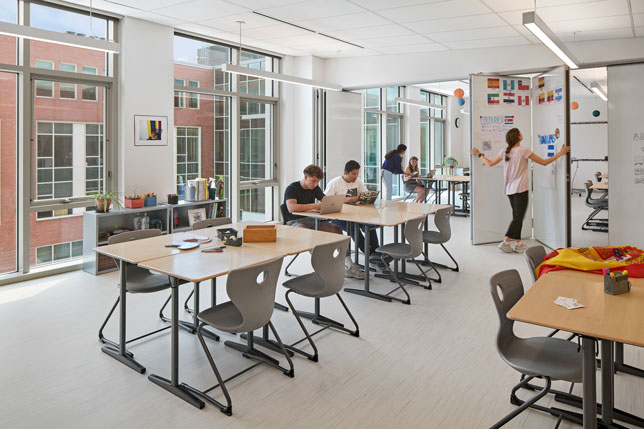
The design achieves flexibility at both the whole building and individual classroom scale. The layout is adaptable to various educational models: it can be organized by program or restructured as a house model in which each floor functions as a self-contained learning community. Classrooms feature moveable furniture, operable walls, and adjacent breakout spaces.
A variety of learning environments provide space for hands-on, student-centered education:
- Career technical classrooms for culinary arts, fashion design, engineering, and fabrication promote skills-based learning
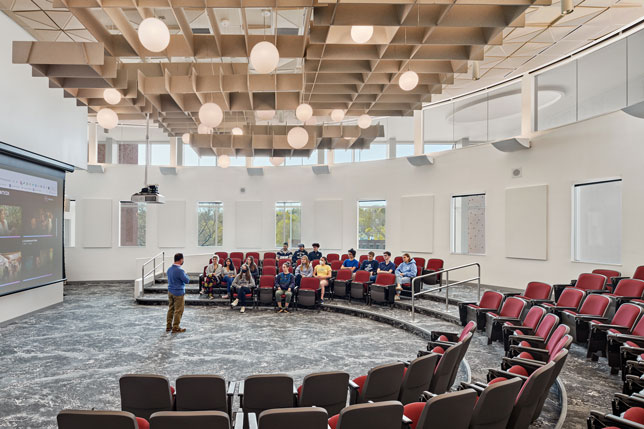
- A 120-seat discourse lab is designed for debate and discussion and equipped with acoustics and advanced projection capabilities
- Multiple gymnasiums and fitness rooms encourage a wide array of physical activities including rock climbing, dance, batting practice, state-wide competitions, and more
- A black box theater with a perimeter catwalk accommodates drama classes, rehearsals, and intimate performances
- An outdoor amphitheater provides a versatile venue for performances, practice sessions, and community gatherings
- A student-operated life skills café is a popular gathering spot during the school day, then becomes a concession stand after hours for community events
Arlington High School is a valuable community resource, home to several district-level programs including Menotomy Preschool, District Administration offices, and the LABBB Educational Collaborative—a regional special education program. Menotomy Preschool was designed as an extension of the main facility with its own entrance, drop-off, play spaces, and identity. To support the development of Arlington’s youngest learners, the preschool incorporates nature-inspired graphics from a sculptural tree at the entrance to wall murals, as well as tunable lighting in classrooms to provide behavioral cues, a multi-purpose activity space, and enclosed play areas.
Unique Features and Innovations
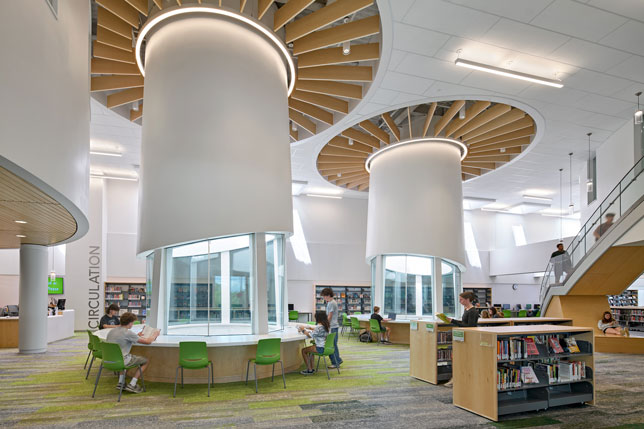
- Multi-story lightwells in the library and academic wings bring daylight deep into the school’s compact interior and feature perimeter countertop study areas
- Felt baffles ensure appropriate acoustics while injecting a lively pop of color
- Operable walls provide flexibility, allowing two individual classrooms to open into one larger space, and provides a connection from the central spine to the school’s courtyard and outdoor classrooms
- Unique locker pods are centrally located at the threshold of each academic wing, offering a place of respite between classes
- Arlington is one of the first municipal buildings in Massachusetts to incorporate low-carbon concrete, helping reduce the school’s embodied carbon by 9% from baseline
Sustainability and Environmental Stewardship
The all-electric, LEED Platinum-certified Arlington High School supports student well-being and minimizes both operational and embodied carbon. Efficient mechanical systems, strategic daylighting, LED light fixtures with daylight dimming, and a high-performance building envelope all contribute to the school’s low pEUI of 24.7 kBtu/sf/year.
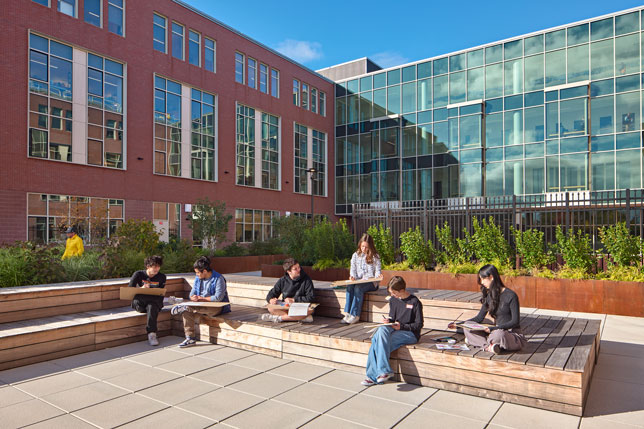
The natural environment is woven into the learning environment through plentiful views and direct connections to outdoor spaces. An amphitheater supports large-scale outdoor gatherings and performances, a garage door in the makerspace opens to an outdoor work yard, a large central courtyard provides space for classwork and social interactions, and a pollinator garden with native plantings collects and stores rainwater, slowing stormwater runoff.
Sustainable design strategies throughout the school create a healthy interior environment and ensure that Arlington’s largest town-owned facility is resilient and operationally efficient:
- Curtain walls, windows, skylights, and multi-story lightwells bring natural light into even the most central spaces of this five-story building
- 92.8% of regularly occupied spaces have access to quality views
- 100% of classroom spaces have operable windows
- Low-flow fixtures in the school conserve over 660,000 gallons of water per year
- An 850 kW photovoltaic array supplies energy to the grid through a Power Purchase Agreement (PPA)
- A new, accessible connection to the commuter bikeway, bicycle racks, and electric vehicle charging stations promote sustainable transportation
Graphics and signage throughout the school illustrate high-performance building strategies, engaging students on topics from carbon reduction to water conservation and habitat management.
Project Challenges, Responsive Design, and Cost-Effective Project Delivery
The project’s constrained site presented significant challenges, including a 25-foot grade change, contaminated soils, and the need for phased construction on an active campus. Rather than a limitation, the topography informed the design of the central spine and forum stair, linking the upper and lower entrances.
With no swing space available, a CM@Risk delivery method enabled close collaboration among the client, contractor, and design team from the outset. Construction occurred just feet from occupied areas, requiring strategic phasing and careful coordination to ensure student safety and minimize disruptions to education. Despite these complexities, the project was completed on time and on budget, with a final design that feels inevitable on its site.
Site constraints also required innovative sustainability solutions to deliver an all-electric facility in line with Arlington’s ambitious goals. While the school’s contaminated site precluded the use of geothermal wells, the team integrated Variable Refrigerant Flow (VRF) systems, which supply fossil-fuel-free space heating and cooling, with careful zoning based on weekly and daily educational and community program needs to limit the hours of operation for these units, significantly reducing the school’s energy use."
Architect(s):
HMFH Architects