 Classroom Revitalization – Basil Hall Room 216
 Classroom Revitalization – Basil Hall Room 216
 Classroom Revitalization – Basil Hall Room 216
 Classroom Revitalization – Basil Hall Room 216
 Classroom Revitalization – Basil Hall Room 216
 Classroom Revitalization – Basil Hall Room 216
 Classroom Revitalization – Basil Hall Room 216
Project Information
Facility Use: Higher Education
Project Type: Spaces
Category: Academic/Classroom
Location: New York
District/Inst.: St. John Fisher University
Chief Administrator: Dr. Gerard Rooney, President
Completion Date: 8/29/2025
Gross Area: 1,620 sq. ft
Area Per Student: 36 sq. ft
Site Size: n/a
Current Enrollment: 45
Capacity: 45
Cost per Student: $9,474.03
Cost per Sq. Ft.: $263.17
Total Cost: $426,331.34
For the past five years, St. John Fisher University has been quietly transforming. One classroom at a time, we've been rethinking what learning spaces should look and feel like in higher education today. Each renovation has taught us something new about how faculty teach and how students learn. We've collected survey data, observed classes in action, and had countless conversations with both instructors and students about what works and what doesn't. We've learned about furniture height and table configuration, about the right shade of paint on a wall, about lighting that energizes rather than drains, about writing surfaces that invite spontaneous collaboration rather than remain untouched throughout an entire semester. All of this research, all of these conversations, all of these iterations have led us to room 216 in Basil Hall, a space that represents the culmination of everything we've discovered along the way.
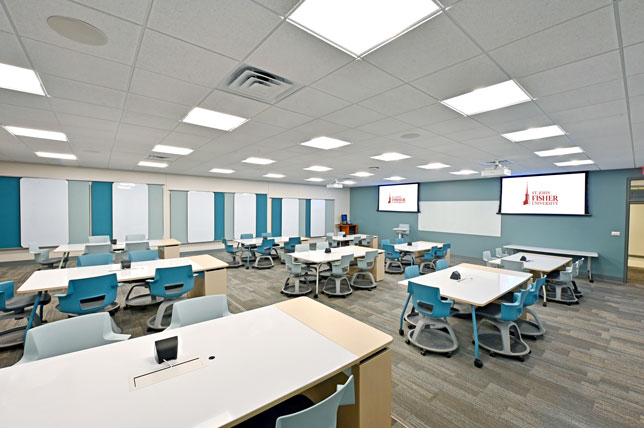
This room is not just another renovation. It is the distillation of years of pedagogical practice, campus culture, and design thinking into a single, flexible learning environment. Basil 216 was once what many college classrooms still are: sterile, passive, and lecture focused. Rows of forward-facing desks, a single projection screen at the front, fluorescent lighting, hard surfaces that made every sound echo. It was a space designed for delivery rather than discovery, for listening rather than doing, for one voice rather than many. Now, it is something entirely different, a dynamic hub capable of supporting any teaching style while actively encouraging the kind of student engagement that transforms passive attendance into active learning.
The challenge with Basil 216 was significant from the start. Unlike many of the other classrooms we had renovated over the previous years, this space came with a built-in constraint: a three-tiered floor that had been installed decades ago to ensure every student in the large room could see over the head of the person in front of them. That design made perfect sense when the assumption was that all eyes should be on the instructor at all times. But in an era when we know that students learn best through interaction, collaboration, and peer-to-peer engagement, those tiers presented a real problem. How do you create a collaborative learning environment when the architecture itself seems to insist on hierarchy and one-directional attention?
The acoustics were another major hurdle. Large rooms with hard surfaces and high ceilings are notoriously difficult spaces for clear communication. Sound bounces, voices get lost, and the background hum of conversation during group work can become overwhelming rather than energizing. We knew that if we were going to transform this space into something that could support the kind of dynamic, shifting activities we envisioned, we had to solve the sound problem at the same time.
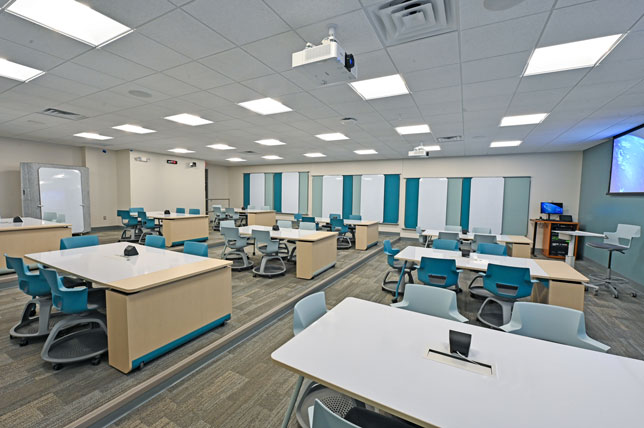
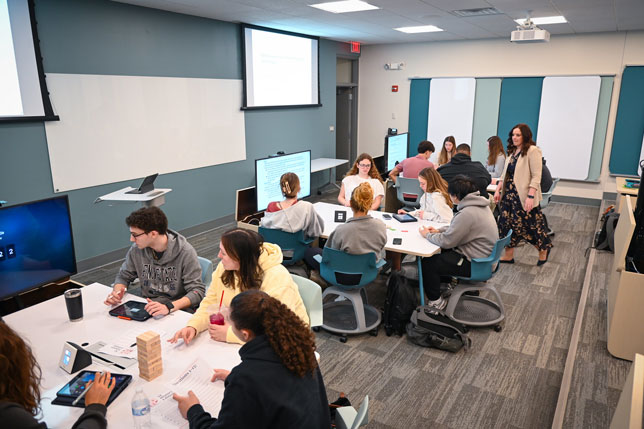
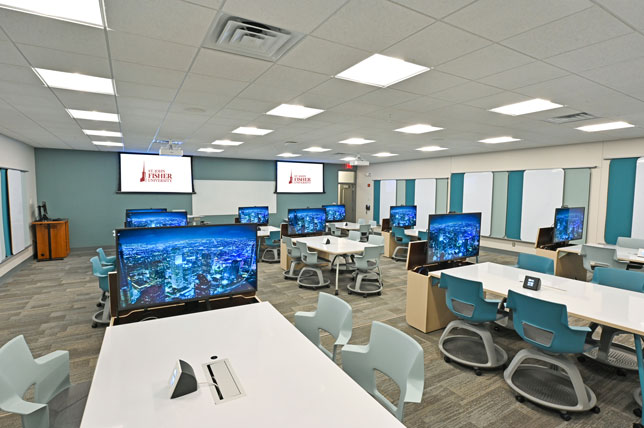
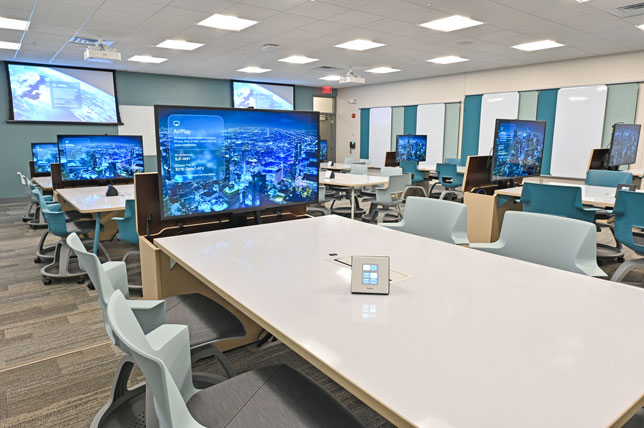
The solution we arrived at was both simple and innovative: rather than fighting against the tiered floor, we would use it to our advantage. Instead of trying to flatten the space or work around the levels, we would embrace them as natural zones for collaboration. We replaced the forward-facing rows with technology-equipped pod-style stations, arranged so that small groups of students could work together at each level. The singular "front" of the room disappeared, replaced by a distributed display system and perimeter whiteboarding that allows learning to happen everywhere in the space rather than only in one direction. Students can now switch from listening to a central lecture to collaborating at their individual pods instantly, using student-driven display technology or engaging with the multitude of whiteboard surfaces both on the tables themselves and around the room. The tiers that once created distance now define distinct collaboration zones. The architecture that once enforced passivity now supports flexibility.
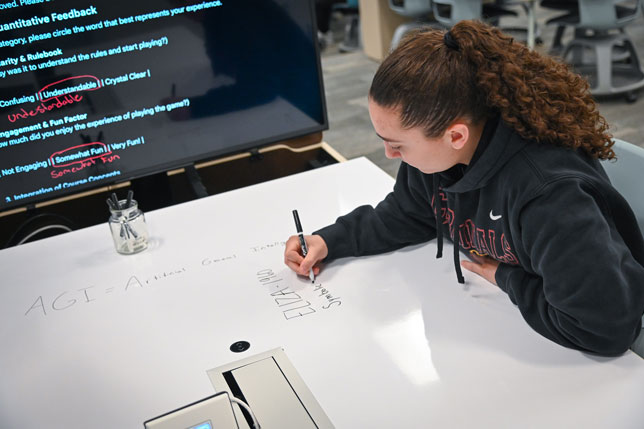
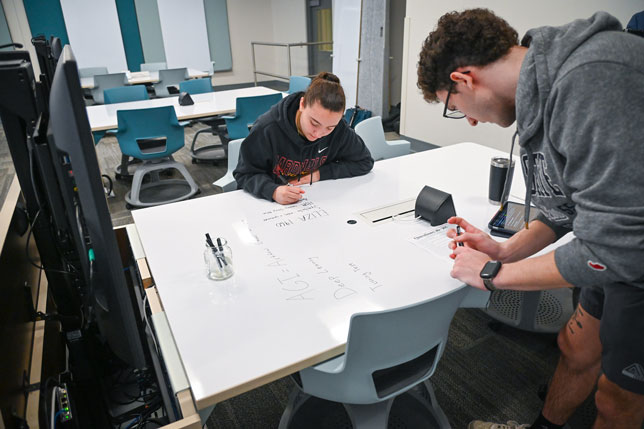
The tables themselves represent one of the most innovative aspects of the room's design. Each pod station is equipped with a retractable screen that can move up and down based on what the learning activity requires. When the screens are down, the tables function beautifully for traditional lecture portions of class. Students can take notes, follow along with content projected on the main displays, and focus their attention on the instructor. When the screens come up, the entire dynamic shifts. The tabletop itself is a whiteboard surface, inviting students to sketch ideas, work through problems together, and make their thinking visible to one another. The screens allow any student at the table to display their device independently from the other table screens, so different groups can be working on different tasks at the same time without disrupting one another. The instructor controls the entire system from the front of the room, able to raise or lower screens across the space with the press of a button, allowing faculty to shift the room's configuration to match the pedagogical moment. This flexibility is what makes Basil 216 so powerful.
The real measure of any renovated space is not what it looks like on paper or in photographs, but instead on what happens inside the room once real teaching and learning begin. By that measure, Basil 216 has already exceeded our expectations. Faculty who have taught in the room since the renovation describe it in terms that speak directly to what we set out to create. Words like "versatile" and "unsurpassed" have come up repeatedly in their feedback, and one instructor captured the spirit of the design particularly well: "The diversity the space allows in instruction is key. The ability to use high-tech and low-tech approaches in the room with minimal disruption or set up saved time and improved the course." That is precisely the outcome we were working toward. Not a room that demands a particular teaching style, but one that expands the range of what any instructor can do. The enthusiasm has been strong enough that faculty have already begun asking for another space like this to be created elsewhere on campus. That kind of response, from the people who spend their professional lives in these rooms, tells us something important.
Students, too, have embraced the space in ways that affirm the thinking behind every design decision. Their descriptions of the room as "calming," "modern," and "high-tech" suggest that the environment itself is communicating something to them before a single lesson begins. Beyond impressions, though, the data is equally encouraging. Seventy-three percent of students surveyed reported that the classroom design encouraged them to develop connections with their classmates during class, and eighty-one percent reported that in-class activities were enhanced by the features of the room. Among all of those features, the whiteboard tables stand out as a consistent highlight. "I really like the whiteboard tables," one student noted. "They are great for drawing diagrams as a way to build repetition with class material." Another echoed the sentiment just as plainly: "They should honestly be in every classroom. I'm able to map out concepts, draw diagrams, or study on them." What strikes us about this feedback is that students are not just enjoying the tables as a novelty. They are describing them as tools for thinking and surfaces that support both collaborative group work and individual self-reflection on difficult course concepts. And perhaps most telling of all, one student observed that the room feels "modern and spacious, yet compact enough to make it an inviting space to learn." That balance of expansive but not overwhelming, high-tech but still human, was exactly what we were reaching for.
Basil 216 is one room. However, the questions it raises, and the answers it offers, are much larger than one room. Learning spaces need to evolve alongside every other dimension of campus life, and yet they are too often the last to change, left behind as institutions invest in new technology, new construction, and new programs while the classrooms where the actual work of teaching and learning happens remain frozen in a different era. Rooms built twenty or thirty years ago were designed for a model of education that research has since moved past. What once felt like a neutral container for instruction now functions, in many cases, as a quiet but persistent barrier to the very approaches we know work best for student learning and achievement. We cannot continue to ask faculty to do twenty-first century teaching in twentieth-century spaces and expect that the room will not get in the way. The work of updating our existing learning environments is not a cosmetic project, it is a pedagogical one. It is, ultimately, about creating the conditions in which both students and faculty can reach their fullest potential. Basil 216 is proof that those conditions are achievable.