Using the Sun to Save Money
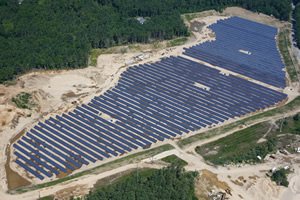
PHOTO COURTESY OF BORREGO SOLAR
For years, schools have had to minimize the impact of cuts on students and educators, and reducing energy costs through solar photovoltaic (PV) systems has proven extremely impactful in freeing up operating costs.
Plymouth Public Schools, a pre-K–12 school district that operates 12 schools in Plymouth, Mass., has multiple solar systems that are now boosting its budget and bringing the district closer to its goal of deriving up to 80 percent of its electricity from solar. The projects include three off-site systems financed and developed by Borrego Solar: a 5.7-megawatt (MW) project in Plympton — the largest for any school or district in the state; a 3.5-MW installation in Freetown to be completed by the end of the year; and a 1.4-MW project in Wareham. The fourth is a 342-kilowatt system on the roof of the newly constructed Plymouth North High School.
For a number of reasons, solar PV is a particularly effective way to reduce energy costs. Schools demand the most energy use during the middle of the day, when energy prices are at their highest, but because solar energy production is also high during this time of day, solar offsets the highest energy costs that schools typically incur. Schools generally also have large, unused rooftop space, which is ideal for housing a solar project. As the price of solar PV panels continues to drop, and as the cost of utility-provided energy increases, the economic case for solar PV systems will only be stronger.
Upon first glance, the idea of installing a solar system might seem costly, but accessible financing mechanisms can make going solar a no-brainer.
Financing a solar project
If solar energy does make sense for a school facility or district, there are a variety of financing options to consider. One funding option — and the one PPS exercised — is a power purchase agreement (PPA), a mechanism by which a third-party company — in PPS’s case, Borrego Solar — pays for the installation of the solar system and then sells the power back to the customer at a predetermined cost. Not only does the third-party take on all the tax incentives and pay the savings forward to the school in the form of a lower rate, it also allows schools to go solar with zero upfront costs.
Through a PPA, schools can enjoy the benefits of renewable energy without the burden of large upfront capital costs. With solar, PPS is saving more than $400,000 per year in energy, and is projected to save more than $8.5 million over the 20-year term of its PPA contract. Partnering with a solar company with proven development and financing track-records working with multiple schools and districts is important, as it will have a strong understanding of how solar PV systems benefit a district’s operations and which financing schemes are in your favor.
Benefits of going solar
Aside from the economic benefits, solar also provides school districts with a unique learning tool that can be incorporated into K-12 lesson plans across multiple disciplines. After going solar, PPS has incorporated various solar lessons into its vocational technical program through onsite, hands-on training and education. The solar installation is being used as an ongoing education tool for these vocational courses, and solar-related curricula includes field trips to the Plympton installation, K-12 lessons plans and the use of energy-production data streaming in real time to monitoring kiosks on campuses and web portals that can be accessed by students and faculty 24/7.
This article originally appeared in the issue of .
About the Author
Jared Connell is senior project developer at Borrego Solar, which finances, designs, develops and installs commercial and utility solar power systems.